Terry Manning is a developer of technologies and self-financing integrated development concepts for the world's poor.
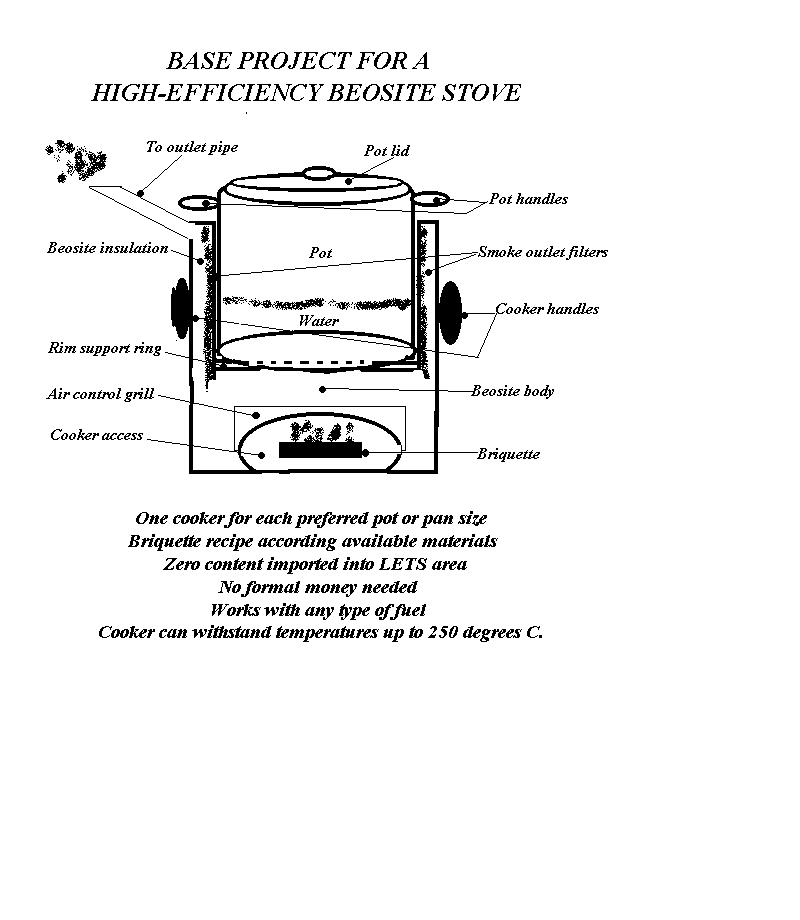
He also supports the promotion of the "Beosite (R)" technology developed by the Dutch technology developer Eos Consult. Beosite (R) technology enables many items important to local development projects to be made in low-cost labour-intensive local production units with 100% local value added.
He supports hygiene training programmes based on the formation of Community Health Clubs and on-going hygiene education in schools. These have been successfully developed and introduced by the NGO Zimbabwe A.H.E.A.D.
He supports the use of mass capacitation techniques, as introduced by the Brazilian Clodomir Santos de Morais, through which the users themselves organise, execute, run, maintain, pay for and own the structures set up under the project.
YOWANI NGOLI
Yowani Ngoli is an experienced borehole mechanic who comes from the project area. He has experience in local development in the Mvolo County in Southern Sudan where he is well known and respected as an officer of the Sudan Inland Development Foundation. He wishes to cooperate with Terry Manning to promote integrated self-financing development concepts in the Yeri District of the Mvolo County in Southern Sudan. Mr Ngoli is supported by the Mvolo County assembly, by the County Commissioner, by the County Executive Director, by the County Secretary for Rehabilitation and Relief, by the Administrator of the Yeri sub-district, and by the area council.
THE SUDAN INLAND DEVELOPMENT FOUNDATION
The Sudan Inland Development Foundation (SIDF) is an indigenous local non governmental, non profit making humanitarian oganisation. Its mission is to alleviate the suffering of vulnerable groups of people by provision of medical and non-medical relief assistance to the population of Mvolo County in Southern Sudan. To achieve these goals the SIDF seeks to set up sustainable development projects in the area guaranteeing a better quality of life for the people, with the involvement of local bodies and individuals in project planning and implementation.
The SIDF was formed in 2000 in response to the deplorable living conditions of the people in Mvolo County in the central part of war-torn New or Southern Sudan. The SIDF is based in Domeri in Mvolo County in the centre of the targeted area to enable the local people to participate effectively in the activities of the Foundation. It is currently the only non-governmental organisation based in the project area at this time. It was registered with the government of Southern Sudan (SPLM) in 2000 under registration number ????
SCHEDULE 11 Constitution and Statutes of the NGO SIDF Sudan Inland Development Foundation, with general information..
| Abbreviation | Description |
| CASO4 | Calcium sulphate |
| DIAM | Diameter |
| DIAM EXT | External diameter |
| DIAM INT | Internal diameter |
| EG | For example |
| H2O | Water |
| LETS | Local exchange trading system |
| NGO | Non governmental organisation |
| PV | Photovoltaic |
| SHS | Solar home systems |
| TV | Television |
| UV | Ultra-violet |
| V | Volt |
| Wp | Watts peak |
| Page | Contents |
| General cover | |
| Draft letter to Minister | |
| Cover page to executive summary | |
| Executive summary | |
| 001 | Cover page project document |
| List of key words | |
| 002 | The promoters |
| 003 | Drawings and graphs part of the project documents |
| 004 | List of abbreviations used |
| Contents | |
| 007 | 1. Project background |
| 014 | 2. The project |
| 016 | 2.01 Immediate goals |
| 2.02 Long term goals | |
| 017 | 2.03 General economic bases of the project |
| 019 | 2.04 Principles behind the project |
| 2.05 The five conditions precedent for a project applications | |
| 020 | 2.06 Institutional structures |
| 027 | 2.07 The question of ownership |
| 2.08 Assurances as to performance | |
| 2.09 Taxation under the local exchange trading (LETS) systems | |
| 2.10 The effects of inflation on seed loan payments and gift content | |
| 030 | 2.11 Insurance and gift content |
| 2.12 Information flow | |
| 031 | 2.13 Recycling of funds and imported goods |
| 032 | 2.14 Project auditing |
| 033 | 3. Planned works and results |
| 3.0 Onchocerciasis (river-blindness eradication programme) | |
| 036 | 3.1 Hygiene education structures |
| 3.2 Sanitation facilities | |
| 038 | 3.3 Local Beosite (R) production units |
| 039 | 3.4 Water supply structures |
| 040 | 3.5 Institutional developments |
| 041 | 3.6 PV lighting television and refrigeration |
| 042 | 3.7 Domestic solar home systems |
| 3.8 High frequency radio network | |
| 043 | 3.9 Payments and on-going costs |
| 044 | 4. Work plan |
| 4.1 First, initial research phase | |
| 045 | 4.2 Second phase |
| 4.2.0 Payment of the project funds | |
| 4.2.0.1 Onchocerciasis (river-blindness) eradication programme | |
| 048 | 4.2.1 Health Clubs |
| 050 | 4.2.2 Local social structures |
| 051 | 4.2.3 LETS local money systems |
| 052 | 4.2.4 The radio network |
| 053 | 4.2.5 Micro-credit system strucutures |
| 055 | 4.2.6 Beosite production units |
| 056 | 4.2.7 Recycling structures |
| 058 | 4.2.8 Structures for the production of bio-mass for stoves |
| 059 | 4.2.9 Structures for drinking water distribution |
| 060 | 4.3 Third, implementation phase |
| 061 | 4.4 Fourth, second implementation phase |
| 061 | 5. Short indicative budget |
| Outgo (capital) | |
| 063 | On-going costs and income |
| Comments | |
| 064 | 6.Short indicative budget onchocerciasis eradication programme |
| 065 | Recycling of funds for micro-loans |
| 066 | SCHEDULE 1 - The project in detail |
| 01. Justification of the project | |
| 068 | 02.0 Cooperation of the local people |
| 069 | 02.1 Health clubs and hygiene education |
| 070 | 02.2 Social structures |
| 02.3 Local money LETS strucutures | |
| 072 | 02.4 Micro-credit structures |
| 074 | 02.5 Beosite (R) production units |
| 02.6 Recycling structures | |
| 078 | 02.7 Energy efficient stoves and bio-mass production |
| 079 | 02.8 Drinking water supply |
| 02.8.1 Siting of boreholes and wells | |
| 079 | 02.8.2. Basic project specifications |
| 094 | 02.8.3. Summary of water supply |
| 095 | 02.8.4. Principles for siting water supply structures |
| 02.8.5. Well linings | |
| 096 | 02.8.6. Equipment of water points near the users' houses |
| 02.8.7 Budget items relating to the water supply systems | |
| 102 | 02.9. PV lighting, television and refrigeration |
| 104 | 02.10. Forest and water harvesting |
| 106 | 02.11. The project and educational structures |
| 02.12. The project and communications structures | |
| 107 | List of supporting schedules |
| Schedule 01 : The project in detail | |
| Schedule 02 : Information on Clodomir Santos de Morais and the Organisational Workshops | |
| : | SCHEDULE 2 BIBLIOGRAPHY |
| SCHEDULE 2 ORGANIZATION WORKSHOPS | |
| SCHEDULE 03 Project maps | |
| SCHEDULE 04 Technical information on solar pumps | |
| SCHEDULE 05 Technical information on handpumps | |
| SCHEDULE 06 Technical information on the Beosite(R) process | |
| SCHEDULE 07 The hygiene education programme | |
| SCHEDULE 08 Operation of the local currency (LETS) systems | |
| SCHEDULE 09 25 progressive steps for local development | |
| SCHEDULE 10 MATERIAL FOR PRESENTATIONS USING TRANSPARENTS OR POWERPOINT | |
| SCHEDULE 11 Constitution and Statutes of NGO SIDF, Mvolo, South Sudan | |
| The Role of Micro-credit in integrated self-financing development projects | |
| Water supply issues in self-financing integrated development projects for poverty alleviation | |
| PV and Biomass spects and their Financing | |
| Integrated bio systems : a global perspective | |
| PV, a cornerstone of self-financing development projects for poverty alleviation in dveloping countries | |
| New horizons for RE technologies in poverty alleviation projects | |
| 108 | Acknowlegements |
Supplying such basic life needs warrants top priority within the framework of foreign aid programmes for the benefit of the poor in developing countries, including Southern Sudan.
The situation of the people in Mvolo County and in the Yeri project area is extremely critical. Some women get up at 2 a.m. to fetch water and return with it at 3 p.m. Clinics in the area are without medicines and are not operative. 80% of the population in some areas in the County is infected with onchocerciasis (OV) or river- blindness. Many hundreds have already become blind. A quarter of the population is infected and risks becoming blind.
The project "New Horizons for Yeri" will be financed using a 10 year interest-free development loan for Euro 3.500.000, local currency or LETS (Local Exchange Trading) systems and a cooperative interst-free Micro-credit system modeled on the successful Grameen banks in Bangladesh.
The financial proposals allow funds in both the local LETS currencies and the formal, or ordinary, currency to be re-circulated - interest free- as many times as possible within the participating communities. Financial leakage from the project area is discouraged.
A local cooperative bank (the Yeri Cooperative Local Development Bank) dedicated to development in the project area will be set up to support the project by pioneering the introduction of interest-free cooperative micro-credits for productivity development in the Yeri district.
The project is founded on the idea that most people in the Yeri project area, despite their extreme poverty, are willing to pay for their own hygiene education, water supply, sanitation, rubbish disposal and bio-mass production structures provided they have the seed money necessary to get started. The seed money will be interest-free.
Potential to develop the production of goods and services at community level in the project area exists. Development there is presently restricted by a chronic lack of formal money and extreme isolation. The little formal money that there is, leaks from the local economy to national, or more often, international, havens. Leakage of financial resources away from the project area makes problems worse because it artificially limits the people's basic right to produce and exchange goods and services.
The project will permanently improve the quality of life and stimulate on-going local economic development of the people in the project area. It will establish local exchange trading (LETS) systems for the exchange of local goods and services and provide interest-free seed money to fund micro-credit loans. It includes hygiene education, sanitation, clean drinking water, lighting for study, efficient cooking equipment and means of producing bio-mass to fuel the stoves as well as a system for recycling non-organic solid waste. It also includes a programme for the eradication of onchocerciasis (river-blindness) and the useful integration of the blind into local society and a basic high frequency radio communications network. Services may be extended in a later phase to rainwater harvesting and Solar Home Systems. The project will also encourage local contribution to improved primary and junior secondary education structures.
The proposed hygiene training, sanitation, and drinking water systems take the social structures of the communities into account. All structures, with the exception of the emergency programme to eradicate onchocerciasis, are self-financing, subject to certain aspects involving interest payments, exchange rate variations and "insurance" set out in detail in the project document. They remain financially viable and sustainable without the need for further seed money once the initial interest free seed loan has been repaid.
Mvolo County is in Southern Sudan, to the west of the White Nile river. It covers an estimated land surface of approximately 68500 square kilometers in total of which 43000 square kilometers is still virgin natural-forest without human settlement. The current total population of Mvolo County is estimated to be 350,000 people. This number is expected to increase when peace comes and those individuals who are in the diaspora return to their homelands. About 13,000 people from Mvolo County are believed to be living at the moment in forced camps for displaced people in the north of Sudan. There are also some Mvolo people in refugee camps in neighbouring countries. Most of them are likely to return home when peace comes. Furthermore, two big villages in the County, Billing and Mapourdint, have been designated as settlements for people displaced from other regions. An estimated 7,000 people from Mvolo County itself are among the settlers there.
The population of smaller centres varies between 1800 and 8000 people, but in the larger towns such as Mvolo, Yeri and Wulu populations are over the 30000 mark. However, most of the population in the county live in scattered villages, which are not all marked on the map.
The main rivers are the Naam, and the Yei, which are seasonal, and the Geli.
There are 14 boreholes and wells in the county. These are at Mbara, Yeri, Domeri, Kila, Minikolome, Kulu, Wulu, Woko and Morokoci. The other 40 centres, including Mvolo itself, have no source of clean drinking water.
Access throughout most of the county is feasible only during the dry season (Nov – April). The roads are not sealed.
Primary Schools are located in Morokoci, Kulu, Mvolo, Kila, Domeri, Yeri and at Mbara. The enrolments per school range between 250 – 540 pupils for populations of up to 30.000. This evidences the chronic lack of educational facilities in the area.
There are clinics at Mbara, Yeri, Domeri, Mvolo and in Wulu but all with exception of the one in Wulu have no medicines at the moment. There is no donor yet to supply the clinics with medicines. The International Rescue Committee (IRC), an American originated humanitarian organization, is supporting the clinic in Wulu.
The area was politically oppressed until August 2001 when the Government of South Sudan (SPLM) decided to create an independent county (Mvolo County) under the office of the Chairman (President). The top civil position in this particular area is the office of the County (District) Commissioner. The commissioner is deputized by County Executive Director and a Secretary for Rehabilitation and Relief. Decisions regarding development are taken in the office of the County Secretary. Only difficult matters and security related agreements are taken to the commissioner and/or to the deputy Chairman of the Movement (SPLM).
The county is divided into seven administrative areas known as payams (sub-districts). Each payam consists of two Area Councils, or bomas. Each payam is headed by an Administrator who is directly accountable to the County Commissioner. The boma administrators answer to the payam administrators in matters of rule and governance.
Mvolo County is one of the areas in the Sudan badly affected by a dreaded disease known as onchocerciasis (OV) or river blindness. It is a water related disease as the vector (black-fly) that transmits it usually breeds in riverbeds. It is estimated that 80 % or more of the population in some parts of the project area is infected with the virus. If not treated the infections will cause blindness. In some areas of the county a quarter of the population is already blind or likely to become blind. The project therefore includes a health tranche to try to eradicate the black-fly in the project area and treat those infected. The project also incorporates a tranche for the rehabilitation of the many blind in Mvolo County and therefore also in the project area.
Agriculture, animal rearing and fishery support the livelihood of the people. The main crops are sorghum, sesame seeds, groundnuts, cassava, pumpkins, beans, maize, yams and various types of fruit trees.
About 97.5% (ninety-seven point five percent) of the population is illiterate.
Annual individual income is about $ 120 for top class and $ 66 for middle class individuals. Annual income for a typical family of six therefore varies between Euro 462 and Euro720. This income is mainly earned through exchange of farm produce for other essential commodities or some cash. Men are the prime earners in the family. Women earn a little income mainly as pay for labour.
The general life style is very basic. A considerable amount of time is spent on looking for water and firewood and processing daily food.
The ongoing civil war in the country has worsened the situation. Many of the families are not in position to afford basic necessities such as clothing, blankets, mosquito-nets, and soap. Many parents are too poor to afford clothes for their children. Girls cover themselves with leaves and knitted strings. Boys use barks of trees or rags as loin-cloths wrapped between their legs.
Since the economy in South Sudan is not a cash economy, some essential commodities are difficult to get locally. The country relies on the importation of goods from Kenya, Uganda and Ethiopia. As a result the prices become too high for the poor to afford. School-going children with nothing to cover themselves from the cold are a common sight.
Most people live in isolated villages based on clans and ancestral linkages. Displaced people tend to go to the towns where families can settle regardless of which tribe they are from.
There is no electricity at all in the County or in the project area.
Some economic potential is offered by a sustainable exploitation of the forest areas in the region.
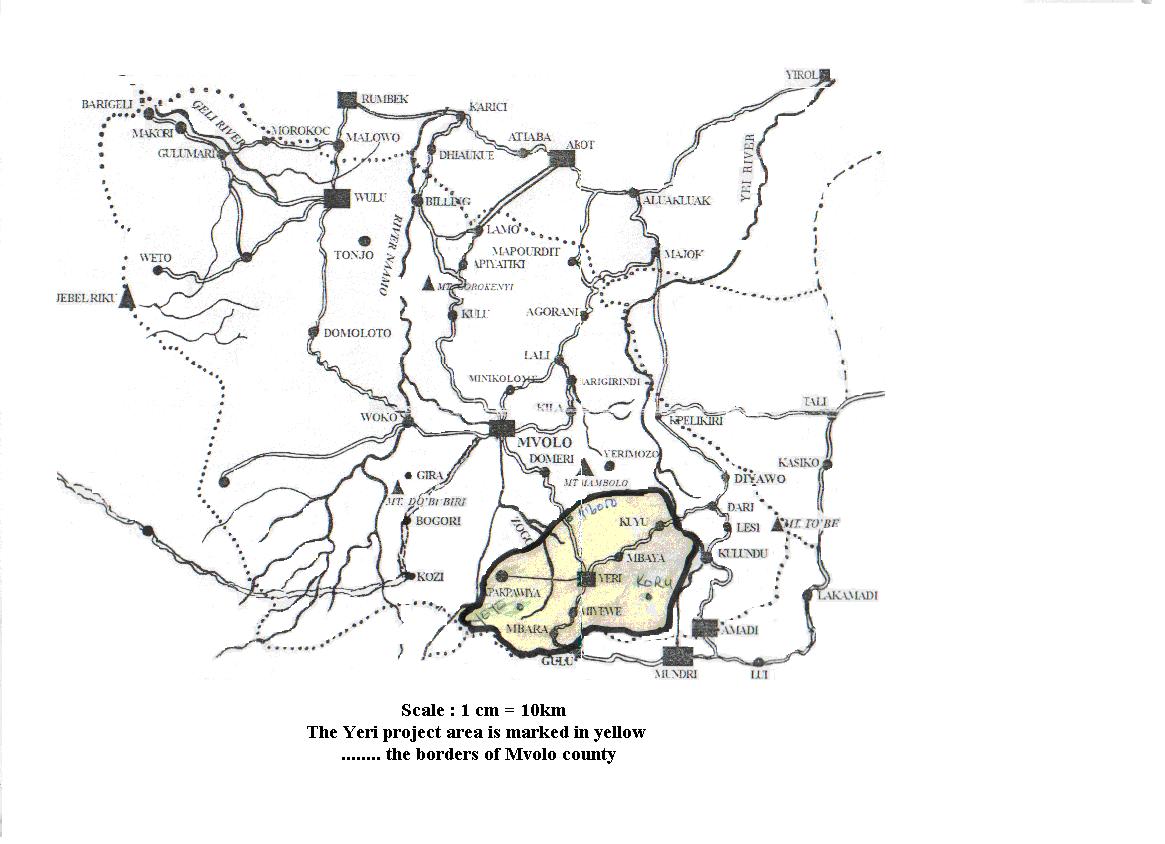
Maps of the area are available in SCHEDULE 03 - Project maps.
The project covers an area of about 200 km2 in the south-eastern corner of Mvolo county, to the west of the Yei river. The area covers about 50 kilometers from west to east and 40 km from north to south. The population in the area is estimated to be 45.000.
Yeri town with its "suburbs" has a population of 33247. There are 5541 households with an average of 6 persons per household. The people there speak Nyamosa which is a dialect of Modo, the main language spoken in Mvolo county. Nyamosa, with Wira and Beli, is one of a cluster of dialects related to Modo. The people using the various dialects can understand and communicate with each other.
Most of the people are Christians. There are a few animists.
The literacy level of the area is only 2.5%. That means that 97.5% are illiterate. The town of Yeri, with more than 30000 people, has just one primary school. There are only three primary schools in the whole project area, the other two being in Mbara and Gulu.
There is clearly a severe lack of schools at all levels, and of facilities for evening classes and vocational training centres, to cater at least for minimum educational needs of the entire population.
Water is a major problem throughout the project area. It is so serious that some women in the Yeri area in summer get up at 2 a.m to fetch water and return with it at 3 p.m.
Apart from the main rivers (the Naam, the Yei and the Geli) there are some small streams and water-holes where water can be found during the rainy season, which runs from May to October. People can then collect water from mud pools in the middle of the roads.
The water situation worsens intolerably during the dry season (November to April). The streams dry up, the rivers recede and turn into stagnant ponds. Even these water sources are usually many kilometers away from the villages. The Naam river in particular is the breeding place of the blackfly, a vector transmitting onchocerciasis or river blindness, which has reached nightmare proportions in some parts of Mvolo county.
Open hand-dug wells have proved ineffective. The soil is of a collapsed sand type. Digging is easy, but when it rains the soil caves in and the wells fill up with sand. Some of the few boreholes in the county, there are just 14 of them, are 20 years old and still function well. The project foresees however digging wells wherever possible and lining them properly to avoid caving in, and boreholes where the water table is set deeper.
The amount of water consumed is not more than 5-10 liters per person per day, covering all drinking, cooking, washing, body cleaning and other needs. Apart from being seriously contaminated, its cost in terms of human effort is tragic. Women and children collect it in pots and carry it on their heads for hours on end. If they accidentally fall or break their pot their family will spend the day without water since the distance to be travelled to go home, get another pot, and fetch more water at the water point, is too far to be covered again that same day.
Water is stored in clay-pots, gourds and plastic jerry cans, which in these areas are considered a luxury. During the beginning of the rainy season some rainwater is harvested and kept in large clay pots.
The highly contaminated water is generally consumed unfiltered. Apart from onchocerciasis which has already been mentioned, water-related diseases such as cholera, typhoid, dysentery, all types of worms, amoeba, and bilharzia are also all endemic. The containers are washed and dried in the hot sun when empty.
Hot water is used almost exclusively for cooking. Apart from the effort required for the water, the human cost in collecting and transporting firewood to heat the water is also enormous.
There are at present just 3 boreholes for the 45000 people in the project area. One is in Yeri, one in Mbara and one in Gulu. Yet the water table is not excessivly deep. It is thought to vary between 18 and 30 meters.
Food preparation is a long process.It involves grinding sorghum or maize using a grindstone or pounding it with a mortar. Fetching water and firewood, boiling vegetables for soup, baking bread and preparing porridge are extremely time consuming activities. The whole process of food preparation takes approximately from one to two hours for each meal, depending on the quantity to be cooked.
Local food production is usually enough for family needs. It is non-monetised. Costs are expressed in terms of human labour. Locally produced food for local consumption is stored in granaries, or in leaves, or tied up in special types of grass. Any surpluses tend to be passed on to needy relatives. Only a small portion is exchanged for other essential commodities, partly due to the lack of markets and commercial outlets in the area.
Common foods imported into the project area include salt, cooking oil, and onions.
There are currently no restrictions to landholding because of the availability of free lands. Choice of land and settlement sites by individuals or family members is free. Work is divided between men and women. Men traditionally do land preparation and planting while women take care of weeding and harvesting.
Common diet-related diseases are kwashiorkor, anaemia, goiter, pellagra, scurry, rickets, and general malnutrition.
Three quarters of the foods consumed are cooked by the women, usually by boiling food in clay pots heated on an open fire. The fuel used is firewood. Grasses and dry rubbish are also used. A lot of firewood is needed to prepare each meal. The thickness of the clay pot calls for a high temperature for initial heatup. More time is also needed to cook the food than would be the case with more efficient systems.
If the wood used is not collected by the women and children themselves, its cost represents a major charge on the family budget. Each family typically uses at least 4kg of wood per day or about 1.5 tons per year. The total consumption in the project area is therefore about 10,000 tons of wood per annum. Sale to industrialised countries of CER certificates for CO2 savings coupled with the use of locally built high efficiency stoves could cover some, if not all, of the project costs.
The unsustainable use of wood for cooking leads to de-forestation and erosion, air pollution and health hazards. Moreover, the traditional cooking methods used are inefficient. The project therefore introduces high efficiency stoves. They will be locally manufactured within local currency LETS systems. Bio-mass needed to fuel the stoves will also be locally produced and treated, without limiting the use of the natural fertilisers in local agricultural production. An important part of all loan repayments and expenditure under this project will be funded by savings brought by the use of energy efficient stoves and growing bio-mass for fuel under the local money systems.
Locally manufactured solar cookers will also be introduced where daytime cooking does not contrast with local customs.
Lighting is needed for reading and protection from stinging insects such as scorpions. There is an urgent need for lighting for students. The only means of lighting currently available to them in the evening is an open fire or shea-nut butter. Despite the need for them, evening classes cannot be held in the project area because there is no lighting available. Adult education is best carried out in the evening because the temperature is cooler and more conducive to studies.
Animals are not used for transport. Available means include bicycles and, rarely, lorries. People use them to transport goods and sick people to towns. Sometimes they are used for fetching water and firewood. Lorries cost about $ 0.2 cent per kilometer per person.
Transport is difficult in the wet season because of the bad, unsealed, roads.
For outsiders, Mvolo county is best reached by air. The Mvolo air-strip has been repaired, making it possible to land there throughout the year. There are no commercial line flights into Mvolo. Charter flights from Kenya to Mvolo cost about Euro 3650 for a 12 seater plane and up to Euro 7350 for a larger plane. There is an air-strip in Yeri too but it is not operational.
While Mvolo is on the main north-south road, it can only be reached that way during the dry season, from November to May. The trip from Uganda to Mvolo calls for either a lorry or a Land-Cruiser with four-wheel drive. Prices range from Euro 1500-Euro3000 a trip, depending on the capacity of the vehicle. There are no buses or taxis in the area.
There is no electricity and no fax or telephone service. Mobile telephones cannot be used because there is no provider coverage in the area and the SAT system is unpayable.
Improved communication is perceived to be vital for the development of the project area. Setting up a radio station is considered to be unwise for security reasons, as it could become a target for bombardments. The project therefore foresees setting up a basic high frequency radio network for communications purposes throughout the project area.
Traditional and primitive principles of hygiene are passed orally from generation to generation.
There is a Women's Association working in the project area. Monica Samuel, its General Secretary, is based in Yeri. Some basic short term courses have been offered since the year 2000. These include, apart from adult literacy classes, some basic community health education and basic skills development programmes.
There are only three primary schools in the project area. These reach just a tiny part of the population and courses related to hygiene education are non-existant.
A traditional practice of thorough general body cleaning for expectant mothers is applied to bless the child about to be born.
Cooking utensils are mainly washed and then dried in the sun.
Leaves, twigs, old paper and smooth pieces of stone are used for cleaning after defecation.
It is customary to wash hands before and after eating.
Heating of the rooms is needed during the wet season but is not available.
A special tranche has been added to the project for the purposes of Onchocerciasis eradication in the whole of Mvolo County, to be financed separately by way of gift. The reason for extending the project this way is that the rivers (especially the Naam River) where most of the blackflies breed are outside the project area. Although the flies themselves have a short range of just five kilometers, people go to the river areas to fetch water. Infected people can in turn infect others.
The project includes setting up Community Health Clubs for hygiene education and hygiene education courses in the few existing schools; provides sustainable toilet and wastewater facilities, wells and boreholes wherever necessary, pumps, and water tanks. It establishes a local exchange trading (LETS) system to promote local exchange of goods and services. It implements an interest-free revolving micro-credit system to pay in formal currency for items and services originating outside the local communities and a cooperative bank for local development to manage the system.
Within the framework of the local money system set up, initiatives will be undertaken to establish primary education facilities using qualified local teachers.
The project also refers to PV (photovoltaic) lighting for study and in clinics, and PV refrigeration for medicines. Any PV lighting needed for separate local production initiatives would be included within their respected micro-credit schemes. PV operated TV sets for education can be included. Private Solar Home Systems (SHS) may be financed by the Local Development Bank where users are able to sustain their obligations under a hire purchase agreement for the SHS as well as meet their obligations under the project itself.
Where daytime cooking is not in conflict with local customs, local manufacture of Beosite (R) solar cookers will be set up under the LETS systems.
Harvesting rain-water to increase agricultural production and the general quality of life is promoted.
The project cost is Euro 3,500,000, which can be 100% financed through an interest free loan with a 10 year repayment time. Of the interest-free loan, 95% is expected to be made available by an external support agency, as the government of South Sudan currently enjoys no country programmes with aid partners, and 5% by the Mvolo county council and/or the Government of Southern Sudan. The special tranche for Onchocerciasis eradication is to be fiinanced separately by way of grant.
A detailed indicative budget is set out on page 061.
The project will be continued for at least a further 8 years beyond the initial two years' start-up period. After the initial two years, further development will be generated by the communities themselves under the supervision of the Project Coordinator.
The initial project will take 24 months from the date funding is approved, more particularly:
- Phase 1 : preparation and submission of the basic project.
- Phase 2A : Emergency programme for the eradication of onchocerciasis
- Phase 2B : final project preparation, arrangements with tax authorities, formation of Health Clubs and starting hygiene education, starting organisation of Beosite(R) production units, setting up of local currency LETS
groups, setting up the communications network; final project approval : 6 months
- Phase 3 : continuing hygiene education, building the sanitation services, installing wells, pumps and tanks, starting cooker production, organising bio-mass production, setting up the recycling centres : 18 months
- Phase 4 : installing water purification units and PV lighting systems for study purposes. Continued production of cookers and of bio-mass to fuel them. Rain-water harvesting.
From the third year onwards local development will be continued and extended to phase 5.
- Phase 5 : Extension to Solar Home Systems, water harvesting, and soil conservation and re-afforestation projects.
a) To promote hygiene education activities by establishing Community Health Clubs in the Yeri area and promoting formal hygiene education courses in schools.
b) To install technically appropriate sanitation facilities for the people in the Yeri area.
c) To provide a permanent safe drinking water supply in the project area in all foreseeable circumstances.
d) To make safe drinking water available within a radius of 150-200m from users' homes.
e) To contribute to the fight against water-related diseases through onchocerciasis eradication, hygiene education, the supply of appropriate sanitation and clean drinking water systems.
f) To reduce the work load on women
g) To provide for the continuity of health, sanitation and drinking water systems by establishing appropriate institutional structures.
h) To eradicate onchocerciasis (river blindness) from Mvolo County and from the project area.
i) To enable students and others who wish to study in the evening to do so.
j) To reduce the use of wood and promote reafforestation.
k) To introduce efficient bio-mass fuelled means of cooking and solar cookers for daytime applications.
l) To create added value through recycling of non-organic waste.
m) To keep available financial resources (LETS money and formal money) revolving within the beneficiary communities.
n) To stimulate on-going local industrial and agricultural development through the use of local currency (LETS) and micro-credit systems.
o) To create large-scale job opportunities
p) To integrate the blind in the local social structures
q) To set up a basic high frequency radio communications network in the project area
r) To set up primary school facilities in the project area
a)To sustain on-going improvement of the general quality of life wellbeing and health of the local people.
b)To free more human resources for local production and development.
c)To reduce water-borne diseases so that medical staff and financial resources can be re-directed to other health objectives such as vaccination programmes and preventive medicine.
d)To decrease infant mortality and promote family planning.
e)To increase literacy levels.
f)To avoid dependency on fuels imported from outside the project area.
g)To help reduce deforestation and global warming.
h)To create value added from locally recycled non-organic solid waste.
i)To create a "maintenance culture" to conserve the investments made.
j)To increase the local pool of expertise so that local people can improve their sustainable well-being and development by identifying and solving problems, including erosion, with a minimum of outside help.
k)To create full employment in the project area.
l)To integrate the disabled and blind into the local society.
b)95% of this capital will be contributed by a external support organisation recognising the urgent humanitarian nature of this project, and the remaining 5% by the Mvolo County Council and/or the Government of Southern Sudan.
c)General financial supervision will be in line with section 2.14 of this project, on terms agreed with the lenders of the seed capital, but with the elimination of unnecessary bureaucratic restraints.
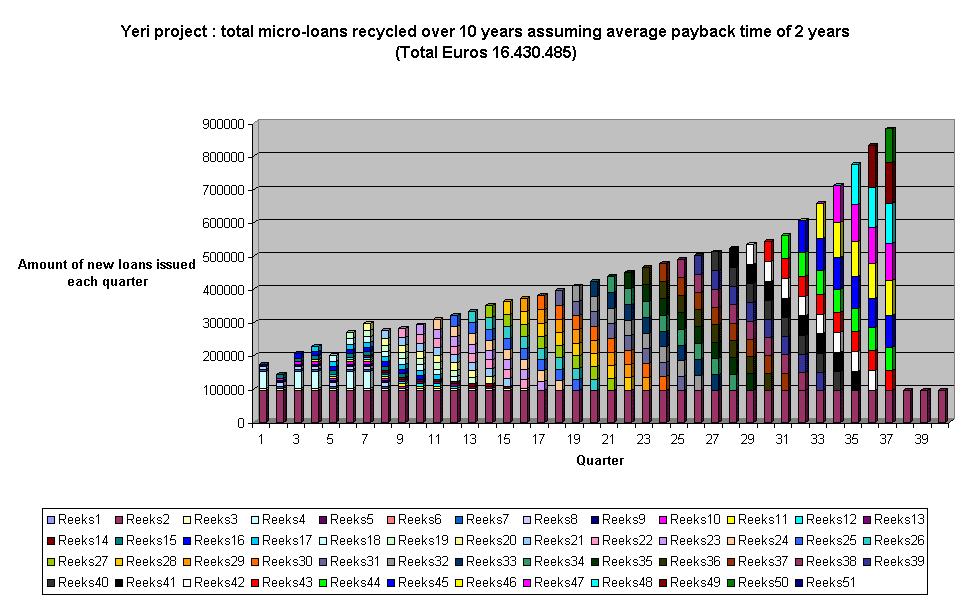
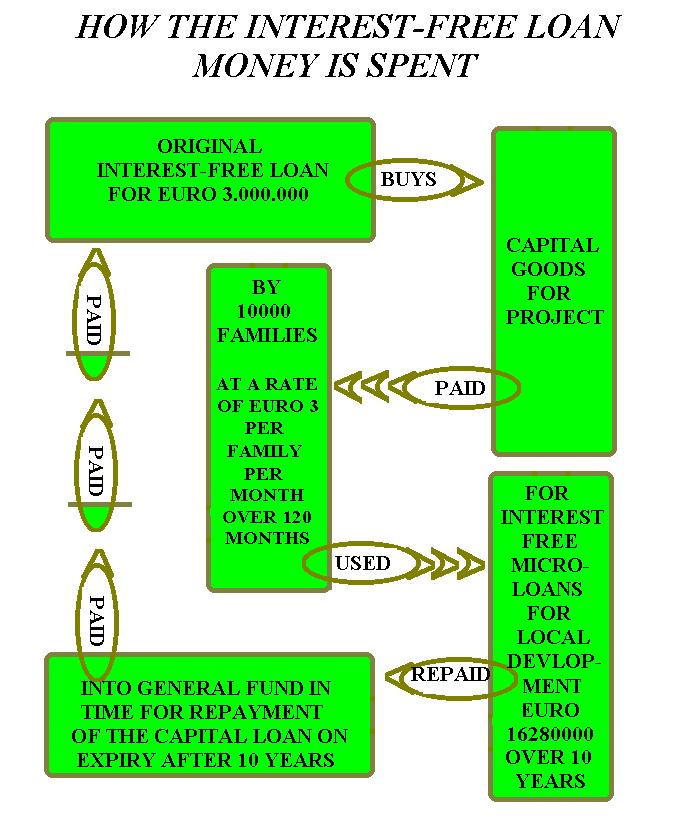
d)Seed capital repaid by users in monthly instalments will be retained in the local area until the end of the loan term. During that time, the repayments will be used to grant revolving interest-free micro-credits for local development.
e)Seed capital not required for short term use, will similarly be used to grant interest-free revolving micro-credits.
f)Local currency (LETS) systems set up within the framework of the project will form the general method of payment for most local goods and services produced at community level, including those provided for the project from within the local community.
g)The part of the maintenance money destined for long term replacement of capital items will also be recycled as interest-free micro-credits until it is needed.
h)Users will be 100% responsible for on-going administration, capital repayments, and maintenance costs. Each household will pay a monthly contribution of Euro0.60 per family member (Euro 3.60 per family of 6) to cover all on-going maintenance and capital repayment costs. The instalments will be to a large extent covered by savings on funds traditionally spent on fuel and water and by way of registration for Carbon Emission Reduction certificates under the Kyoto treaty.
i)The project encourages open competition and free enterprise within the framework of a cooperative and non-profit-making global financial structure.
j)Administration, construction and maintenance work will be done by local operators and villagers who will be paid mostly in local LETS currencies.
k)Local work will be paid for at current local pay rates expressed in the local LETS currencies.
l)The on-going administration costs of the Project Coordinator are specified in the project budget.
m)Users must make their first monthly contribution in advance, as project structures are put into use.
n)The tank commissions will be paid a small monthly allowance in formal currency, and receive an allowance in local LETS money for their work. The well commissions will be paid a monthly allowance under the local LETS currencies for their work.
o)Individual women or women's groups will, without payment, each look after their own sanitation units.
p)Regular inspection of installations will be paid as necessary in the local LETS currencies.
q)The operation of the local bank (The Mvolo Cooperative Local Development Bank) to be set up may be supported and supervised by a international Green Bank to be named.
r)The Mvolo County Council, the Government of Southern Sudan have undertaken not to intervene to impede the development of the local LETS currencies either during or after the project period.
s)The Project Coordinator will reach a specific agreement with the ( applicable tax authorities) before the start of the project as to taxation of activities under the Local Exchange Trading (LETS) systems.
t)Before the project starts, a formal agreement will be made to ensure ownership of the project is vested in the beneficiary communities, suject to formal handing over when the final instalment of the interest-free seed loan is repaid.
u)The local people design, execute, install, run, maintain, own and pay for all project structures.
v)All products and services supplied by the local people for the project will be paid under the local money systems. Those supplying products or goods for the project before the local money systems are set up will be paid from the project funds in formal currency.
a)The enhancement of self-sufficiency in local economies.
b)Existing social traditions will not suffer.
c)Local expertise, labour and materials will be used.
d)Women will play an active role in the project.
e)The people of the Yeri area must be able and willing to take full responsibility for all goods and services provided under the project and for its administration.
f)The users must contribute financially to loan repayments, cover on-going costs and accept the powers of the elected tank- and well commissions.
g)With the exception of the tranche for the eradication of onchocerciasis, the project will be self-funding. Savings on traditional fuel costs for cooking and services will cover most of the project costs.
h)The supply of traditional natural fertiliser for agricultural purposes will not be compromised.
i)Each individual user will be enabled to meet his financial commitments to the project.
Household difficulties in meeting monthly quotas can be cushioned either from the monthly allowances received by the tank commissions, or by creating a simple LETS system safety net. Members temporarily in difficulty could be allowed to run up a larger than usual debit balance. Members permanently in difficulty could perform services within the LETS group in exchange for group payment of their outstanding debts.
j)'Small is beautiful'. Small decentralized systems are to be preferred wherever possible. This promotes close contact of the people of Yeri with the installation and running of their own local infrastructure.
k) Local LETS currencies will complement the use of formal money. They will make up for the lack of formal money that would otherwise be needed to expand the quantity of local goods and services. Economic development within the LETS systems will also stimulate growth in the formal economy and increase its formal tax base.
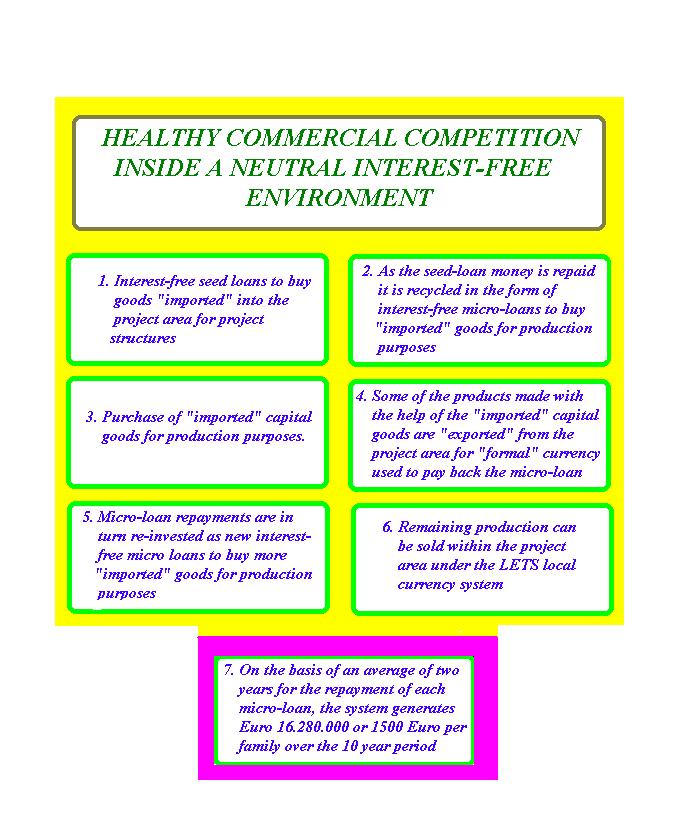
l)The seed loan capital will be systematically recycled to users as interest-free micro-credits for productivity development. The micro-credits will allow goods and services that cannot be locally produced to be bought with formal currency outside the project area.
m)Leakage of formal currency out of the project area will be reduced. Seed capital will be retained in the local area during the 10 year interest-free loan period.
They are:
2.1 Acceptation of Health Clubs. These do not only serve the purposes of offering basic hygiene education courses. They also serve as a platform for women, so that they can organise themselves and participate and play an important role in the various structures foreseen. The health clubs therefore constitute a means of addressing the so-called "gender problem".
2.2 Willingness to pay at least the equivalent in Old Sudanese Pounds (or new currency to be issued) of Euro0.60 per person per month (the equivalent in Old Sudanese Pounds of Euro3.60 per family of 6) into a Cooperative Local Development Fund. This payment covers the entire package of basic services foreseen including hygiene education, drinking water supply, sanitation, waste removal, high efficiency stoves and fuel for them, and lighting for study purposes. It does not include the costs of the emergency action to eradicate onchocerciasis.
2.3 Acceptance of the use of local exchange trading (LETS) systems, which enable goods and services originating in the project area to be exchanged without the need for formal money.
2.4 Acceptance of the BEOSITE process which enables most of the items required for local development to be made locally with 100% local value added within the framework of the local LETS systems in local low cost labour intensive production units.
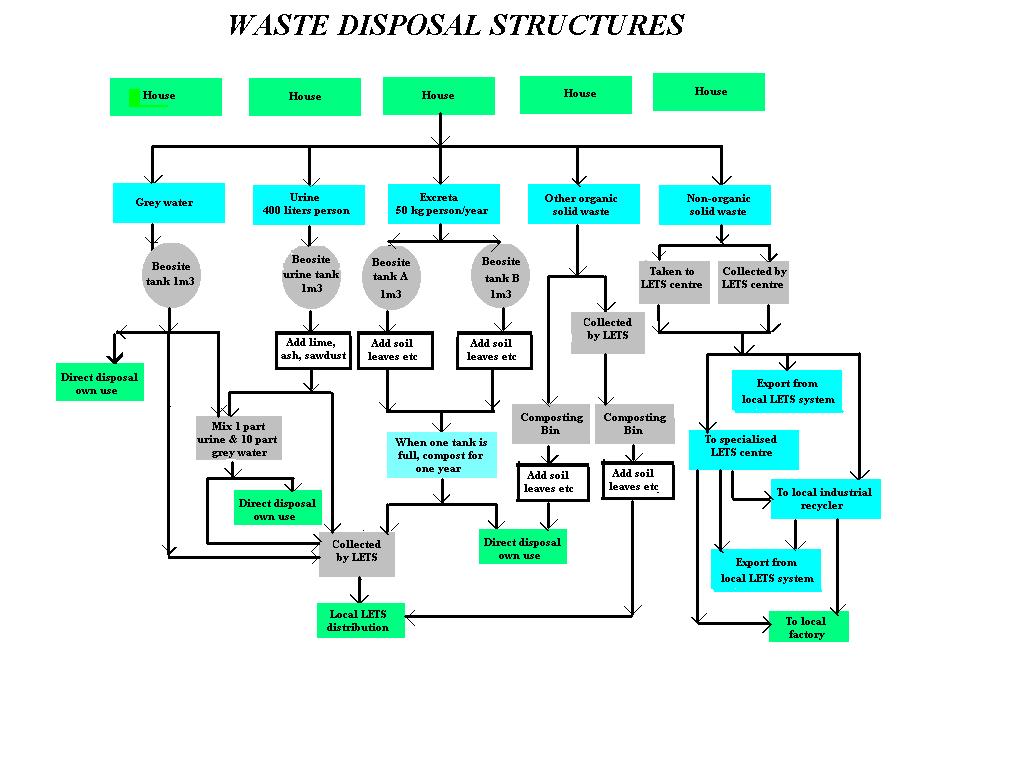
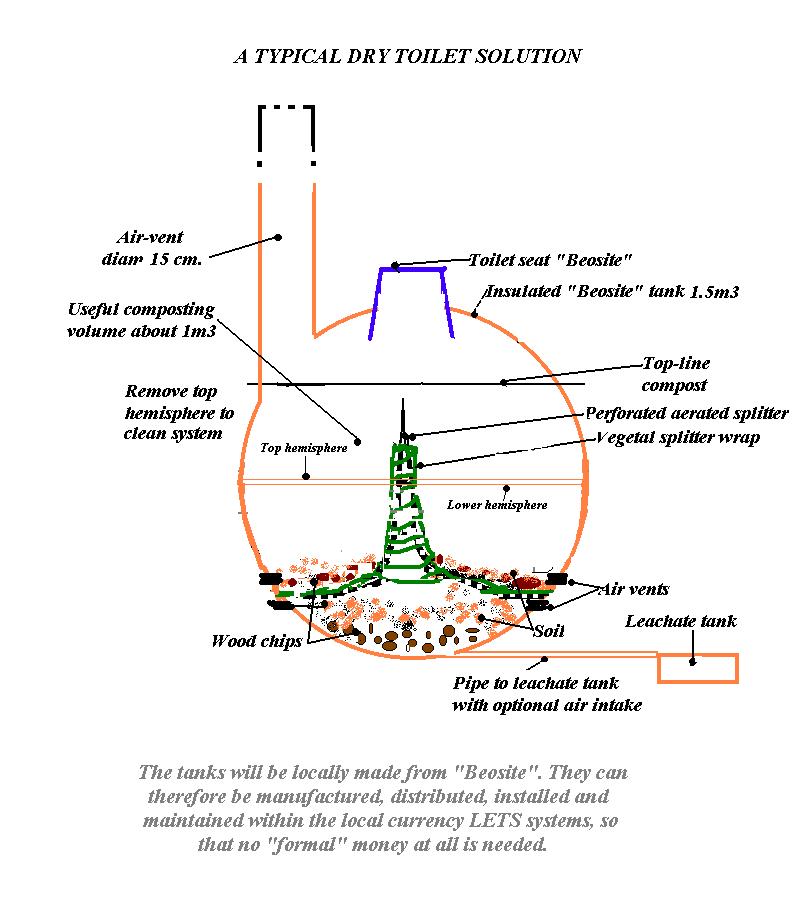
2.5 Acceptance of dry composting toilet systems with the separation of urine and faeces. Aspects relating to the form, the colour, the finish, privacy and similar will all be discussed with and decided by the users. The dry toilet systems foreseen enable waste to be recycled at household level so that problems connected with the pollution of surface and ground water can be addressed at local level without the need for major investments.
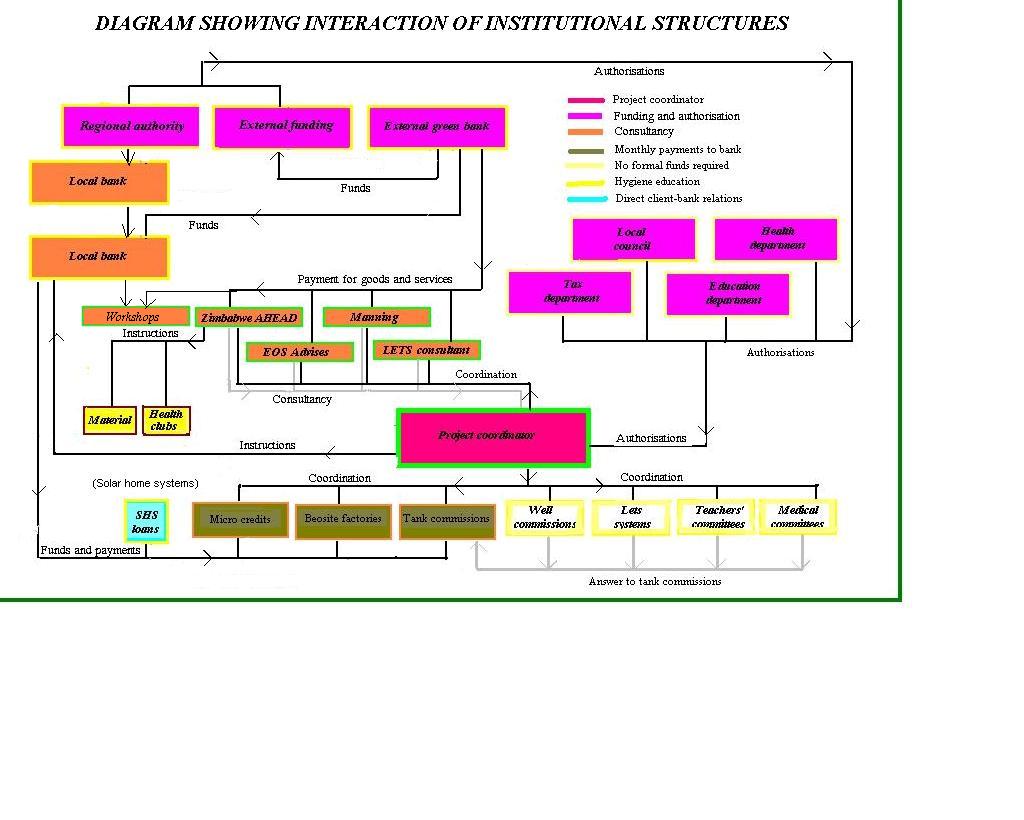
The responsibilities of the various parties which would presumably be involved in the project are:
2.6.01 THE LOCAL NGO "SIDF Sudan Inland Development Foundation", Mvolo, Southern Sudan
THE LOCAL NGO "SIDF Sudan Inland Development Foundation" Domeri, Mvolo County, Southern Sudan
The NGO "SIDF" officially fronts for the project. Its constitution and statutes are attached to this project as Schedule 11. The members of the board of the NGO SIDF are fully representative of the people in the Project area and enjoy the full confidence and support of the people. Their functions are honorary.
Financing parties may nominate their representatives (eventually paid by the financing parties themselves) to the board of the NGO, with the task of acting as auditors and for the purpose of monitoring progress.
The NGO approves the project and presents it for financing by an external support agency.
The NGO nominates the project coordinator and puts the project funds at the free and unconditional disposal of the Project Coordinator in a bank account in the name of the Project.
The NGO does not interfere in the execution of the project, except to carry out its auditing and monitoring duties. It is the counterpart of the project coordinator.
2.6.02 THE PROJECT COORDINATOR (Yowani Ngoli)
Yowani Ngoli is responsible, together with Terry Manning, for the project preparation, for contacts with local authorities and banks and with the users, for the actual implementation of the project. Mr Ngoli is also responsible for all professional work or operations that cannot, at the time of the project, be provided from within the local communities. He is also in charge of the maintenance of the project structures, for collecting the monthly contributions of the users (through the tank commissions) and for general supervision of payments out of the project accounts. Mr Ngoli will also coordinate the establishment of the local Beosite (R) production units and the network of recycling centres. Mr Ngoli's fees are in the public domain and formalised in the Project budget.
Curriculum Mr Ngoli
2.6.03 TERRY MANNING
Terry Manning is responsible for formulating the project, initial coordination with the NGO Zimbabwe A.H.E.A.D., initial contacts for setting up the Organizational Workshops, for the organisation (through the Workshops) of the local money LETS systems, setting up a Micro Credit system, coordinating with EOS Consult in setting up local Beosite(R) production units, delivering pumps, PV-panels and related materials needed to implement the project. He will act as consultant to the Project Coordinator (through the Workshops) for the training and supervision of water supply, water quality and hygiene control and maintenance personnel identified during the Workshops.
2.6.04 ORGANISATIONAL WORKSHOPS
BIBLIOGRAPHY
ORGANIZATION WORKSHOPS
All activities will be executed by the local people themselves. Organizational workshops (mass capacitation workshops or OW's) following the method of the Brazilian Clodomir Santos de Morais will be held for the various sectors of activity involved. During the workshops the users will organise themselves respecting the principles of the division of labour.
Amongst the activities for which Organizational Workshops would be held are:
Setting up Health Clubs
Setting up Tank and Well commissions
Setting up the local communications network
Setting up the local money (LETS) systems
Setting up Beosite production units
Setting up structures for the water supply systems
Setting up structures for the sanitation systems
Setting up structures for the growing of bio-mass to fuel high efficiency stoves
Setting up the local bank and/or the Cooperative Development Fund
Setting up the waste recycling system
Setting up structures for rainwater harvesting
Setting up export-import cooperatives
Setting up a net-work of local agrarian consultants
The costs of the Workshops are set out separately in the balance sheet.
The Organizational workshops will typically directly involve about 4.000 users representing some 15% of the adult population.
No workshop is foreseen for the emergency action for the eradication of onchocerciasis. Much of the work under the action can, however, be conducted under the local money system once it has been set up.
2.6.05 EXTERNAL SUPPORT AGENCY ADMINISTRATOR(S)
The administrator(s) of the external support agency which agrees to supply the project funds will, on acceptance, make available its 95% share of the interest-free loan necessary for the project and nominate structures and channels for supervising the project expenditure and liaising with other parties.
2.6.06 THE MVOLO COUNTY COMMISSIONER (or government of South Sudan)
The Mvolo County Commissioner will be an enabling body only. He will guarantee the continuity of the local currency (LETS) system. Before the project begins, he will guarantee transfer of ownership of the project structures to the local communities when the seed loan is repaid. He will ensure, by agreement with the Central Government of South Sudan, that goods imported for the project come into South Sudan Duty Free. He will authorise without creating unjustified obstacles the siting of boreholes, wells, feed-pipes, tanks and others structures necessary to the execution of the project.
He may take full political credit for the project, but will agree not to otherwise intervene in its organisation, implementation or day to day running.
2.6.07 COUNTY SECRETARY FOR REHABILITATION AND RELIEF
The Mvolo County Secretary for Rehabilitation and Relief has agreed to do everything in his power to guarantee respect by the national, regional and local administrative authorities for the continuity of the local currency (LETS) systems. He agrees to the importation of goods destined for the project without the application of customs duties taxes or other formal levies, and to the transfer of the project structures to the users.
He will act as liaison points between the Project Coordinator on the one hand and the local funding authority and the local political institutions on the other. He may take full political credit for the project, but will agree not to otherwise intervene in its organisation, implementation or day to day running.
2.6.08 THE YERI PAYAM ADMINISTRATOR
The Yeri payam administrator will formally approve the project after having obtained the acceptance of the two local area councils (Bomas). He will act as an enabling body. He may take full political credit for the project implementation, but will not otherwise intervene in the organisation, implementation or day to day running of the project. He will guarantee and respect decisions of the vested authorities in relation to ownership of the project goods and services, and fully support the local currency (LETS) system and the duty-free entry into the project area of goods to be used in the project.
The Administrator will approve reasonable project proposals for laying and embedding water pipelines to dedicated water tanks, drilling bore holes, digging wells, locating and building sanitation facilities, siting of Beosite (R) manufacturing units, siting of, and collection of rubbish by, recycling centres. He will support the adaptation of local market places and supplying them with drinking water and sanitation facilities.
2.6.09 THE HEALTH DEPARTMENT
The Health Department is formally responsible for health services in the project area. It will respect the administrative decisions taken by the Yeri payam administrator relating to the Project and will approve of the use of its own Health Workers within the framework of the Community Health Clubs' hygiene education programme to be set up by Zimbabwe A.H.E.A.D.
The health department will approve that its workers be paid in the local LETS currencies for any work not already covered under their existing salaries.
It will approve that ownership of drinking water facilities, sanitation services where supplied, PV lighting, PV refrigeration, and water testing equipment placed in clinics within the project area be vested in the tank commissions in whose areas the clinics are situated.
It will support the emergency onchocerciasis eradication programme instituted under the project, and make its personnel available for the purpose where necessary.
It will support formal hygiene education courses in schools in the project area.
It will reach an agreement with the project coordinator to ensure training of (women) users at on-going checks of water quality, and systematic inspections of the sanitation facilities built within the framework of the project. Testing and inspection work not already included within the Health Workers' salaries will be paid for in the local LETS currencies. The equipment for conducting such systematic water quality tests will be made available under the project to a local clinic or hospital and financed by testing work carried out by the clinic for third parties outside of the project area.
PV lighting, sanitation where needed and refrigeration for medicines for the clinics in the project area which are not on the grid will be paid for by the communities as they do for drinking water facilities dedicated to the clinics and schools in the project area. Ownership would in this case be vested in the tank commission in whose territory the clinic is located. PV lighting and refrigeration installations in clinics outside the project area serving users inside the project area need to be separately discussed. The disposal, where required, of specialised waste from clinics will be addressed separately.
The health department will help train people to make regular hygiene inspections of the local recycling centres where these are set up .
2.6.10 THE EDUCATION DEPARTMENT
The education department will approve that ownership of drinking water and sanitation facilities and PV lighting placed in schools within the project area be vested in the tank commissions where the schools are located. It will also approve that the teachers' commissions nominated to operate water and sanitation services and PV lighting report to the local tank commissions.
It will support ongoing hygiene education courses in the schools in the project area and approve the reasonable course curriculum presented by the Project Coordinator and apply it during normal school hours.
It will fully support the efforts of the project to extend education basic facilities and opportunities for adult education and evening classes.
2.6.11 THE LOCAL TAX AUTHORITIES
The Project Coordinator will reach a binding agreement with the tax authorities, before the Project gets under way, to ensure that the tax authorities are not deprived of current tax revenue.
The project is based on a tax moratorium of at least 20 years on all LETS activities.
The tax authorities will define LETS activities carried out in LETS currencies under the project as non-commercial, and therefore non-taxable.
2.6.12 THE MVOLO COOPERATIVE LOCAL DEVELOPMENT BANK
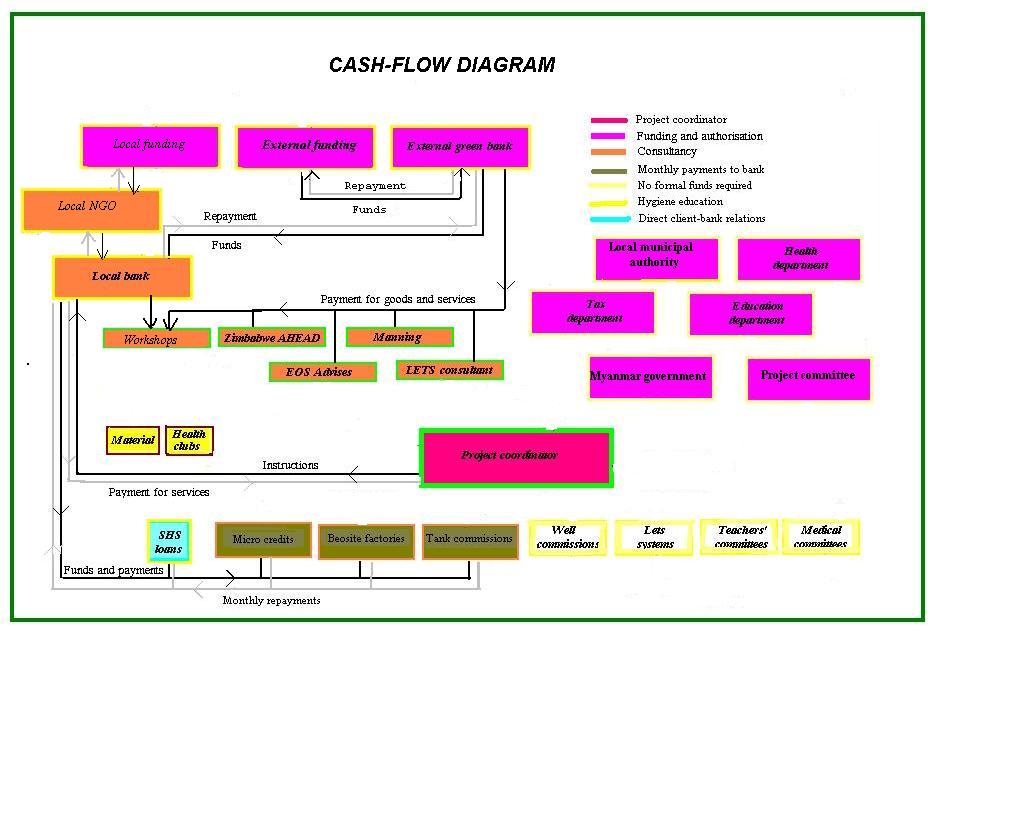
After its institution, the Mvolo Cooperative local development bank will administer project funds actually deposited in the Yeri project area of the Mvolo County in the Sudan. On the instruction of the Project Coordinator, it will formally administer Grameen Bank style interest-free micro-credit loans and repayments and the project funds, in cooperation with the External Green Bank. It will NOT intervene in the decisions relating to the granting of the loans themselves which will be made by the project coordinator in consultation with the communities. All shares in the bank will be held on trust for the people of the project area.
The bank will autonomously finance and administer micro-loans for the installation of solar home systems for individual non-productive household use.
2.6.13 THE EXTERNAL BANK (BARCLAYS KAMPALA???? NAIROBI??? TO BE DEFINED)
The external funding authority will pass its financial contribution through an appropriate financial institution, where possible a Green Bank willing to act as adviser to the Mvolo Cooperative Local Development bank. The external Bank will, on the instruction of the project coordinator, administer the project monies deposited in Kenya ??? Uganda???, under the supervision of the External Funding Authority and will support the Mvolo Cooperative Local Development Bank in setting up the Micro-credit system for local development.
2.6.14 THE LOCAL BEOSITE(R) PRODUCTION UNITS
These units will make, with a sanitary finish where necessary, ecological items such as water tanks, water containers, well-linings, san-plats in low cost labour intensive production units with up to 100% local value added. They will also make the high efficiency stoves and solar cookers. The Project will finance them on an interest-free basis with a pay-back period of 3-5 years. They will operate autonomously and negotiate payment of any royalties directly with the Technology Owner. They will usually sell their products within the project areas in the local LETS currencies, and outside the Project areas in formal currency. Precedence will be given to making items of top priority to the Project. Ownership of the production units will pass to the factory owners when the loans have been repaid. Until then the factory owners will be responsible to the Project Coordinator.
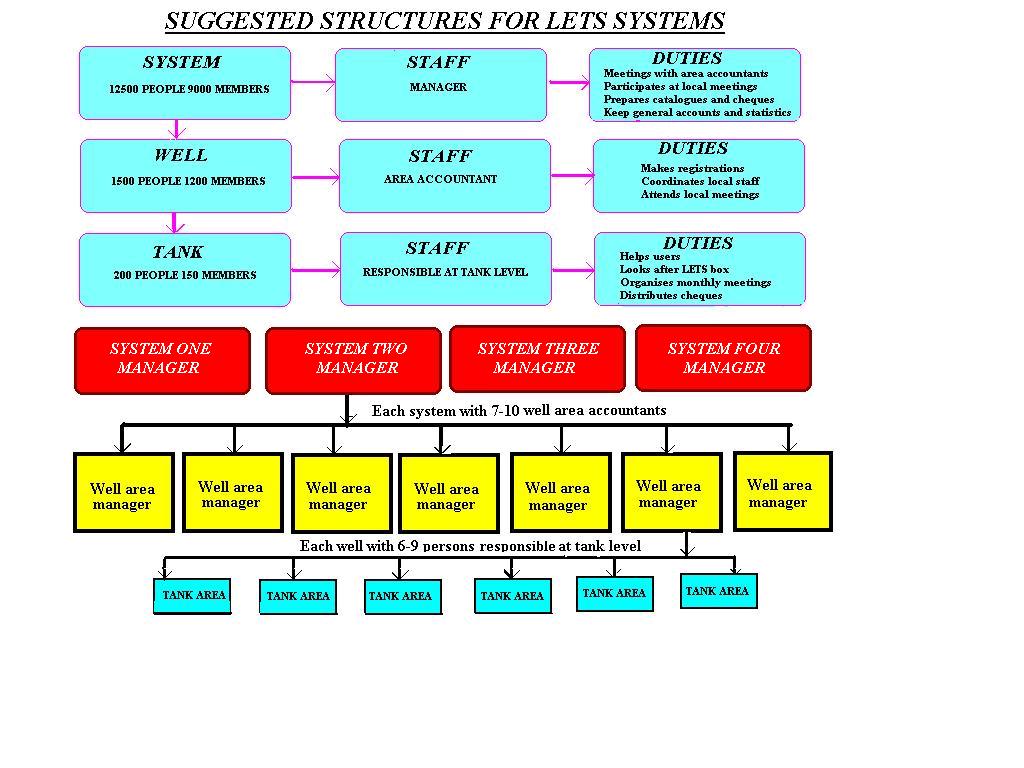
2.6.15 TANK COMMISSIONS
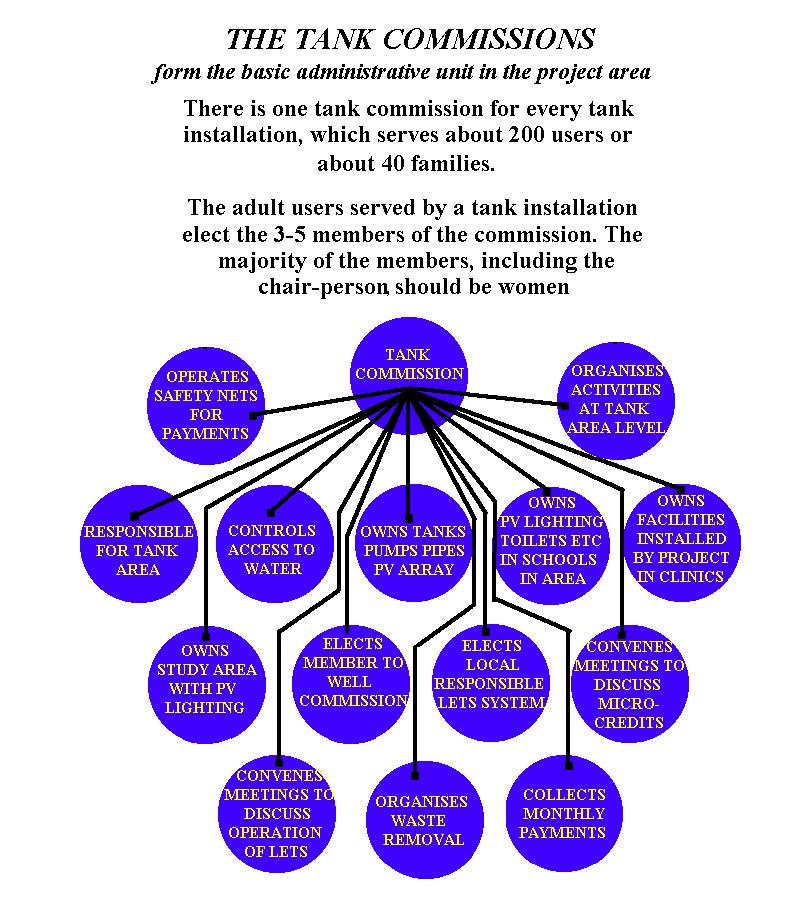
TANK COMMISSIONS - THE KEY STRUCTURES.
Every water tank supplies an area or group of households with water. A tank commission, elected by the users, will supervise the use of the tank and its associated works, the collection of the monthly contributions and the carrying out of minor operations such as keeping tank areas clean. Each tank commission will be paid a small monthly fee in formal currency, equivalent to perhaps Euro 5 per month, which it is free to spend as it wishes. Since women enjoy the greatest benefits from the execution and on-going management of the project, they should provide most of the tank commission members.
Ownership of a given tank and its associated works, of the dedicated solar pump, PV array and array support, and of the dedicated pipeline from the pump to the tank is vested in its respective tank commission. Passage of ownership of existing structures to the tanks commissions to be decided by the people themselves.
The tank commissions will nominate one of their members to liaise with the system maintenance structures set up.
The tank commissions would also be responsible for study rooms and PV lighting and for coordination of recycling in their area.
The tanks commissions will be set up using the Moraisian organisational workshop method. Their form may vary from one area of the project to another.
They will nominate a literate person to liaise with the local LETS system coordinator.
The drinking water installations and sanitation services dedicated to schools and clinics will be supervised by commissions of respectively teachers and medical staff who will report to the tank commissions where the schools and clinics are located. Ownership of these installations will be vested in the local tank commissions with the consent of the local Education and Health authorities. The costs of loan repayment and maintenance of these installations are built into the users' monthly payments.
PV lighting, PV refrigeration, and water testing equipment supplied to clinics in the project area will likewise be run by the medical commission supervising the water supply. Ownership of these structures will be vested, with the consent of the Health Authorities, in the tank commissions where the clinics are located. The medical commission will report to the local tank commission.
The problem of specialist waste removal from clinics, where needed, will need to be studied separately.
The tank commissions will also convene regular meetings to discuss activities under their local LETS system and priorities for micro-credits.
The tank commissions will elect the well commissions.
The tank commissions will nominate a female candidate from their own area to carry out cooperative inspection of the sanitation, rainwater harvesting, and cooking facilities installed, and arrange for her training.
Specific to this project and not shown on the above illustration, the tank commissions will own the local high frequency radio communications equipment and nominate the local radio officer (where possible, a blind person) to run the service.
2.6.16 WELL COMMISSIONS
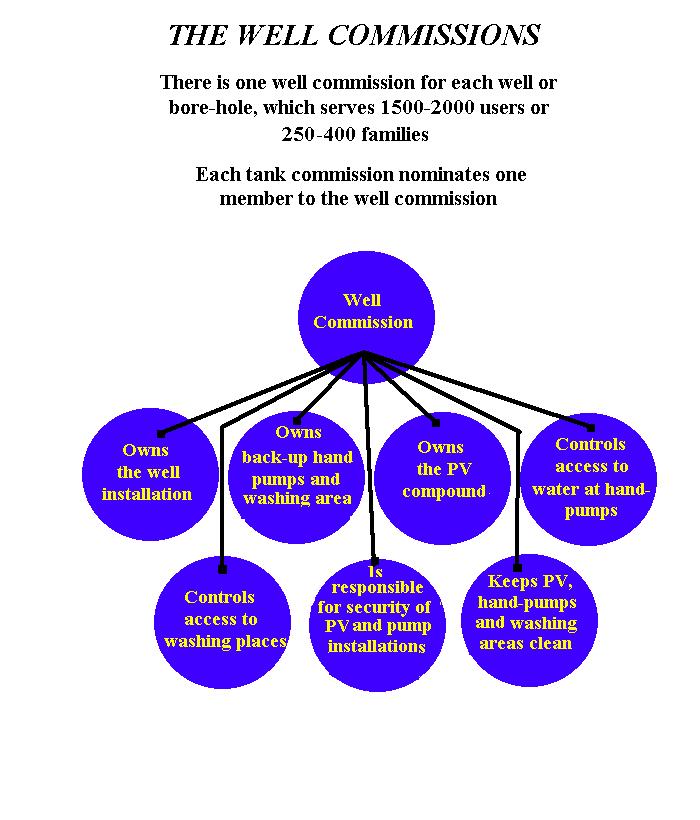
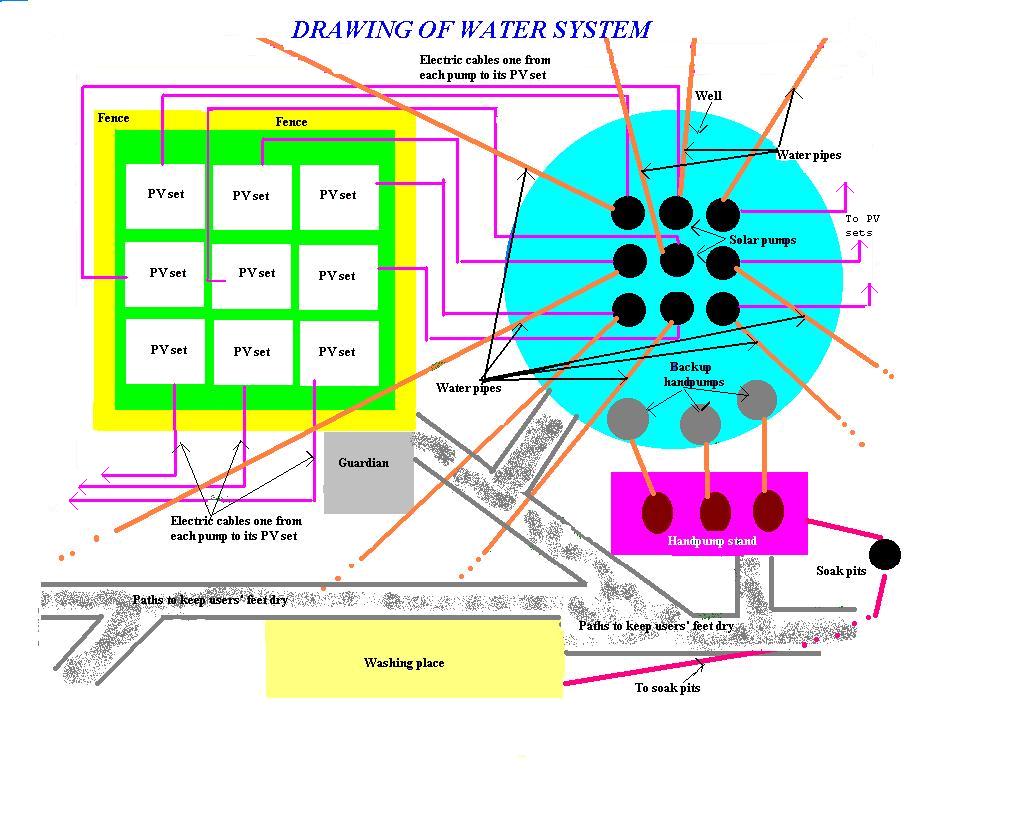
Every well/bore hole area comprises:
- The well or bore hole itself
- The backup hand pump installation
- The washing area
- The enclosure for PV systems and supports
- A guard system for the PV installations
Passage of ownership of existing structures to the well commissions to be decided by the people themselves.
The well commission, elected by the tank commissions, supervises the use of the structures common to the water supply system, and carries out minor maintenance operations such as cleaning washing areas, well areas, and backup hand pump systems. The well commission also regulates use of the well area in case of crisis or calamity. It collectively receives a small monthly payment in the local LETS currency (e.g. the equivalent of Euro 5 per month) which it is free to spend as it wishes. Members can be awarded a salary paid out under the local money LETS system. Since women enjoy the greatest benefits from the execution and on-going management of the project, they should provide most of the well commission members.
The well commission will nominate one of its members to liaise with the system maintenance structures set up and with those responsible at tank commission level for maintenance.
The well commissions will nominate a female candidate from their own area to monitor the cooperative inspection of the sanitation, rainwater harvesting, and cooking facilities carried out at tank commission level, and arrange for her training.
2.6.17 ZIMBABWE A.H.E.A.D.
This NGO from Zimbabwe is the author of the original material for the Health Clubs.
The Community Health Clubs will be set up, and local health workers trained to lead the hygiene education courses during a Moraisian organizational workshop.
A hygiene education course for use in the schools in the project area will be developed the same way, and health workers and teachers trained to apply it.
2.6.18 EOS CONSULT
This Dutch company is the registered owner of the Beosite(R) process.
It will act as consultant during the Organization Workshop during which the local Beosite (R) production units in the project area will be set up, and independently negotiate any conditions for technology transfer.
2.6.19 MEDICAL COMMISSIONS
Medical commissions will, where they exist, supervise installations supplied to clinics under the project. They will report to the tank commission where the clinic is situated. They will where required arrange with the Project Coordinator collection of special medical waste products.
They will fully cooperate with the project in connection with the emergency action for the eradication of onchocerciasis in the project area.
2.6.20 TEACHERS COMMISSIONS
Teachers commissions will supervise installations supplied to schools under the project.
They will support and apply the approved hygiene education courses in the schools should such courses be conducted.
They will report to the tank commissions where the school is located.
2.6.21 THE INDEPENDENT AUDITORS
Financing parties may nominate an independent auditor to co-sign payment authorisations made by the project. The independent auditor answers to the project NGO. See par. 2.14 for more information.
Before the project starts, the project coordinator will offer to provide on-going maintenance, training of maintenance operators, and administration for an agreed fee for at least ten years. Pumps and structures have a life-span of more than 20 years. Once the seed capital has been fully repaid at the end of ten years, on-going monthly contributions will create a large surplus for future renewals and extensions of the project facilities. Until it is needed, this money can be re-invested interest free in micro-credit loans for local development.
Ownership of drinking water installations, communications systems, PV lighting and refrigeration and water testing equipment installations in schools and clinics will be vested in the tank commissions where the schools and clinics are located.
Ownership of PV lighting sanitation services and refrigeration installations in clinics outside the project area serving users inside the project area needs to be separately discussed. Ownership will be vested in the tank commission in the project area nearest the clinics in question.
Financial and political participants should each issue a written warranty that money, permits, and guarantees they have agreed to provide will be forthcoming on schedule.
As the project is cooperative in nature, the participating parties, and in particular those financing the project, are free to impose appropriate reporting and verification procedures which should be simple and direct to eliminate "red tape". For more information see 2.14.
This project is designed to create rapid, sustainable and durable local development.
The project coordinator will reach a binding agreement with the (tax authorities --- name them!!), before the project gets under way, to ensure that the tax authorities are not deprived of current tax revenue.
The tax authorities will define LETS activities carried out in LETS currencies under the project as non-commercial, and therefore non-taxable.
The project is based on a tax moratorium of at least 20 years on all LETS activities.
After the moratorium, the following basic rules will apply:
-1. LETS exchanges where a user helps a friend, or performs a job on a "one-off" basis are not taxable.
-2. LETS exchanges involving activities not part of the normal business activities of the supplier are excluded.
-3. The expression "normal business activities" will be interpreted in the manner most favourable to the users.
-4. Normal LETS exchanges by businesses are taxable.
-5. All costs and business expenses are tax deductible.
-6. Businesses will be taxed in respect of LETS exchanges on the net profits they generate from them.
Users repay the interest-free loan after ten years. At that point of time they will have been repaying the loan at the rate of the equivalent in Old Sudanese pounds of approximately Euro0.70 per family member (or the equivalent in Old Sudanese pounds of Euro 4.20 per family of 6 per month) for 120 months. Their repayments are, however, made in the local (formal) currency. Should the local (formal) currency through inflation or exchange measures have devalued against the Euro, the amount in local currency collected by the users will not be sufficient to pay the original loan back . This situation is beyond the control of the parties to the project, and in particular of the users.
A decision on how this risk is to be covered will therefore need to be made when the project is being financed.
Is the interest-free seed loan to be expressed in the local (formal) currency or in Euro?
LOAN EXPRESSED IN LOCAL CURRENCY
If the loan is expressed in the local (formal) currency, then the external bank (working together with the local bank) will need to obtain the acceptance of the lenders that the amount repaid, when reconverted into Euro, may be lower than the original Euro loan.
The following are four possibilities:
1) The lenders or their governments formally accept they are willing to run this risk and write off the eventual difference as a gift.
2) The lenders agree to extend repayment time until the total amount collected in the fund is sufficient to repay the whole loan expressed in Euro. This can lead to a "win-win" situation in that the amount available for recycled micro-loans would remain at a high level. In return for the extra monthly payments, users have more money to recycle in micro-loans than would otherwise have been the case.
3) The lenders require payment of the available funds on expiry, and that the difference be collected using the next following monthly payments, until such time as the original amount expressed in Euro is balanced. This solution is negative for users in that for a shorter or a longer period (depending on the inflation which has taken place) users will not be able to benefit from re-cycled micro-loans and on-going local development will slow down and could, in some cases, even stop.
4) The lenders require repayment of the available funds on expiry but reinvest any difference for a further cycle of ten years. This will reduce users' funds for renewing capital goods or extending services at the end of the second period of ten years, but will not negatively affect recycling of micro-loans for on-going local development under the project.
LOAN EXPRESSED IN Euro
If the loan is to be expressed in Euro, will users' monthly repayments be indexed to the Euro? If so, how will the monthly rate expressing the amount payable in Euro be determined, and by whom? How will the users be advised?
If repayments are to be indexed to the Euro, the total amount collected by users over the ten year period may, when converted into Euro, still be (considerably) less than the total original amount in Euro. This is because the indexing of the local payments to the Euro is progressive over ten years while the exchange rate applicable on repayment of the loan after the ten years' loan period is the one applicable at the moment of the repayment. The difference would normally be less than where the loan is expressed in the local currency, but one of the four options mentioned above would have to be applied to it.
While capital structures installed within the framework of the project may, if rarely, be insurable against loss or damage by Act of God such as lightning, hurricanes, or earthquakes, it is not possible to insure them against loss or damage deriving from causes such as Act of Political and Military Authorities, civil war, commotion, rebellion, and strikes. Even if insurance against such risks were to be available the cost would be so high that it would constitute a major on-going financial leakage from the project area, which is just one of the major problems the project is designed to stop.
What happens in case of loss of or damage to the capital structures installed under the project before repayment after ten years of the interest-free seed loan must therefore be clearly addressed at the time this project application is being financed.
The beneficiaries of the project are by definition poor and the loss or damage in question derives from causes entirely beyond their control. To require these poor people to repay a loan after ten years for capital structures they have lost for reasons beyond their control is in profound contradiction with the short term and long term goals of the project. In some cases the lending organisations may have forms of insurance available to cover funds at risk in projects in developing countries. In such cases they would ensure, at their own cost and by way of gift, that funds for the project are insured by such Funds. Where, however, such insurance is not available, the lending organisations should accept that in the case of loss of or damage to project structures deriving from causes beyond the power and control of the users the interest free loan be converted into a gift so that users are freed from their contractual obligations.
Normally, at the time the (uninsured) loss of or damage to the capital structures occurs, users will have paid a part of the loan into the Cooperative Local Development Fund.
It must therefore be clarified whether the money which has already been collected in the Cooperative
Local Development Funds at the time the loss of or damage to the capital structures occurs:
a) Must be used immediately to reinstate the capital goods lost or damaged
b) Has to be repaid to the lenders at the end of the original ten years' interest free loan period.
c) Has to be repaid immediately
d) Will, subject to analysis of the current political situation, be integrated by a further loan to enable complete reinstatement of the capital structures so that the project application can make a re-start.
The same users will at the same time need separate instruction on how best to recycle their urine, and later, their composted faeces. Basic recommendations will be developed under the project for this, although single users, the local tank commissions, or the project coordinator could also obtain consultancy under b). Where the project supplies recommendations, cooperative structures similar to those described for hygiene would need to be developed to make sure they are applied properly.
The first series of such purchases is usually made with the original loan funds. Since the original loan funds will be made available in Euro or other leading international currency, and converted into the local currency for the purposes of the project, their re-conversion where necessary from the local currency into the international currency should not pose a problem.
The amount of capital goods needed for local productivity increase under recycled micro-loans could, however, amount to several times (5 or 6 times or more) the amount of the original interest-free loan expressed in foreign currency.
A condition for the granting of an interest-free loan under the project is, normally, that the beneficiary be able initially to sell some of the goods or services in question outside the project area for formal money to enable him to repay the loan. The beneficiary therefore exports the goods or services outside the project area for formal local currency, but not necessarily outside the national borders. Since capital goods will usually need to be imported into Southern Sudan, a situation of financial leakage of the formal national currency occurs for the purpose of buying the foreign currency necessary for the purchase of new capital goods for production purposes. This financial leakage is not desirable but it may in part be offset by the increase of local production tending towards a reduction in the need for imported goods.
The leakage can only be completely avoided where the project area succeeds with time to export directly outside national boundaries enough of its production to earn enough foreign currency to cover the costs of the imported goods. It is unlikely this be possible at least in the early phases of the project. The local government must therefore when it approves the project application accept that this (temporary) financial leakage is going to take place during the initial stages of the project. Its Finance Ministry must ensure flexibiility in granting leave to convert local formal money into the foreign currency necessary for the purchase of the capital goods. Failure of the Ministry to do so would in practice lead to serious delays in project execution. The more often the project funds are recycled the more rapidly the project area will develop. The Project Coordinator, on the other hand, is bound to endeavour to reduce the financial leakage of formal currency in question by purchasing capital equipment, where available, which has already been imported and is available on the local market.
The following schedule will produce a zero national import/export balance for the project during its execution and a long-term ongoing
foreign exchange credit balance:
First two (executive) years : zero franchise
Third year, at least 35% of imported value exported
Fourth year, at least 50% of imported value exported
Fifth year, at least 75% of imported value exported
Sixth year, at least 100% of imported value exported
Seventh year, at least 125% of imported value exported
Eight and following years, at least 150% of imported value exported
The project is based on separation of powers between the controlling party (the NGO SIDF) and the project coordinator nominated by the NGO to execute the project.
Financing parties have, if they wish, two structures enabling them to carry out on-going audits of the project works.
1. The project NGO SIDF fronts for the project and maintains on-going auditing powers to ensure correct project execution. The statute of the project NGO allows the financing parties to nominate executive auditors to the Board of Directors. The nominated auditors may be paid salaries by the financing parties. For practical purposes they should be resident in or near the project area. The NGO does not intervene directly in the execution of the project, as this is the responsibility of its nominee project coordinator.
2. Financing parties may also nominate an independent auditor to act the with project coordinator to co-sign payment authorisations and conduct an on-going audit of project out-go. The independent auditor answers to the Board of the NGO, which includes executive audit nominees of the financing parties. His salary is paid by the financing parties. The independent auditor may not intervene in the running of the project itself. For practical purposes the independent auditor must be resident in the project area, either in Yeri itself or in Domeri.
To avoid conflict of interest, neither the project coordinator nor the independent auditor may be a member of the NGO. They both report, independently of each other, through the NGO SIDF to the financing parties.
The source of the following basic information on oonchocerciasis is WHO (http://www.who.int/ocp/ocp001.htm):
Begin citation
Onchocerciasis is a major public health problem. It gives rise to serious visual impairment, inlcuding blindness; to intensely itching rashes, wrinkling and depigmentation of the skin; to lymphadenitis, resulting in hanging groins and elephantiasis of the genitals, and to general deliblitation. The disease is also called "river-blindness"- a name which expresses its endemic location and its most serious manifestation. Since the fertile riverside areas where the blackfly vector abounds are frequently deserted through fear of the disease, it is not surprising that onchocerciasis constitutes a serious obstacle to socioeconomic development.
Ochocerciasis is caused by a parasite, Onchocerca volvulus. The adult female macrofilaria, which is 30-80cm long, concentrates in nodules under the human skin where during its lifetime, averaging 12 years, it produces millions of microspoic embryos called microfilariae, about 0.3 micrometers in length. The microfilariae, which live for some two years, move around in the human body and are the actual agents of onchocercal manifestations.
Microfilariae produced in one person are carried to another by the blackfly, which in Africa belong to the Simulium damnosum species complex. Blackfly eggs are laid in the water of fast-flowing rivers from where the adults emerge after eight to twelve days; the blackflies live for up to four weeks and can cover several hundred kilometers in flight.
After mating, the female blackfly seeks a bloodmeal, necessary for the maturation of her eggs, and may thus ingest microfilariae if the meal is taken from a person infected with onchocerciasis. A few of these microfilariae may transform into infective larvae within the blackfly; they are then injected into the person from whom the next bloodmeal is taken and subsequently develop into macrofilariae, thus completing the lifecycle of the parasite. Onchocercal manifestations occur one to three years after the injection of infective larvae.
Close of citation
The onchocerciasis (river-blindness) eradication programme covers the whole of Mvolo County. Three quarters of the area of Mvolo County have been classified as OV endemic areas by the country Health authority.
The programme will continue throughout the project period. As soon as the local money system is set up in the Yeri project area, costs of administration and labour there will be expressed in local money and passed on to the inhabitants. The extreme gravity of the situation in the project area is such that this work must be started using capital funds supplied as a gift. Retribution for SIDF trainees involved with onchocerciasis eradication in other areas of Mvolo County will need to be covered by formal money donations until such time as self-financing integrated development projects such as the Yeri project are established there as well.
In the Yeri project area the programme is closely interconnected with the supply of clean drinking water, sanitation facilities, and initiatives for proper drainage and elimination of stagnant waters under the self-financing project. The time frame for getting the drinking water part of the main project in execution involves, however, a step by step process requiring 12-18 months. This is too long. There is therefore a priority to set up a minimum clean drinking water supply pending execution of the main project. This means that some operations such as digging and lining the wells and supplying handpumps and platforms which would all normally have been carried out under the local money system under the main project will have to be done under the formal money system.
The programme comprises:
1.Action to limit the breeding of the black-fly along the Naam river. This involves:
a) Initial aerial spraying using (herbicide) especially along the Naam river. This may have
a short term effect only as blackflies rapidly develop resistance to most insecticides. This item has been entered pro-memoria in the bduget pending further development.
b) Under laboratory conditions, the Charles Darwin Research Station (CDRS) for the Galapagos has tested the use of Bacillus thuringiensis israelensis (Bti), an entomopathogen of the Simulium bipunctatum blackfly larvae. The Simulium bipunctatum is the blackfly present on the Galapagos islands. This has had a 95% success rate. CDRS chose Bti as the most promising control agent based on the findings from similar international blackfly control projects with a success rate of 70 to 100%. In 2003, CDRS will initiate Bti trial applications in the field. Upon successful completion of the field trails, CDRS will extend the Bti program to include all of the affected areas of the island with the aim to control, and possibly eradicate the blackfly. (Source
CDRS:) This item has been entered pro-memoria in the budget pending further developments.
2.Avoiding the need to fetch water from the Naam river.
a)Digging and lining 57 wells for drinking water at critical points in the most infected areas in Mvolo County.
The most urgent of these are the following:
Kulu, population 16770 - 15 wells, 45 handpumps
Woko, poulation 3120 - 2 wells, 6 handpumps
Gira, population 8830 - 8 wells, 24 handpumps
Bogori, population 13830 - 11 wells, 33 pumps
Domeri, population 12985 - 11 wells, 33 pumps
Bilebi, population 310 - 1 well, 2 single pumps
Lali, population 9420 - 8 wells, 24 pumps
Dotira'ba, population 630 - 1 well, 3 pumps
b)Sealing the wells and fitting each well with a triple handpump system and a platform ensuring users keep their feet dry, and a proper run-off area
Costs: Euro 90.000
3.Action to cure existing infections so as to avoid further cases of blindness
a)No medicine capable of killing the onchocerca volvulus worm is yet available. The Merck product Mectizan acts to block the millions of microscopic embyros (microfilariae) each female worm produces during its lifetime. Since the average lifetime of the worm is 12 years but can be longer, Mectizan must be administered regularly to all eligible persons for a period of at least 15 years.
a)Those infected are reached and identified by noting individual cases during general controls. These controls have already been conducted and 120000 infected people in Mvolo County have been identified.
b)A supply of 720,000 Mectizan tablets per year is needed to treat a total of 120,000 eligible persons
victims of the disease. Each person will be given 3 tablets twice a year. (SIDF has only so far received a donation of 36,000 tablets towards this program from Healthnet International). Mectizan tablets are available free of charge through the Merck Mectizan Donation Programme. SIDF is
to become affiliated with the Mectizan Donation Programme.
c)Annual labour costs for 60 operators at Euro 75 per person per month ($US
54000 per year) plus management (Euro6000 per year) until such time as these costs can be transferred to the local people under local money systems set up under self-financing development projects
similar to the Yeri project. Cost over 15 years Euro 900.000. SIDF has already trained 56 operators for this purpose.
These operators have to carry out 240.000 interventions per annum, or 3.600.000
interventions over 15 years. This amounts to an average of 10 interventions per
operator per day.
4. Means of transport for the Onchocerciarsis eradication project
a)60 bicycles are needed for the trained Community Directed Distributors who will take the medicines and distribute them to the eligible persons in their homes. Each bicycle costs approximately Euro 100.00 (One hundred dollars). 56 such operators have already been trained by SIDF.
b)A Toyota Landcruiser will be needed for transporting the medicines to the main centres and effective monitoring of side effect cases. The purchase price of a Toyota Landcruiser is Euro 38,000 (thirty-eight thousands, US dollars). The priority call on this vehicle is for the onchocerciasis eradication programme. When not in use for this purpose it will also be used for the Yeri development project.
c)Additional funding $5,250 per year will also be needed for fuel, car maintenance and transport of medicines from Kenya or Uganda into Sudan. Cost over 15 years Euro 78750.
5. Means of communication for the Onchocerciarsis eradication project
Introduction of a high frequency radio communication network is essential for effective implementation of the onchocerciasis eradication programme. The radios can be installed in
central locations such as Yeri, Mbara, Lesi, ‘Boyi, Barigirindi, Domeri, Mvolo, Kulu, Woko, Gira, Bogori, Doteko, etc. A mobile one will also be installed in the car.
a)Cost of solar operated radio transmitters with a range of 150km. Reserve
for 20 systems : Euro 50.000
b)Fee for obtaining a License for frequency use is $250 per radio per year (pending further megotiation with the local authorities) (US5000 per year). The radio operators may be able to transmit for the general public against payment to cover part of these costs.
c)A radio operator can be employed at a monthly salary of $75. Cost per year Euro
18.000 for 20 operators. Cost over 15 years Euro 270.000 Radio operators may be able to transmit on behalf of the general public against payment to
recover part of these costs. Radio operators in the Yeri project area will work under the local money schemes as soon as these are introduced.
6.Reintegration of the blind into the community
Creation of job opportunities for the blind within the framework of the local money system to be set up under the project.
a) Bee-keeping. Young males can be trained to weave bee-hives.
b) Sheanut butter production. Females can remove the shells from sheanuts used for making cooking oil throughout Mvolo County
c) Radio communications operators in the project area. Several hundred will be needed. There are 300 blind people in the Yeri project
area alone.
d) Other activities such as musicians' cooperatives, professional story telling, poetry , and traditional arts of massage.
The structures, rules and administrative aspects of the Health Clubs will be established during an Organisational Workshops, during which the Health workers will also receive due training.
For some indicative information on the courses, refer to Schedule 7. This material is subject to adaptation according to the preferences expressed by the Workshop participants. The material will need to be translated into Modo, the local language.
The Health Clubs will continue to meet regularly after the course has finished. Their role is fundamental to the project. They serve as a forum for identifying community needs, assisting with project planning and implementation, and developing the sense of unity and cooperation on which the success of the project depends.
A system will be set up to provide on-going inspection of the individual sanitation and water supply systems by local Health workers.
Water quality will be systematically monitored using testing equipment supplied under the project. The testing equipment will be housed in the Health Centre in Yeri.
Hygiene education courses will be established in the schools in the project area as soon as the number and coverge of the schools is large enough to justify the intervention. They will be supported and approved by the local Health and Education authorities. They will be applied during normal schools hours under the supervision of the teachers' commissions.
DRAWING SHOWING PROPOSED WASTE DISPOSAL STRUCTURES.
DRAWING OF COMPOSTING TOILET TANK MADE FROM BEOSITE(R)
These are based on the separation of urine, faeces, and grey water.
In urban areas, urine, grey water and fertiliser can be used in vertical gardens made from Beosite (R) blocks under the LETS systems.
The number of users for each toilet unit will be decided during phase 2 of the project based on users' preferences and customs in accordance with the decisions reached during the organisation workshop to be held. Units could be for an individual or a group of related families.
A typical unit will comprise a small toilet building containing three Beosite(R) tanks. One tank will be used for urine. The other two tanks will be used as aerobic composting toilets. Building support structures, san-plats for urinals and toilet seats will also be supplied by the local Beosite(R) production units. The toilet structures will be built by local builders or cooperative groups and paid for using the LETS local currencies. Use of improved evaporation systems could eliminate one of the composting toilets. For health reasons we prefer the twin tank method, which is inherently safe.
Almost the whole sanitation project can be done under local exchange trading (LETS) systems, with nearly 100% local value added.
The toilets will be supplied with appropriate washing and cleaning means for personal hygiene.
A small quantity of locally available lime, ash, sawdust or similar would be added to the urine tank once or twice a day and to the faeces after use of the toilet. The contents of the urine tank can be emptied at any time. A mixture containing one part urine and ten parts of water can be safely used for watering plants. This high quality product has been known to more than double the productivity of a household garden. An average family with 6 members can produce about 30m3 of this fertiliser per year.
Users not wishing to dispose of the urine themselves will hire local operators to do it for them under the local LETS currency systems. The development using LETS currencies of a collection system may be needed where users have no gardens or are unable to dispose of their urine.
With the double composting dry toilet system, one properly aerated toilet tank is used until it is more or less full. It is then sealed and allowed to compost for at least 9-12 months while the second toilet tank is being used. The contents need to be moved from time to time. During that time, the compost in the sealed tank reduces to about one wheelbarrow full of soil per adult person per year. After 9-12 months composting, the soil can be safely and profitably used as soil conditioner.
Users not able to dispose of the soil conditioner will hire local operators to do so under the local LETS currency systems.
Organic material other than urine and faeces will be composted in simple compost boxes built and supplied under the local LETS currency systems. Alternatively it can used for animals and/or collected under the local LETS currency waste recycling structures.
In rural project areas, grey household water from the kitchen and from household cleaning can be collected in an appropriate closed container and spread on the family vegetable plot once a day, avoiding the formation of open or stagnant pools and concentrations of water. It can also be used to dilute urine. Users not able to dispose of their grey water will hire local operators to do so under the local LETS currency systems.
In Yeri town, grey water may need to be regularly collected, possibly together with urine, and taken to the countryside nearby where it can be recycled. This work would be done under the local LETS currency systems.
Non-organic solid waste products will be recycled in recycling centres operating under the local currency (LETS) systems, creating more local added value. In Yeri the centres may be specialised to some extent. Collection charges will depend on the kind of material being recycled. Environmentally harmful materials will be charged for at a higher rate than other materials. Special waste from clinics will be addressed separately.
Appropriate sanitation services where needed for schools and clinics in the project area will be included in the project.
Useful references for further information on dry sanitation are:
a)Winblad Uno et al, "Ecological Sanitation", SIDA (Swedish International Development Cooperation Agency), Stockholm 1998. ISBN 91 586 76 12 0
b)Del Porto David & Steinfeld Carol, "The composting toilet system book", CEPP (Center for Ecological Pollution Prevention), Concord Massachusetts 1999. ISBN 0-9666783-0-3
c)Sawyer Ron (editor), "Closing the Loop - Ecological sanitation for food security", UNDP-SIDA, Mexico 2000 ISBN 91-586-8935-4
A practical alternative to concrete, is to use a new-age product like Beosite(R). Beosite(R) production units can be established wherever there are local deposits of cheap gypsum (CaSO4 + water) or anhydrite (CaSO4 + 1/2 water) which are very common, occurring naturally in most parts of the world. They can be used to make cheap, ecological, hygienic tanks, well-linings, toilets and other products. Beosite(R) is a state-of-the-art technology originating in the Netherlands. It can easily be transferred to South Sudan. The Beosite (R) production units can make a major contribution to the regional economy after the project has been completed as well as manufacturing the products needed for the project itself.
Beosite(R) production units are permanent industrial assets. They will be used to make various load-bearing structures and other building materials. Beosite (R) can even be used to weather-proof the mud walls of locally built houses and as a susbtitute for construction timber, reducing de-forestation.
Beosite (R) will also be used to make high efficiency stoves. The stoves can stand temperatures of up to 500 degrees C. They will recycle heat from smoke circulated around the pot. The stoves can be safely carried by hand with boiling water in the pot and fire in the stove. Although they will work with any sort of fuel, mini-briquettes made from bio-mass will be produced locally under the project.
Beosite (R) will also be used to make solar cookers under the LETS systems in applications where daytime cooking is not in contrast with local customs.
The modest cost of Beosite (R) production units will be funded within the project by interest-free green loans repayable over a period of 4 years. The initial casting moulds for Beosite (R) products can cost several thousand Euro. These costs will restrict the initial range of products any single production unit can make. The top priority will be to service the needs of the project itslef. Additional copies of the initial moulds are, however, very cheap to make.
The entire system for the production of items in Beosite from cheap gypsum or anhydrite, the management of the deposits of raw materials, the construction of the factories, the production and installation on the items manufactured will be organised during a series of Moraisian workshops for which a separate allowance has been made in the budget.
While the workshops will work out the details, it is forseeable that the Beosite production be highly labour intensive calling for minimum capital outlay. The products can be made manually without the need for any machinery, with a professional quality of finish.
Geological research and records in the project area are inexistant. It is not known whether there are any gypsum or anhydrite deposits in the 200 km2 comprising the project area, or whether the material will have to be brought in from neighboring areas. The budget includes a small amount for on-site search for gypsum.
Refer to Schedule 6 for more information on the Beosite (R) (r) process:
NOTES ON BEOSITE for a general description of the Beosite technology.
PREPARATION OF BEOSITE PRODUCTS for some information and an example of a more advanced application.
The situation with regard to clean drinking water in the project area is disastrous. There are practically no organised drinking water supply systems in the project area, not even in Yeri itself, where there is just one (open) borehole. Large diameter wells will be dug and/or boreholes drilled, using local labour, construction methods and materials supplied under the local LETS systems.
However, because of the extreme urgency of the onchocerciasis (river-blindness) eradication programme (refer to paragraph 3.0 above), a first lot of wells will have to be dug in the very early phases of the project using formal money. These wells will have to be fitted with handpumps and platforms which will also need to be bought under the formal money system.
In the standard project scheme, about 6-9 solar submersible horizontal axis piston pumps (see Schedule 4 for a full description) will be installed in each borehole. Each of the pumps will supply water to a dedicated water tank serving a local community. The well is the hub of the supply system. The water pipelines radiating from it are its spokes.
Schools will each receive one dedicated tank. Clinics, for further safety, will be served by two tanks each with its own pump.
Each borehole will be equipped with back-up handpumps (see Schedule 5 for a complete description of the handpumps).The handpumps will provide water during unusually long periods of bad weather. As already stated, the backup handpumps will be installed in a very early phase of the project within the framework of the onchocerciasis eradication programme.
Where culturally appropriate, there will be a communal washing area near each well so that women used to doing their washing in groups can continue to do so. The backup handpumps may also be used to service the washing areas and in cases of emergency.
The water supply is based on a water consumption of 25 liters per person per day. Since solar energy is to be used to pump the water, bad weather must be taken into account. For that reason, the tanks need to have a capacity for three days' use. Each tank will supply about 200 people. The capacity required to give 25 liters per day to 200 people for three days is 15m3, the planned size of the tanks.
Where the water table is not deep, hand-dug wells instead of drilled boreholes will be prepared. Boreholes will be drilled where it is considered impracticable to dig wells because of the sandy nature of the soil.
According to the wishes of the people in each tank commission and/or well-commission area, existing water supply structures can be upgraded to the requirements of this project and ownership of them handed over to the tank commissions and well commissions who would then be responsible for their administration.
Permanent on-going procedures to maintain and administer the system will be worked out with the users themselves during Organization Workshop to be run for this purpose, with the involvement of Terry Manning as consultant, the project coordinator, the tanks and wells commissions, maintenance and inspection staff, and the Mvolo cooperative local development bank to be set up to administer micro-credit loans.
The purpose is to create a "maintenance culture".
Structures to be created include the Health Clubs, the local money systems, the Beosite factories, systems for installation and maintenance of the drinking water supply system, waste recycling structures, structures for the production of bio-mass, the local banking and micro-credits system, the tank and well commissions, not to forget the local high frequency radio network.
Multiple re-cycled interest-free micro-credits will provide formal money needed to develop local production capacity. The rest of the development will be done with the LETS systems.
The capital available for re-cycling in the form of micro-credits is made of:
a) Part of the initial seed money until it is needed for the project.
b) Seed loan repayments.
c) Micro-credit repayments.
d) The long term maintenance fund.
e) The system capital replacement fund which will be built up after the ten years' seed loan has been fully repaid.
For instance, a woman may need a sewing machine to be able to make clothes. She will need "formal" currency to buy the sewing machine. That money will be available in the form of an interest-free micro credit. She will sell outside the local LETS system some of the clothes she makes to earn the "formal" money she needs to repay her loan. The rest of the clothes can be sold within the local currency LETS system.
As she repays her loan, the repaid capital can be loaned again for another interest free micro-credit project, so the available seed money repeatedly re-circulates within the local economy.
Establishing local exchange trading (LETS) systems to overcome the chronic lack of "formal" money in the Yeri project area is fundamental to the project. LETS systems create local currency units to exchange goods and services. They eliminate common complaints concerning the operation of development projects such as:
"There's no money to pay people to write out the water bills"
"There's no money to collect the monthly contributions"
"The people can't afford san-plats for their toilets"
Very often, all that is needed is a way to transfer goods and services within the community without having to use formal money.
We propose to make participation in the LETS systems compulsory for all people in the project area of working age because everybody will benefit from and participate in some of the community level initiatives undertaken within the project. For instance, PV lighting for study will be financed at local tank commission level and its costs written off against the users in that tank area only. Others, such as tree-planting or road building may benefit the whole community and every member will be charged for his share. Compulsory membership is also needed where common assets are being used or sold or when goods and services for the project have to be supplied in the local currencies.
Nearly all LETS transactions are open to normal "free market" negotiation between the parties.
Many goods and services like those provided by the Community Health Clubs, and those needed to build the sanitation and water supply services can be paid for using the LETS systems. We have included some formal currency estimates for these goods and services in the budget so that enough micro-credit loan money is available to start developing local production.
For more information on the nature and organisation of LETS systems, refer to Schedule 8.
In this project just one LETS system will be set up for the whole of the project area which is centered on thei town of Yeri.
Enough money has been set aside in phase 4 of the project to cover 200 PV lighting systems.
The purchase of a PV operated TV set for each of study area is subject to discussion and has been listed "pro-memoria" in the budget. We have done this because:
- it is doubtful that suitable educational material is available Modo
or other language understandable by the local populations.
- the TV set would need to be safely housed in a weather-proof environment
- of maintenance and security problems
We have also listed the purchase of PV lighting and refrigeration for clinics outside the project area "pro-memoria" in the budget pending complete information on the necessity. This is because the willingness to share the onus of payment will have to be discussed from case to case and consents to transfer of ownership to the local tank commissions would have to be obtained. Examples could be clinics in Mvolo, Kulu, and Domeri.
PV lighting facilities for evening classes in schools and other buildings have also been included in the budget. This has been set at two sets per location pending information on real needs with respect to evening classes. It has been assumed that more basic school facilities will be built, and local teachers paid to work in them, under the local money system.
The project will set up a separate cooperative interest-free fund under which solar home systems can be installed within interest-free self-terminating building society type structures set up at tank commission level.
The tank commissions will decide the social priorities for the gradual distribution of these systems. They may for instance decide priorities by drawing lots. The seed fund is purely to set an example, and cannot supply more than 150-200 systems, one for each tank commission, to launch the system. Capital must come from the cooperative contributions made by the users participating, including repayment of the pilot system.
The speed of the distribution of the systems will depend on the possibilities of all participants in a given tank commission area to make payments. The tank commissions must consider the possibilities of the poorest families in their midst. Each participating family in a tank commission area will pay an affordable amount into the Tank Commission fund and new systems distributed by lot each time there is enough money in the fund to pay for them. It will therefore be up to each tank commission to decide how much the families in their areas are willing and able to pay each month. This may mean that PV lighting in one area may develop more rapidly than that in other areas.
Distribution of solar home systems is expected to commence in the last, phase 4, of the project. Various activities currently cause of financial leakage from the project area will then be taking place under the local money (LETS) systems, and it is conceivable that (some) users have more formal money available than is now the case. They will therefore be able to form buying cooperatives for solar home systems at tank commission level, whereby each family contributes an amount (eg Euro5) each month into its commission's cooperative lighting fund. This would allow one family out of 20 to install a system each 16 weeks. This would mean that each family would have a solar home system installed within about 6 years after the start of the cooperative.
The project therefore foresees setting up a network of about 200 high-frequency radio communication points each with a range of 70 kilometers, so that any resident in the project area can communicate with any other point in the project area.. Each tank commission will organise the construction under the local money system of a radio point centrally situated near the water tank for which it is responsible. The tank commissions will nominate at least two radio officers to run the radio point under the local money system. The radios will be charged by a small photovoltaic generator. The radio officers are expected to be nominated from amongst the blind, as part of the project campaign to usefully integrate the blind in the local society.
The project also foresees about 30 long distance high frequency radio communication points, one at each well commission level, plus one at the project headquarters, one in each operating clinic, one at each police station, and one at each administrative centre. The purpose of these points is to enable communication between the project area and offices situated in Kenya, Uganda, and eventually other areas of Mvolo County, including Mvolo town itself.
The radio points set up in the project area will also be used for the onchocerciasis project. Radio points set up in other areas of Mvolo County for the programme will need to be paid out of separate donor capital for the onchocerciasis eradication programme.
GRAPH SHOWING DEVELOPMENT OF MICRO-LOANS .
THE INTEREST-FREE LOAN CYCLE .
HOW THE ORIGINAL SEED LOAN MONEY IS USED.
TYPICAL PROJECT EXPENDITURE BY QUARTER (Items 1-21 of the budget)
TYPICAL PROJECT EXPENDITURE BY QUARTER (Items 22-58 of the budget)
DETAILED EXPENDITURE FIRST QUARTER
DETAILED EXPENDITURE SECOND QUARTER
DETAILED EXPENDITURE THIRD QUARTER
DETAILED EXPENDITURE FOURTH QUARTER
DETAILED EXPENDITURE FIFTH QUARTER
DETAILED EXPENDITURE SIXTH QUARTER
DETAILED EXPENDITURE SEVENTH QUARTER
DETAILED EXPENDITURE EIGHTH QUARTER
DETAILED EXPENDITURE NINTH QUARTER
DETAILED FINAL EXPENDITURE
The people of the Yeri area in Mvolo County in Southern Sudan are poor and plagued by an extremely low quality of life. The initial seed capital for the project will therefore come from donors in the form of an interest- free loan repayable over a period of ten years. Donors will provide a gift for the emergency onchocerciasis eradication campaign.
The users will pay a monthly fee to be decided during phase 2 of the project. It is expected to be the equivalent in Old Sudanese pounds of approximately Euro0.70 per family member (or the equivalent in Old Sudanese pounds of Euro 4.20 per month for a family of six. This sum will be used:
- to repay the loan itself (excluding the funds granted for eradication of river- blindness in the area). This money will be re-cycled interest-free for use as micro-credits to develop local production capacity.
- to pay on-going administration and maintenance costs. This money pays the monthly fees of the project coordinator and the salaries and transport costs of maintenance and inspection personnel and of the tank commissions.
- to set up reserves for long term maintenance. These funds will also be re-cycled for micro-credits but managed so that the capital is available when it is needed.
Once the original seed money has been repaid, the monthly payments will create a large fund which can be used to extend the basic services provided under this project.
The whole cost of the Beosite(R) production units will be covered by interest-free loans repayable over 4 years. This capital can also be re-cycled as it is repaid.
There may be large savings in the traditional social costs of collecting fuel for cooking. The savings will come from using high efficiency Beosite (R) stoves and local production of bio-mass for fuel.
Provision of drinking water under the project will help avoid health hazards and improve productivity.
Waste re-cycling under the project will produce savings by creating value added from resources currently unused.
Users have accepted the five conditions precedent to the success of self-financing development projects of the type here presented:
4.1.1 Acceptation of Health Clubs. These do not only serve the purposes of offering basic hygiene education courses. They also serve as a platform for women, so that they can organise themselves and participate and play an important role in the various structures foreseen. The health clubs therefore constitute a means of addressing the so-called "gender problem".
4.1.2 Willingness to pay the equivalent in Old Sudanese pounds of at least Euro0.70 per family member (or the equivalent in Old Sudanese pounds of at least Euro4.20 per month per family of 6) into the Yeri Cooperative Local Development Fund. This payment covers the entire package of basic services foreseen (hygiene education, drinking water supply, sanitation, waste removal, high efficiency stoves and fuel for them, and lighting for study purposes, radio communications network.
4.1.3 Acceptance of the use of local exchange trading (LETS) systems, which enable goods and services originating in the project area to be exchanged without the need for formal money.
4.1.4 Acceptance of the BEOSITE process which enables most of the items required for local development to be made locally with 100% local value added within the framework of the local LETS systems in local low cost labour intensive production units.
4.1.5 Acceptance of industrial quality dry composting toilet systems with the separation of urine and faeces. Aspects relating to the form, the colour, and the finish of the systems, and privacy and similar will all be discussed with and decided by the users. The dry toilet systems foreseen enable waste to be recycled at household level so that problems connected with the pollution of surface and ground water can be addressed at local level without the need for major investments.
Map of the project area are included in Schedule 3.
There is no budget included for the work during this first phase which has been carried out free of charge.
GRAPH SHOWING DEVELOPMENT OF MICRO-LOANS .
THE INTEREST-FREE LOAN CYCLE .
HOW THE ORIGINAL SEED LOAN MONEY IS USED.
TYPICAL PROJECT EXPENDITURE BY QUARTER (Items 1-21 of the budget)
TYPICAL PROJECT EXPENDITURE BY QUARTER (Items 22-58 of the budget)
DETAILED EXPENDITURE FIRST QUARTER
DETAILED EXPENDITURE SECOND QUARTER
DETAILED EXPENDITURE THIRD QUARTER
This is the most critical phase during which the basic structures necessary for the operation of the entire system are set up by way of a series of organizational workshops following the method introduced by the Brazilian sociologist Clodomir Santos de Morais.
Refer to Schedule 2 for some material and a bibliography on Organisational Workshops.
BIBLIOGRAPHY
ORGANIZATION WORKSHOPS
The sequential order of the activities and workshops is very important.
One of the first operations is setting up the onchocerciasis eradication campaign. No workshop is required for this as operations will be funded from a separate formal money grant.
The first workshops are the ones setting up the Health Clubs, which offer women a platform from which they can organise themselves. After that, the tanks commissions, which are the heart of the system, can be established. The third structure is the local money LETS systems, followed by the radio network, the micro-credit system, the Beosite factories, the second phase of the water supply system, and the recycling system.
Since the local Mvolo Cooperative Local Development bank will be instituted later on, given that no suitable banking institution is present in the project area, the funds will have to be paid into a temporary account in the name of the NGO SIDF with a leading western bank such as Barclays Bank in Uganda or in Kenya.
The programme is closely interconnected with the supply of clean drinking water, sanitation facilities, and initiatives for proper drainage and elimination of stagnant waters under the self-financing project. The time frame for getting the drinking water part of the project in execution involves, however, a step by step process requiring 12-18 months. This is too long. There is therefore a priority to set up a minimum clean drinking water supply pending execution of the main project. This means that some operations such as digging and lining the wells and supplying handpumps and platforms which would all normally have been carried out under the local money system under the main project will have to be done under the formal money system.
The programme comprises:
1.Action to limit the breeding of the black-fly along the Naam river. This involves:
a) Initial aerial spraying using (herbicide) especially along the Naam river. No agreement on this has yet been reached with an organisation (such as the WHO) capable of paying for and carrying out air-spraying operations. Some put the use of such action in question, as blackflies rapidly develop resistance to most insecticides. This item has been included "pro-memoria" in the budget.
b) Under laboratory conditions, the Charles Darwin Research Station (CDRS) for the Galapagos has tested the use of Bacillus thuringiensis israelensis (Bti), an entomopathogen of the Simulium bipunctatum blackfly larvae. The Simulium bipunctatum is the blackfly present on the Galapagos islands. This has had a 95% success rate. CDRS chose Bti as the most promising control agent based on the findings from similar international blackfly control projects with a success rate of 70 to 100%. In 2003, CDRS will initiate Bti trial applications in the field. Upon successful completion of the field trails, CDRS will extend the Bti program to include all of the affected areas of the island with the aim to control, and possibly eradicate the blackfly. (Source :) This item has been included "pro-memoria" in the budget.
2.Avoiding the need to fetch water from the Naam river.
a)Digging and lining 30 wells for drinking water at critical points in the most infected areas in Mvolo County, along the Naam river.
b)Sealing the wells and fitting each well with a triple handpump system and a platform ensuring users keep their feet dry, and a proper run-off area
Costs: Euro 90.000
3.Action to cure existing infections so as to avoid further cases of blindness
a)No medicine capable of killing the onchocerca volvulus worm is yet available. The Merck product Mectizan acts to block the millions of microscopic embyros (microfilariae) each female worm produces during its lifetime. Since the average lifetime of the worm is 12 years but can be longer, Mectizan must be administered regularly to all eligible persons for a period of at least 15 years.
a)Those infected are reached and identified by noting individual cases during general controls. These controls have already been conducted and 120000 infected people in Mvolo County have been identified.
b)A supply of 720,000 Mectizan tablets per year is needed to treat a total of 120,000 eligible persons of the disease. Each person will be given 3 tablets twice a year. (SIDF has only so far received a donation of 36,000 tablets towards this program from Healthnet International). Mectizan tablets are available free of charge through the Merck Mectizan Donation Programme. SIDF is
to become affiliated with the Mectizan Donation Programme.
c)Annual labour costs for 60 operators at Euro 900 per person ($US 54000 per year) plus management (Euro6000 per year) until such time as these costs can be transferred to the local people under local money systems set up under self-financing development projects
similar to the Yeri project. Cost over 15 years Euro 900.000. SIDF has already trained 56 people to make the 240000 annual visits to patients necessary. This is approximately 10 visits per operator each day.
4. Means of transport for the Onchocerciarsis eradication project
a)60 bicycles are needed for the trained Community Directed Distributors who will take the medicines and distribute them to the eligible persons in their homes. Each bicycle costs approximately Euro 100.00 (One hundred dollars).
b)A Toyota Landcruiser will be needed for transporting the medicines to the main centres and effective monitoring of side effect cases. The purchase price of a Toyota Landcruiser is Euro 38,000 (thirty-eight thousands, US dollars). The priority call on this vehicle is for the onchocerciasis eradication programme. When not in use for this purpose it will also be used for the Yeri development project.
c)Driver @ 900/year for 15 years, total $13.500
c)Additional funding $5,250 per year will also be needed for fuel, car maintenance and transport of medicines from Kenya or Uganda into Sudan. Cost over 15 years Euro 78750.
5. Means of communication for the Onchocerciarsis eradication project
Introduction of high frequency radio communication network is essential for effective implementation of the onchocerciasis eradication programme. The radios can be installed in the central locations such as Yeri, Mbara, Lesi, ‘Boyi, Barigirindi, Domeri, Mvolo, Kulu, Woko, Gira, Bogori, Doteko, etc. A mobile one will also be installed in the car.
a)Cost of solar operated radio transmitters with a range of 150km. 20 systems @ Euro2500 Total 50.000
b)Fee for obtaining a License for frequency use is $250 per radio per year (pending further megotiation with the local authorities) (US5000 per year). The radio operators may be able to transmit for the general public against payment to cover part of these costs.
c)A radio operator can be employed at a monthly salary of $75. Cost per year for 20 operators Euro 18.000. Cost for 15 years Euro 270.000 Radio operators may be able to transmit on behalf of the general public against payment to
recover part of these costs. Radio operators in the Yeri project area will work under the local money schemes as soon as these are introduced
5.Reintegration of the blind into the community
Creation of job opportunities for the blind within the framework of the local money system to be set up under the project.
a) Bee-keeping. Young males can be trained to weave bee-hives.
b) Sheanut butter production. Females can remove the shells from sheanuts used for making cooking oil throughout Mvolo County
c) Radio communications operators in the project area. Several hundred will be needed. There are 300 blind people in the Yeri project area.
d) Other activities such as musicians' cooperatives, professional story telling, poetry , and traditional arts of massage.
The Programme organisers will be expected to produce the following structures:
a) A system coordination structure for coordination of the progamme:
- with the project coordinator
- with the Health department
- amongst the Health department trainers and the persons locally responsible
b) A materials structure
- full discussion with members of the programme execution groups
- confirmation of the physical structures (premises) necessary
- confirmation of the means of transport necessary and of running and
maintenance costs
- final definition of the medicines and equipment necessary
- preparation of material for the propagation of the programme
- actual physical preparation of the structure
- distribution of the medicines and equipment
c) A methodological structure
- decisions on how to proceed
- the role of the Health Department specialists if there are any
- the role of the local Health Club leaders where these have been set up
under the integrated project in the Yeri area
- practical exercises
d) A communications structure
- vertical, at project level (coordinator, programme management, Health
department)
- horizontal, amongst programme officers
One Moraisian workshop will be held in Yeri during which draft Health Clubs rules will be prepared and discussed with the local people so the community fully "owns" the project. The Health Clubs will be a socially acceptable method of getting people used to working together, the cornerstone for a successful project. Local Health Workers will be trained to lead Health Club discussions. Material for the Health Clubs and for hygiene education courses in schools will be adapted, using local artists. Preference will be given to the use of traditional local art styles. A new section of the programme will ned to be prepared for Onchocerciasis.
Indicative participation
The Moraisian trainers
The project coordinator
The Zimbabwe AHEAD Consultant
Representative of the ONG
At least 3 observers (possible coordinators for future projects)
10 qualified istructors indicated by the Department of Health to guide the Health Club lessons
200 female initiative takers at the level of the future Tank Commissions
Duration of the workshop: about three weeks.
The Workshop will be expected to produce the following structures:
a) A system coordination structure for coordination:
- with the project coordinator
- amongst the main project areas
- with the Health department
- amongst the Health department trainers and the women locally responsible
- the statues and ruls for the running of the clubs
b) A materials structure
- discussion with potential members of the Health Groups
- definition of the content of the courses according to local requirements
- adaptation of the material according to local customs (illustrations, languages etc)
- actual physical preparation of the course
- distribution of the material
d) A communications structure
- vertical, at project level (coordinator, Health Clubs leaders, Health ministry teachers)
- horizontal, amongst local Health Club leaders, use of the (future) high
frequency radio network
e) A structure at local Tank Commission level
- Payment of the local Health Club leader once the local money systems have been formed
- Relationship between the local Health Club leader and the (future) Tank Commission
- Relationship between the local Health Club leader and the Health ministry teacher responsible for the area
- Discussion with persons (women) interested in the (future) local Tank Commission
- Registration of Health Club members
- Practical organisation of the lessons and later group meetings
BASIC INDICATIVE COURSE FOR HEALTH CLUBS
The workshop for Hygiene Education programme in the schools will be suspended until such time as a adequate primary school network has been set up. At the moment there are just three primary schools in the whole project area (one in Yeri, one in Mbara and one in Gulu) and these schools can be approached on an individual basis with regard to hygiene education classes.
Ultimately one Moraisian workshop will be held during which Local Health Workers will be trained to lead hygiene education courses in the schools. Material for the courses in schools will be adapted, preferably using local artists. Preference will be given to the use of traditional local art styles.
The Moraisian trainers
The project coordinator
The Zimbabwe AHEAD Consultant
Representative of the ONG
Representative of the Health Ministry
Representative of the Education Ministry
At least 3 observers (possible coordinators for future projects)
5 qualified istructors indicated by the Ministry of Health to guide the lessons
20 teachers from the schools once the schools have been established.
Duration of the workshop: about three weeks.
The Workshop will be expected to produce the following structures:
a) A system coordination structure for coordination:
- with the project coordinator- with the Health ministry
- with the Education ministry
- amongst the Health Ministry trainers and the teachers' commissionsb) A materials structure
- discussion of course content according to the different levels of the pupils
- definition of the content of the courses according to age groups (illustrations, Modo language etc)
- adaptation of the material according to local customs (illustrations, Modo language etc)
- actual physical preparation of the course
- distribution of the material
c) A methodological structure
- how to use the material
- the role of the Health Ministry specialists
- the role of the teachers
- planning the courses
- continuity
d) A communications structure
- vertical, at project level (coordinator, Health ministry specialists, teachers' commissions)
- horizontal, amongst the teachers' commissions and the families, (future) radio programme
e) Formalities
- Payment in local LETS currencies of the teachers involved.
One Moraisian workshop will be held in Yeri. The Tank Commissions form the basic project structure and the workshop can involve up to 500 people.
Indicative participation:
The Moraisian trainers
Duration of the workshop: about four weeks.
The Workshops will be expected to produce the following structures:
a) Definition of the social form of the tanks commissions and the well commissions
b) Organisation
c) Coordination
d) A communications structure
e) Individual initiatives
- Payment of the local Health Club leaders once the local money systems have been formed
- Relationship between the local Health Club leader and the (future) Tank Commission
- Relationship between the local Health Club leader and the Health ministry teacher responsible for the area
- Discussion with persons (women) interested in the (future) local Tank Commission
- Registration of Health Club members
- Practical organisation of the lessons and later group meetings
- Relatonship with the radio netwok to be set up.
For detailed information on LETS systems refer to appendix 8
One Moraisian workshop will be held in Yeri.
Indicative participation.
The Moraisian trainers
Duration of the workshop: about six weeks.
The Workshop will be expected to produce the following structures:
a) Definition of the social form of the LETS structures
b) Structure for the registration of transactions
c) Coordination with users
d) A communications structure
One Moraisian workshop will be held in Yeri once an appropriate agreement has been reached with the local authorities on the matter of radio licensing..
Indicative participation :
The Moraisian trainers
Duration of the workshop: about two weeks.
The Workshop will be expected to produce the following structures:
a) Definition of the social form of the radio network structures
b) Structure for the registration of transactions
c) Coordination with users
d) A communications structure
The Mvolo Cooperative Local Development Bank bank will manage formal currency funds necessary for running the project, acting on instructions of the project coordinator given on receipt of the indications received from those responsible at tank commission level. The funds do not belong to the bank, which will intervene only in the practical management and transfer of the funds. The decisions are taken by the users' structures set up under the project.The funds formally belong to the users until the expiry of the 10 years' interest-free credit term. The interests of the financing parties are protected by their representatives nominated to the board of the ONG, who will be invited to participate in the workshop.
The services of the bank will be paid in local LETS monies at a fixed rate per transaction to be set during the workshop. The bank can then use its LETS credits to purchase goods and services inside the project area and sell them for formal money outside the project area.
One Moraisian workshop will be held to prepare the Bank structures.
Indicative participation
The Moraisian trainers
Duration of the workshop: about four weeks.
The Workshop will be expected to produce the following structures:
a) Definition of the social form
b) Physical aspects
c) Financial aspects (Definition of initiatives at each structural level. How much money is to be distributed at each level?)
a) Central structure
b) De-centralised structure
c) Coordination
d) Financing of specific projects
e) Communications structure
Three Moraisian organisational workshops will be held, one for each production unit planned. Localities to be decided in accordance with the local availability of gypsum or anhydrite or the need to import it into the project area. Indicatively one might be located in Kuyu, one in Miyewe, and one in Pakpawiya.
Indicative participation (all workshops together)
The Moraisian trainers
Duration of each workshop: about six weeks.
The Workshops will be expected to produce the following structures:
a) Definition of the social form of the production units
b) A structure for the supply of materials
c) Definition of the items to be made (tanks, toilets, stoves, solar cookers etc)
d) A structure for the factories
e) A production structure
f) A structure for the installation of the items produced
g) A structure for communications
A special fund is included in the budget to cover the costs of setting up the recycling strucutures, which have priority. The funds will be repaid by the beneficiaries in the same way as those made available to the Beosite factories. They will take the form of interest-free credits repayable according to the real possibilities of those involved as decided during the organisational workshops during which the structures are set up. The repayments will be financed by sale of materials such as fertilisers and compost
outside the project area and by the "exportation" of solid non-organic waste which are not recyclable within the project area itself. For an illustration of a possible general structure for the integrated recycling of waste in project areas refer to:
DRAWING OF WASTE DISPOSAL STRUCTURES.
The work of the recycling structures will be carried out within the local money LETS systems already set up. One of the more interesting features of LETS systems is that, in contrast with what happens in the western monetised economies, work considered as "dirty" and/or "heavy" is usually better paid than "clean" and/or "light" work as the rates charged will normally be related to the perceived value of an hour's work in the forseeable normal working situation.
One Moraisian workshops will be held.
Indicative participation:
The Moraisian trainers
Duration of the workshop: about six weeks.
The Workshop will be expected to produce the following structures:
a) Definition of the social form of the structures
b) Analysis of requirements
c) A structure for the recycling centres
d) A structure for the collection/deposition of waste
e) A commercial structures
f) A monitoring structure
g) A communications structure
For a typical possible high efficiency stove design refer to:
DRAWING OF TYPICAL HIGH EFFICIENCY Beosite (R) STOVE.
The structures foreseen are for the production of mini-briquettes for the stoves to be made by the Beosite production units and for the production of bio-masse to make the mini-briquettes.
One Moraisian workshop will be held.
Indicative participation
The Moraisian trainers
Duration of the workshop: about four weeks.
The Workshop will be expected to produce the following structures:
a) A coordination structure
b) Analysis of requirements
c) Analysis of the bio-masse resources available
d) Definition of the recipes (mixtures) socially acceptable
e) Creation of the physical structures for briquette production
f) Logistics
g) Organisation of the cultivation of bio-mass
h) Commercial
For possible technical solutions for the drinking water distribution system refer to:
DRAWING OF WATER SYSTEM STRUCTURES.
These structures incorporate and extend the emergency drinking water system using handpumps, already set up within the framework of the onchocerciasis (river-blindness) eradication programme.
One Moraisian workshop will be held.
Indicative participation
The Moraisian trainers
Duration of the workshop: about four weeks.
The Workshop will be expected to produce the following structures:
a) A coordination structure
b) Analysis of requirements
c) Hydrogeological research
d) Preparation of maps showing:
e) Specifications
f) Permits
g) The civil works
h) Installation of the structures
i) Maintenance
DETAILED EXPENDITURE THIRD QUARTER
DETAILED EXPENDITURE EIGHTH QUARTER
The funds recycled are approximately 16.430.000 Euro. They are made up of:
a) Repayments of the interest-free seed loan itself. These are shown as horizontal lines at the bottom of the micro-loans graph. They are constant. During quarters 42-45 the amounts left for repayment UNDER THE PROJECT are reduced to zero. However users continue to make monthly contributions on their own account, so the recycling of funds will in practice continue. The capital fund will build up again as shown in the micro-loans graph. It will drop again when replacements of the original capital goods are made or the system services extended. It will then build up for a third time to cover further collective capital investments and so on for so long as the users continue making their monthly contributions.
b) Certain capital sums (eg repayments for the Beosite (R) factories) and reserves.
c) Repayments under the micro-loans. These are seen as diagonal lines in the micro-loans graph. Towards the end of the project period, payback times are shortened to ensure capital re-enters in time for repayment of the original seed loan.
Yet much of the world's population is still without safe sanitation and drinking water. Local economies have long since been "drained" of the formal money needed to exchange goods and services in the present market economy.
In the Yeri district in Mvolo County, South Sudan there are no community level hygiene education programmes. Traditional principles of hygiene such as washing hands before meals and after going to the toilet and personal cleanliness are however generally applied. Sometimes water is boiled but it is usually used without treatment. The project aims at incorporating this work under the Health Clubs to be set up.
School hygiene education lessons focus on cleanliness, environment and sanitation, but specific on-going hygiene courses for children are not held in the primary schools. The project aims at incorporating the work already done within formal on-going hygiene education courses in the
schools, where they exist..
There are practically no sanitation strutures at all. Some people have hand-dug pit latrines.
Many users use collect water from open sources and from just three unprotected
wells in the entire project area. Insects animals and other contaminants are present everywhere.
Onchocerciarsis (river- blindness) is endemic in much of Mvolo County with disastrous personal and social consequences for the whole area. This project includes a separate emergency tranche for the eradication of onchocerciasis, not only in the Yeri project area, but in the whole of Mvolo County. With the present state of knowledge this involves an on-going 15 year programme involving some 3.600.000 medical interventions. The disease will also be fought by lowering the risk of exposure of the people to blackfly bites by making drinking water available in towns and villages situated nearest the Naam river, and, if possible by attacking the blackfly itself.
In most villages water is fetched from rivers and streams. Women and children often have to carry water over several kilometers from contaminated sources to their houses. Water quality is considered poor. Few steps are are taken to purify water. Water is kept in pots, tins and tanks. Rainwater harvesting techniques are rare and tend to be limited to people with large storage facilities and dams.
Besides onchocerciasis, open surface water, insufficiently protected latrines, and poor water quality spreads water-related diseases such as cholera, typhoid, dysentery, all types of worms, amoeba, and bilharzia
which are also all endemic.
The cost of the fighting often deadly water-related diseases takes up a large slice of the family incomes. Much time is wasted fetching dirty water which is then usually drunk with all its pathogens without treatment and without being boiled.
A goal of the project is to help to reduce water-borne disease so medical and financial resources can be re-directed to other health objectives like vaccination programmes and preventive medicines.
In practical terms, this means giving the people throughout the Yeri project area a clean drinking water supply for household use.
The project includes Beosite (R) production units whose first job will be to make water storage tanks and borehole and well linings for the project. Following that, they will also make tanks, san-plats and dry toilet pots for sanitation facilities. Toilets and waste disposal units will be built for each family in the project area as they may wish to install them, and, where necessary in local schools and clinics. In principle, formal currency investment will not be needed for this work as most of it can be done using the local LETS currency systems to be set up as part of the project. Once the needs of the project have been met, the Beosite (R) units can start making other products, and "export" to other projects in the region and beyond.
From the beginning Community Health Clubs will be set up to support on-going hygiene education to optimise the benefit from the new water and sanitation services. The clubs will also be the main forum for identifying community needs and
for planning project implementation. Hygiene education courses will also be implemented in the schools in the project
area, but a formal course for schools will be prepared only when a reasonably
representative number of schools is present in the area. At present there are
just three (primary) schools in the entire area.
A system to collect and recycle organic compost, urine, grey water and non-organic solid waste will be set up where necessary during the 4th phase of the project. The local currency (LETS) systems will be used for this work.
Students wishing to study in the evenings must usually do so with the limited and pollution given by
shea-nut oil lamps. There are no evening classes in the schools because there is
no lighting. PV lighting for study purposes will therefore be provided where a collective study room is already available or built at tank commission level using the local LETS currencies. The project also includes solar powered refrigeration units for clinics which are not grid connected.
PV lighting for study is foreseen in the schools and in three locations in Yeri
where adult education classes are at present necessarily held in the afternoon.
Users (especially women) may obtain interest-free micro-credit loans if they need PV lighting systems to increase their productivity in the evening. Families later able to pay for their own PV Home Systems will do so individually under a micro-credit scheme operated by the
Mvoloi Cooperative Local Development Bank (to be instituted) or under self-terminating interest-free credit groups at tank commission level.
Cooking is done in the project area by women and it takes at least 60 minutes per meal. A support for the pot is erected, usually on stones, and firewood is placed uunder the pot and the fire is lighted. This is an extremely inefficient use of energy. The average use of biomass, nearly always wood, is 4kg per fmily per day. This amounts to 9000-10000 tons of firewood per year in the project area, with the consequential pollution of the living areas and villages environments and a cost to the local community of Euro 500.000 per year. Upper respiratory infections is the second most common health problem in the project area. Smoky, polluted, living environments will be eliminated by the use of energy efficient stoves made by the locale
The Beosite (R)production units.
The stoves will be made for pot sizes commonly used in the community. Each family may buy as many stoves as it needs. The stoves will burn most kinds of fuel though the preferred fuel will be mini-briquettes hand pressed by individual homeowners or made by local tradesmen. Some crops will,
where necessary, be sustainably grown for use as fuel. They will then be mixed with straw, twigs, leaves, dung and other available materials without reducing the amount of fertilisers normally used for agriculture.
Solar cookers will also be made under the LETS systems from Beosite (R) where daytime cooking is not in conflict with local customs
There are no systems available for waste collection in the project area. Organic waste other than urine and faeces is mostly household or food waste, which amounts to about 2kg per family per day,
or 5000 tons per year. At best, this is dumped at a site which becomes smelly and attracts vermin. There are at present no arrangements at all for non-organic waste products. The people are very poor, and there is not a lot of non-organic waste. Non-organic waste is not perceived as a major problem by the local population. However, the question of disposal of non-organic waste is addressed under the project within the framework of the general
network for collection and re-cycling of waste products foreseen.
Under the project most organic waste, including urine and faeces, will be treated at household and local level and transformed into high value-added products for recycling for food production. A network of recycling centres will be set up for to receive
organic and non-organic waste materials for recycling. The centres will also provide a rubbish collection service where required. Collection of environmentally harmful rubbish will be paid for by the users. The collectors may pay for useful materials under the local LETS systems. The idea is to keep as much residual and recyclable value as possible within the local economy. The local systems can also earn some formal currency by exporting waste for industrial recycling that cannot be recycled locally.
Standard sanitation and waste removal services, where required, will also be supplied for the three schools and the three clinics presently in the project area. Specialised waste removal from clinics will be discussed separately.
The users will create the structures during a series of organisational workshops following the method developed by the Brazilian sociologist Clodomir Santos de Morais. A bibliography of the work of de Morais is set out in Schedule 2. The project will try to put at the disposal of the often very large groups involved in the workshops, but ONLY ON REQUEST, the consultants, materials and equipment necessary for the services and structures in question. The groups organise themselves (often
with great difficulty), set up their administrative structures, procure the necessary authorisations and permits, proceed with the construction of factories, and to the production and sale of their products and services as they consider fit.
Key to the formation of the structures foreseen in the project is the order in which the workshops are held. It is not possible to hold workshops to set up the tank commissions (the key project structures) for instance until a suitable platform has been created to enable women to organise themselves, express themselves at meetings and actively participate in the project structures. This is done during the organisation workshop setting up the health clubs. It is not possible to set up structures for the manufacture of articles for sanitation purposes if the local money LETS systems
have not been estbalished. The LETS systems make their production, distribution, sale and installation without the need for formal money
possible, so that even the poorest families can afford to purchase a sanitation
system.
The order of sequence indicated in section 4.2 of the main project document is the following:
2.00 Emergency programme for onchocerciasis eradication
2.01 Health clubs
The workshops represent a general mobilisation of the population, with an active participation of at least 4000-5000 people out of total of 75.000, representing about 12% of the active population. The remaining 88% will be indirectly mobilised through the use of structures such as the local money systems and the interest-free micro-credit systems to be set up.
The first is hygiene education itself tending to the improvement of health standards pending the installation of the drinking water and sanitation structures foreseen under the project. In this work, the
health clubs will support on-going initiatives of community health workers of the Ministry of Health.
The second is the formation of a socially acceptable platform enabling the population, and in particular women, to work together, which is basic to the success of the project. The health clubs constitute a forum for women, helping them to identify tehe requirements of the community and to fully participate in the planning and execution of successive phases.
Hygiene education will become an integral part of the school curriculum at all levels in the schools in the project
area as soon as a network of schools is developed. The purpose of the courses is to reinforce the work done by the Health Clubs. The cooperation of trained personnel of the Ministry of Health is foreseen. This personnel will participate in the Health Club workshops during which the courses will actually be prepared and the Health Clubs organised. Teachers from the schools will also participate in the workshop and in the preparation of the material for the courses.
At the moment there are just three (primary) schools in the area and they will
be indvidually approached without need for a workshop.
Schools will be supplied with appropriate quality clean drinking water and proper sanitation systems under the project. In so far as is possible basic school facilities will be built, and local teachres paid, under the local money system.
Unfortunately most children in the project are do not currently have access to any schooling system. The little schooling there is is mostly funded by parents. This will put extra responsibility on the Health Clubs which will in such cases be called upon to cover hygiene education for the children not covered under the arrangements made with the few existing schools.
The basic administrative structure foreseen by the project is the Tank Commission.
The tasks of the Tank Commission are numerous and include, by way of example,:
Refer also to:
TANK COMMISSIONS - THE KEY STRUCTURES.
The following texts, drawings and graphs form an integral part of this project proposal. They indicate the type of structure which can be expected to come out of the workshops.
DRAWING OF INSTITUTIONAL STRUCTURES.
In principle, just one local LETS currency system will be set up, as the project
revolves around the town of Yeri.
All adults in the project area should be registered as members, but use of the system with exceptions for goods and services necessary for the project itself,
will be voluntary. Any member may usually freely choose whether to conduct a given transaction in the local currency system or within the formal currency system.
The Yeri local money system will have about 20000 registered adult members. Children under the age of 14 will not be registered as they are not, under the international convention on the rights of children, allowed to work. They will become registered members of their local LETS systems upon reaching the age of 14. The members of each group will be coded so that their tank-commission and well areas can be identified and the cost of more local, optional, initiatives such as PV lighting for study purposes debited to the members directly involved rather than to the whole project area. In the same way, the coding can allow for indentification of members of clubs, cooperatives and other informal groups as they may be formed.
A "catalogue" of goods and services is prepared periodically in a form which can be understood/read by the group members. In the Yeri area, what is available and who provides it will often be widely known at local level. However, the range of activities is destined to increase rapidly.
The reference value could be the South Sudanese pound. However this currency is not too stable or inflation free. Or it could be based on the basis of the perceived average value of an hour's work. Or on the basis of a kilo of a local staple product. Since
all future LETS currencies in Mvolo County and South Sudan can be expected to have the same reference value, they can be transferable from one to another. However, not all goods and services will be transferable between the different systems, as this could lead to a drain of resources from one system to another. LETS systems work best when the financial resources remain balanced within each system. The LETS coordinators and the members will decide which goods and services are "exportable". Beosite(R) products made in group A, for instance, could be exportable to group "B". Cloth made in group "B" may be exportable to group A. Crops and vegetables not grown in one group could be importable from the others. This will become important as other self-financing integrated development projects are set up in other parts of Mvolo County. The following comments therefore refer to future developments under which all parts of Mvolo County enjoy the benefits of self-financing integrated development projects.
Assume that a Beosite (R) product is sold by a group A member to a group B member. The transaction would be in local currency A. The Beosite (R) producer would be credited in local currency A. The coordinator of group A would advise his counterpart in group B of the debit for the group B member and separately credit group A with the same amount in group B currency. The group B coordinator would debit the group B buyer in local currency B, and, separately, debit group B with the same amount in group A currency. Goods and services supplied by group B to group A would be registered the other way round. The group A and B coordinators then simply eliminate the respective debits and credits by pairing value units one for one.
The processes broadly follow traditional balance of payments transactions but the objective is to maintain a balance in imports and exports. A large debit balance between one LETS group and another would show resources are being transferred from one group to another. The coordinators would then have to take steps to correct the imbalance. They could, for example, temporarily extend the range of goods and services the debtor group can export to the creditor group, such as by arranging a special market.
It is a key to the success of the system that the imports and exports of each group remain balanced, their sum tending to zero.
There will be an elected local LETS coordinator in each tank commission area. The LETS coordinator will need to be literate and will be responsible to the general LETS systems coordinator. The local coordinators will help those members unable to write/sign their cheques (or deal with other methods of payment), arrange distribution of of chequebooks (or other payment forms)to the LETS users, collect the used cheques (or equivalent) deposited in the LETS POST box near the local water tank and take them to the general LETS systems coordinator for registration. The local coordinators will also display the monthly or weekly reports on the LETS NOTICE BOARD near or above the LETS POST box, advise illiterate members of their LETS balances, call a fortnighly or monthly meeting where the users can discuss the operation of their LETS system, make special requests (such as, for example, increasing the debt limit for sick members or for those making special purchases), and discuss ways to use the goods and services of those with high debts so as to help balance their trading accounts. The local coordinators will also discuss with the members selected proposals for allowing export and import of goods and services into the local LETS system and report back to the general LETS coordinator.
The first general LETS systems coordinator will be chosen by the Project Coordinator. He and the locally elected LETS coordinators will make up the LETS COMMISSION. The LETS COMMISSION will meet at least once a month to discuss particular problems and to decide on actions needed to balance the export/import accounts amongst the various local LETS currencies.
The fortnightly/monthly reports for members in each tank commission area will be published on the local LETS NOTICE board and discussed at a general meeting of the local members. The report will show, for each member, the previous balance, the current balance, the total number of plus transactions and minus transactions conducted, and list each plus and minus transaction since the previous report.
The cheque (or other transaction form used)will have two parts. Each part will have the member's name and LETS number preprinted on it.The SELLER'S cheque is used in each transaction. The BUYERS name and system code are filled in on the cheque, with the assistance of the local coordinator where necessary, as well as a description (with LETS code) of the goods or services sold. Finally the cheque is signed by BOTH parties and deposited in the LETS post box. The amount credited to the seller must be exactly the same as that debited to the buyer.
Payments for LETS services provided by members to their communities will be debited to a special LETS code for the community. When the community debt reaches one LETS currency unit (or other agreed amount) for each member, each member will be debited with that amount. The community LETS code will then be credited by the same total amount. This system allows collective communal property to be involved in the LETS transactions. For example, the sale of wood from communal land can be registered as a credit to the LETS group involved, and then transferred from there to individual group members.
DRAWING OF INSTITUTIONAL STRUCTURES.
The micro-credit system will be set up by the Moraisian organisation workshop conducted for the purpose.
The proposed micro-credit system will be different from those formed up till now. The loan capital repayments and longer term reserves within the project itself will be used to finance the micro-credit system. This is possible because the money is already available for multiple re-cycling, interest-free. When, at the close of the ten years' loan repayment period, the original project capital is repaid, the users will continue their monthly contributions to build up capital for system extensions and to replace the system hardware after 20-30 years. This money, which will build up to a considerable sum, also becomes available for interest-free micro-credits within the project area until it is needed.
Final repayments of blocks of micro-credits will be coordinated so that money for long term capital investment purposes (system replacement and extensions) will be available when it is needed. This way, money for the micro-credits granted is generated by the users themselves within the framework of the project and those micro-credits belong to the users. They are interest-free to ensure they continue to re-circulate within the local economy.
The Mvolo Cooperative Local Development Bank will charge a set fee in local LETS currency for each transaction to cover its costs and make a socially acceptable profit. Its fee will be set before the system starts working. The fee is expressed in the local LETS currencies to stop leakage of formal money from the local economy. In any case associated such as collection of payments and distribution of information will all be paid for in the local LETS currencies.
The Mvolo Local Cooperative Development Bank would thus become a regular member of the local LETS systems. It could, for instance, use the LETS credits it derives from its banking services to buy local products and services and distribute them outside the system in exchange for formal currency.
The purpose of the planned interest-free Micro-Credit system is to ensure that individuals or cooperatives wanting to expand their production who have no access to formal currency to pay for their capital investment can get interest-free micro-credit loans to boost the local economy. The Micro-credit system is therefore applied only to micro-project investment which needs to be made outside the local currency exchange (LETS)
system.
The pay-back time for the interest free loans will vary from case to case. Some investments will generate more goods and services that can be sold outside the local LETS currency area than others. The formal currency so earned can then be used to repay the loans. The sale of some production in the formal economy will be a condition of the granting of the Micro-Credit loan. The speed at which the formal loan currency can be recovered will determine the payback period, which could therefore be anything between a few months and a few years. The loan repayments must be realistically possible. The system is cooperative and interest free and designed to enhance the general welfare within the beneficiary communities. As with the Grameen bank systems, any person or cooperative group wanting a Micro-Loan will be expected to produce four friends who agree to be jointly and severally liable for the periodic loan repayments, and to make sure they are made on time. Since the Micro-credits are essentially self-financed by the communities through their communal funds, the funding priorities must be left to the communities themselves. This is especially so where potential conflicts of interest arise because there is not enough funding immediately available to meet all requests for assistance. Meetings to discuss members' proposals and further developments with on-going projects will become a feature of the social life of the communities. Since it is expected that many of the beneficiaries under the scheme will be women and women's groups, women will need to have full representation during such meetings. One of the basic goals of the formation of the Community Health Clubs foreseen is to use them as a launching pad to create women's groups. These groups will give women the chance to discuss their needs, develop their priorities, and make submissions during the Micro-Credit meetings. The Health Clubs should also be able to ensure that women participate en bloc at the Micro-Credit meetings.
Rules for the organisation of the Micro-Credit meetings will be set up during the workshop with the full participation of the beneficiary communities. These rules must lay down the general principles behind the system. These would, for example, include:
1) All loans are to enable the beneficiary to extend his/her income by producing more goods and services
Consideration should be given to the distance of the sites from the gypsum or anhydrite deposits which will feed them. These sites will be included on the maps in Schedule
3 as soon as the sites are known.
The costs of locating gypsums/anhydrite deposits are covered as a separate item in the budget.
For more information on the Beosite technology as such refer to Schedule 6.
BEOSITE.
The operations will take place under the local money LETS systems. A separate interest-free credit fund is provided in the budget for purchase of equipment which is not available locally and/or which has to be paid for in formal currency.
In principle, the equipment used should not require the consumption of imported energy (electricity, diesel, petrol etc) which causes an on-going financial leakage from the project area. Transport distances should be kept as short as possible.
The following drawings and graphs form an integral part of this project proposal.
DRAWING OF INSTITUTIONAL STRUCTURES.
- 1) Dry composting toilet tanks made from Beosite (R)
- (a) Recycling should always be done at the lowest possible level, starting with the individual user.
Two Beosite(R) tanks will be needed to collect and compost faeces.
The first properly aerated composting toilet tank is used until it is more or less full. It is then sealed and allowed to compost for 9-12 months while the second toilet tank is being used. The compost in the first tank reduces to about one wheelbarrow full of soil per adult person per year, and after the 9-12 months composting period it can be safely and profitably used as soil conditioner. Were an improved evaporation system to be used, the faeces in the single tank used would be evaporated by relatively warm air circulation in the system. This process forms dry coagulated lumps that look like dry dogs' food. These residues are light and greatly reduced in volume. They can be emptied at any time over 2-3 year periods and used as soil conditioner. Users who do not want to dispose of the resultant soil conditioner themselves will hire local operators to do the work under the local LETS currency systems.
Only one toilet seat/sanplat is required for double dry-tank installations. It is simply re-installed over the empty tank when the tanks are changed.
The second tank in the two-tank system can be bought at a later phase of the project because it will not be needed for at least a year. This helps spread purchases within the LETS systems over a wider time span.
The small quantities of water in containers used by toilet users for toilet cleaning and for personal hygiene will be added to the dry toilet tanks.
The small quantities of water in containers used vy urinal users for urinal cleaning and for personal hygiene will be added to the urine tanks.
Users unable to re-cycle the urine from their tanks and who do not use evaporation systems will have to arrange for the urine tanks to be emptied periodically under the local LETS systems for re-cycling within the project area.
Where appropriate, simple filter systems will be used to eliminate grease, oils, and similar from the grey water. The filtered out solids will be stored in the compost bin.
Users unable to re-cycle the grey water from their tanks will need to arrange for the tanks to be emptied periodically under the local LETS currency systems for re-cycling within the project area.
Animals such as chickens and goats are capable of productively recycling normal kitchen refuse.
The workers who collect, store, and re-cycle the compost will get priority micro-credits to buy the equipment they need. They will be well paid within the local currency systems to do the work which is likely to be considered less attractive than other jobs.
The recycling centres will sort the waste and store it until there is enough to sell commercially. Some centres may specialise by buying some kinds of waste collected by other centres so as to increase the commercial volume for export. They may also treat the waste they specialise in and prepare it for use by local industry, keeping the added value within the local system.
Re-cycling centre owners will get priority for micro-credit loans to buy the equipment they need to collect, store, and treat the waste. Their number will be increased in accordance with local demand.
Useful references for composting systems and integrated recycling are:
Cooking is the most energy-intensive activity in the project area. Nearly all the fuel used for the comes from bio-mass, usually wood. Inefficient use of wood for cooking has serious consequences, including health dangers, air-pollution, and de-forestation, especially in the towns and larger villages.
A plentiful supply of wood is available in the project area and in Mvolo County and wood is not usually paid for. Its collection and transport, however, usually
have a very high social cost. Wood must be fetched by, sometimes at a considerable distance from Yeri and the bigger towns and villages, and the people cannot afford to pay for mechanised transportation.
Local production of highly efficient stoves under local LETS systems can eliminate or at least substantially reduce the need to fetch wood. The benefits of this development are dramatic, including:
- halting the depletion of forests
The proposed highly efficient Beosite (R) stoves will reduce the bio-mass needed for cooking by up to 60%. The stoves will run with any kind of fuel. Importantly, the reduced bio mass needed to fuel them can be 100% locally produced, creating jobs to grow it, to make mini-briquettes for cooking and to distribute the briquettes. The production of bio-mass for cooking must not affect the production of local fertiliser for agriculture.
Beosite (R) stoves have been preferred to solar cookers (though these can always be offered as an option) because the use of solar energy for cooking does not always coincide with users' eating habits. The stoves also allow people to retain their customary cooking methods and preferred pot and pan sizes, and are better adapted to preparing traditional staple foods. They incorporate heat level control, and will allow circulation of smoke so that the heat in the smoke is utilised.
The stoves will be locally sized to suit the two or three most commonly used pots and pans. Each family will buy as many stoves as it needs and can afford using the local LETS currencies.
The mini-briquettes will be made from local waste materials like straw, leaves, sticks, paper, and wood chips. Where necessary, suitable fast-growing crops will also be planted to produce enough local bio-mass to make the mini-briquettes needed in the project area. Using the LETS currency systems, the growers will either sell the crops directly to mini-briquette manufacturers or to tradesmen equipped to treat the bio-mass to make it suitable to use in briquettes.
The solar cooker recipients will be made from Beosite (R). South African technology in the public domain will be used.
DRAWING OF INSTITUTIONAL STRUCTURES.
2.8.2 LETS AREA: Yeri
2.8.2.1 Yeri Central
2.8.2.1.1 : Police
Inhabitants : 600 households, 3600 population.
There are at present no schools or marketplaces.
Dig at least two wells.
From each well in or around the police station, pump a total of 45m3 water per day.
Each well will be fitted with 7 Solar Spring solar pumps
Each well system equipped with:
2.8.2.1 Yeri Central
2.8.2.1.2 : Clinic
Inhabitants : 600 households, 3600 population.
There is a clinic which used to have 24 beds and an out-patients section which is still in use.
Dig at least two wells.
From each well in or around the police station, pump a total of 50m3 water per day.
Each well will be fitted with 8 Solar Spring solar pumps
Each well system equipped with:
2.8.2.1 Yeri Central
2.8.2.1.3 Pentecostal Church
Inhabitants : 600 households, 3600 population.
There are at present no schools or marketplaces.
Dig at least two wells.
From each well in or around the pentecostal church, pump a total of 45m3 water per day.
Each well will be fitted with 7 Solar Spring solar pumps
Each well system equipped with:
2.8.2.2 Yeri Ring
2.8.2.2.1 Yeri ECS
Inhabitants : 375 households, 2250 population.
There are at present no schools or marketplaces.
Dig two wells.
From each well in or around the ECS, pump a total of 30m3 water per day.
Each well will be fitted with 6 Solar Spring solar pumps
Each well system equipped with:
2.8.2.2 Yeri Ring
2.8.2.2.2 Yeri RCC
Inhabitants : 375 households, 2250 population.
There are at present no schools or marketplaces.
Dig two wells.
From each well in or around the RCC, pump a total of 30m3 water per day.
Each well will be fitted with 6 Solar Spring solar pumps
Each well system equipped with:
2.8.2.2 Yeri Ring
2.8.2.2.3 Yeri School
Inhabitants : 375 households, 2250 population.
There is a primary school with 387 pupils.
Dig two wells.
From each well in or around the School, pump a total of 70m3 water per day.
One well will be fitted with 6 Solar Spring solar pumps and the other with 7.
One well system equipped with:
One second well system equipped with:
2.8.2.2 Yeri Ring
2.8.2.2.4 Yeri Market
Inhabitants : 375 households, 2250 population.
There is a market with a market held six days per week with about 100 vendors and 250 clients.
Dig two wells.
From each well in or around the market, pump a total of 90m3 water per day.
One well will be fitted with 7 Solar Spring solar pumps
Each well system equipped with:
2.8.2.2 Yeri Ring
2.8.2.2.5 Yeri Military
Inhabitants : 375 households, 2250 population.
Dig two wells.
From each well in or around the Military area, pump a total of 60m3 water per day.
Each well will be fitted with 6 Solar Spring solar pumps.
Each well system equipped with:
2.8.2.2 Yeri Ring
2.8.2.2.6 SDA area
Inhabitants : 375 households, 2250 population.
Dig two wells.
From each well in or around the SDA area, pump a total of 60m3 water per day.
One well will be fitted with 6 Solar Spring solar pumps.
One well system equipped with:
2.8.2.3 Yeri Suburbs
2.8.2.3.1 Winikelu with Dokudovolo
Inhabitants : 135 households, 800 population.
Dig one well to pump a total of 20m3 water per dat.
The well will be fitted with 3 Solar Spring solar pumps.
One well system equipped with:
2.8.2.3 Yeri Suburbs
2.8.2.3.2 Donyiya with Dogirengi
Inhabitants : 205 households, 1220 population.
Dig one well to pump a total of 30m3 water per day.
The well will be fitted with 4 Solar Spring solar pumps.
One well system equipped with:
2.8.2.3 Yeri Suburbs
2.8.2.3.3 Dogburo with Wiramono
Inhabitants : 300 households, 1800 population.
Dig one well to pump a total of 45m3 water per day.
The well will be fitted with 6 Solar Spring solar pumps.
One well system equipped with:
2.8.2.3 Yeri Suburbs
2.8.2.3.4 Kujuaboro
Inhabitants : 730 households, 4360 population.
Dig two wells to pump a total of 109m3 water per day.
Each well will be fitted with 7 Solar Spring solar pumps.
Each well system equipped with:
2.8.2.3 Yeri Suburbs
2.8.2.3.5 Benyi
Inhabitants : 220 households, 1300 population.
Dig one well to pump a total of 32 m3 water per day.
The well will be fitted with 4 Solar Spring solar pumps.
One well system equipped with:
2.8.2.3 Yeri Suburbs
2.8.2.3.6 Disipilesi
Inhabitants : 560 households, 3350 population.
Dig two wells to pump a total of 84m3 water per day.
Each well will be fitted with 5 Solar Spring solar pumps.
Each well system equipped with:
2.8.2.4 Yeri District
2.8.2.4.1 Kuyu
Inhabitants : 65 households, 400 population.
Dig one well to pump a total of 10m3 water per day.
The well will be fitted with 2 Solar Spring solar pumps.
One well system equipped with:
2.8.2.4 Yeri District
2.8.2.4.2 Mbaya
Inhabitants : 500 households, 2950 population.
Dig two wells to pump a total of 74m3 water per day.
Each well will be fitted with 5 Solar Spring solar pumps.
One well system equipped with:
2.8.2.4 Yeri District
2.8.2.4.3 Koru
Inhabitants : 160 households, 970 population.
Dig one well in Koru to pump a total of 25m3 water per day.
The well will be fitted with 3 Solar Spring solar pumps.
One well system equipped with:
2.8.2.4 Yeri District
2.8.2.4.4 Gulu
Inhabitants : 140 households, 820 population.
Dig one well in Gulu to pump a total of 30m3 water per day.
The well will be fitted with 5 Solar Spring solar pumps.
The well system equipped with:
2.8.2.4 Yeri District
2.8.2.4.5 Mbara
Inhabitants : 240 households, 1450 population.
Dig one well in Mbara to pump a total of 45m3 water per day.
The well will be fitted with 7 Solar Spring solar pumps.
One well system equipped with:
2.8.2.4 Yeri District
2.8.2.4.5 Miyewe
Inhabitants : 180 households, 1080 population.
Dig one well in Miyewe to pump a total of 27m3 water per day.
The well will be fitted with 3 Solar Spring solar pumps.
One well system equipped with:
2.8.2.4 Yeri District
2.8.2.4.7 Yeye
Inhabitants : 140 households, 840 population.
Dig one well in Yeye to pump a total of 21m3 water per day.
The well will be fitted with 3 Solar Spring solar pumps.
One well system equipped with:
2.8.2.4 Yeri District
2.8.2.4.8 Kpakpawiya
Inhabitants : 200 households, 1200 population.
Dig one well in Kpakpawiya to pump a total of 30m3 water per day.
The well will be fitted with 4 Solar Spring solar pumps.
One well system equipped with:
2.8.2.4 Yeri District
2.8.2.4.9 Ti'boro
Inhabitants : 150 households, 880 population.
Dig one well in Ti'boro to pump a total of 22m3 water per day.
The well will be fitted with 3 Solar Spring solar pumps.
One well system equipped with:
Inhabitants : 47600
The solar pumps are capable of carrying water under pressure over several kilometers. Multiple small high-efficiency pumps in place of larger (but much less efficient) ones are proposed to guarantee a safe constant water supply. If one pump needs maintenance, or if one water pipeline is accidentally damaged, the other pumps continue working.
Water quality must be checked and water sourced from deeper aquifers if necessary.
Boreholes will have a large diameter up to 10", so that several pumps can go down the same borehole, consistent with the borehole capacity.
Boreholes and wells must be well protected against soil instability, using linings locally made in a Beosite(R) factory. Beosite (R) production units are an integral part of the project. The boreholes and wells must be sealed so that surface water cannot flow back down the well. Handpumps and platforms must be built so that the users' feet remain dry and never come in contact with water. Access to the handpumps/wells must always be dry. For instance, shingle or similar materials can be used so that users' feet always remain dry.
The layout of a typical water installation is shown in:
DRAWING OF WATER SYSTEM STRUCTURES.
The above-ground tanks will each have a capacity large enough for three days' water for the community to which they are dedicated. Back-up handpump systems will also be available at the well sites in case of need.
The water in the tanks at schools and clinics may be purified using ultraviolet solar purification units should suitable technology be available at the moment of installation. Water purification can be extended to other community supply tanks at a later stage of the project. The water tanks will be fitted with double stainless steel ball valve sets. The ground surface at the water points will be laid with shingle and kept dry so that the users' feet always remain dry. A sink-pit with stones and shingle will be used to drain any spill water. The tanks will be made locally from Beosite(R)
The indicative budget includes the following items, expressed in Euro. Together they generally represent about
39% of the project's formal currency capital goods investments.
Funds eventually not used will be added to project reserves and circulated in the form of interest-free micro-credits to increase local productivity. For example, certain materials and equipment may be locally available.
The workshop may take the following aspects into consideration:
2.8.7.1 Establishing base camp and stores
2.8.7.2 Forming the supervisory team for wells and drilling
Personnel : team made up of 6 people
2.8.7.3 Assemble well work groups
Personnel : 4 teams each with 7 men:
2.8.7.4 Materials to be written off over the period of the interest-free loan
2.8.7.4.1.01 Truck 7 ton
Reserve 7.4.1 vehicles and equipment Euro 150.000
2.8.7.4.2 Cost materials
4.2.1 Beosite/anhydrite
Reserve materials 7.4.2 Euro 60.000
2.8.7.5 WELL/BOREHOLE CONSTRUCTION (15 MONTHS)
2.8.7.5.1 Works
2.8.7.5.2 Personnel and fuel
2.8.7.5.3 Drilling
Drilling operations where needed will be let out to operators as near as possible to the project area. This may be in Uganda or Kenya given the lack of operators in South Sudan.
Forecast group 7.5 Euro 126.000
2.8.7.6 BUILDING OF ABOUT 36 PLATFORMS FOR HANDPUMPS
6.1 The platforms can be sited next to the wells since the chosen handpumps work with bends in the feed pipe (See drawing in Schedule 5)
6.2 Material necessary :
6.3 Both the platforms themselves and the labour will fall under the local money LETS systems
2.8.7.7 BUILDING OF ABOUT 36 WASHING PLACES (EXCLUDING THE RIVER-BLINDNESS
ERADICATION CAMPAIGN)
7.1 The washing places will be placed near the wells. No decision has been taken as to whether the water for the washing places is to come from the handpumps or whether solar pumps with tanks be installed for the purpose. The washing places must meet hygiene criteria with:
7.2 Hygienic drainage of water to a sink pit or to gardens
The washing places will be built and installed under the local money LETS systems
2.8.7.8 AREAS AROUND THE WELLS and BOREHOLES
8.1 The area around the wellsand boreholes must be well protected against unauthorised access by persons and access by animals.
8.2 The wells and boreholes themselves must be completely sealed off against insects and anything that could cause contamination of the water.
2.8.7.9 LAYING OF PIPELINES TO THE TANK INSTALLATIONS
9.1 From each well and borehole about 6-9 hygienic pipelines will be laid to the tanks situated near the homes of the users. In some cases these pipelines may be several kilometers long. The various separate pipelines will run through a common shallow trench for as far as possible, and then branch off each pipeline in a separate shallow trench over the last few hundred meters to its dedicated tank installation. A few extra lengths of pipeline can be laid in the common sections of trench for use should installations later be changed or in case of damage to a pipeline in use. Obstacles such as roads and rivers are to be avoided. In case of risk that a trench be crossed by vehicles, appropriate protection for the pipelines shall be used.
9.2 The trenches can be dug by the users themselves against payment of the normal standard
LETS local money daily rate for such work.
9.3 Costs
Total costs 7.9 of pipelines Euro 65.000
2.8.7.10 INSTALLATION OF TANKS(ABOUT 200 x 15.000 LITERS)
Cheaper and better alternatives to concrete tanks will be used. These will be spherical tanks made from (hygienic) Beosite (R), made locally in a factory to be set up within the project itself. The tanks will be placed on solid supports. Each tank will be fitted with two sets of stainless steel two ball valves. The combination of spherical tanks and supports will offer resistance to all foreseeable weather conditions.
10.1 Costs of tanks
Total costs 7.10 tank installations Euro 84.000
2.8.7.11 INSTALLATION OF SOLAR- AND HANDPUMPS
11.1 Costs
Total cost 11.1 Installation solar-and hand pumps Euro 470.000
2.8.7.12 INSTALLATION OF PV PANELS
7.12.1 About 200 panel arrays of 48V 4 x 75Wp in series
It is the intention that the panel supports be made from Beosite in one of the local Beosite factories to be set up under the project.
12.2 External transport panels Euro 15.000
Total cost 2.8.7.12 Installation of panels Euro 437.500
2.8.7.13 INSTALLATION OF UV WATER PURIFICATION UNITS (SCHOOLS AND CLINICS)
13.1 The water is clean when it reaches the tank installations. The reason for the tank installations is that the following must be taken into account:
Water purification technology is still under development. This section is subject to the availability of mature technology at the time
of the installation.
Reserve 2.8.7.13 during phase 4 Euro 12.500. The reserve is low because at the moment there are only three schools in the project
area and just three clinics, none of which is currently operational..
2.8.7.14 TRAINING OF MAINTENANCE OPERATORS
Training will be carried out during the Water Supply workshop
2.8.7.15 COMMISSIONING OF WORKS
15.1 Every well group with associated +/- 6-9 tank installations will be handed over to the well and tanks commissions after payment of the users contributions for the first month. The system remains the property of the project until the loans have been repaid. On completion of loan repayment:
2.8.7.16 HEALTH ASPECTS CONCERNING USE OF WATER
The organisational workshops will establish a network for the systematic control of water quality. The following are some possible indications:
16.1 Organising systematic water sampling to keep a close check on water quality in the wells and in the tank installations.
PV lighting and/or PV refrigeration facilities for clinics within the project area would also be the responsibility of the tank commissions where the clinics are located. The situation concerning schools or clinics outside the project area serving in part users living within the project area presents practical problems which will need to be discussed case by case when the project is finalised.
PV lighting or power sources needed by indviduals for production purposes will be financed on a case by case basis using micro-credit loans.
Financing PV lighting or power sources for (home) systems not used for production can be negotiated between individual users and the
Mvolo Cooperative Local Development Bank when those users have enough income to meet the extra cost.
The terms of the hire-purchase loan and lease agreements for Solar Home Systems will be agreed with the local bank before the project starts.
Cooperative investment groups for the installation of solar home systems may
also be set up at tank commission level.
2.9.1 Cost of equipment
Total cost Euro 200.000
The project coordinator may instruct the groups who have installed the water pumping installations to carry out the PV lighting installations and maintenance in the clinics under the local money LETS system.
2.9.2 INSTALLATION OF PV LIGHTING AND REFRIGERATION SYSTEMS IN CLINICS
There are only three health centres within the project area, and these are not at the moment operatonal. It is expected that these clinics, and others, become operational during the course of this project. Each operational clinic must have at least one refrigerator for vaccines.
A budget of Euro 5.000 has been allowed for lighting and another Euro 5.000 for refrigeration in each existing clinic. A reserve of
Euro 40.000 has been set aside to take account of new initatiatives.
Total budget 4.2 PV lighting and refrigeration in clinics: Euro 70.000
Cases where clinics outside the project area serve users inside the project area are mentioned pro-memoria and will need to be discussed on a case by case basis. The reserve of Euro 40.000 can, at the discretion of the project coordinator be used for this purpose.
The project coordinator may instruct the groups who have installed the water pumping installations to carry out the PV lighting installations and maintenance in the clinics under the local money LETS system.
2.9.3 INSTALLATION OF PV LIGHTING IN SCHOOLS
There are at present just 3 primary schools listed in the the project area and the need for
basic schooling and adult education is desperate. Information on what can be done under this project to help alleviate the lack of education in the project area is described in point 2.11 below.
It is assumed that evening classes will be organised at the three schools and at the three centres in Yeri (SDA Church building, the ECS building, and the Payam Administrator's office) where adult education classes are already being held from 16.00 to 17.00 hours in the afternoon. The project therefore provides for PV lighting systems for the schools and the adult education centres.
An amount of Euro 40.000 has been reserved for this purpose.
2.9.4 INSTALLATION OF SOLAR UV WATER PURIFICATION IN EACH TANK
Up to 200 tanks could be involved. In case of contamination of water in a tank, especially where this occurs systematically, supplementary steps will be needed to ensure the purification of the water. Various technologies are currently under development, from filtration systems susceptible to local manufacture to more complex and relatively expensive systems operating with ultra-violet rays which have to be imported into the project area.
In cases of contamination, means must be found to keep the water safe. A reserve for Euro 38.500 has been set aside in the budget. The purpose of the project is to await the results of technological developments as long as possible before acting. How this money will be spent will also depend on the outcome of the tests conducted with the installations in schools and clinics. The fund may be used for field testing of technologies as they become available. In the meantime funds not spent will be made available for interest-free micro loans.
2.9.5 INSTALLATION OF PV TELEVISION SETS FOR STUDY
This is listed pro-memoria for further discussion as there are some practical problems with the use of TV sets in the Yeri area.
In principle the tank commissions can approve the installation of a PV operated TV system (FOR STUDY PURPOSES) provided:
The funds necessary for the installation in good faith of TV equipment, for didactic
purposes only, will be transferred from the project reserves.
The project coordinator may instruct the groups who have installed the water pumping installations to carry out the PV lighting installations and maintenance in the clinics under the local money LETS system.
Measures needed to combat erosion in the project area are expected to be taken within the local currency (LETS)systems. They can take the form of protection of forests by way of reduction of wood requirements for cooking purposes. They can also take the form of concerted management within the framework of a separate organisational workshop to be held during phase 4. This workshop would be funded from reserves.
Nurseries for the cultivation of plants will be set up under the interest-free micro-credits systems
and within the local money systems. Some of the plants grown, especially those of local origin, could be made available for anti-erosion campaigns which can be conducted entirely under the local money systems.
Houses are usually not more than 3 meters by 2 meters in area. Assuming an area of 6m2, and rainfall of 500mm. families can
in theory capture about 3000 liters of water per year.
This project does not attempt to describe the many possibilities offered by efficient rain-water harvesting. Rainwater harvesting systems will be developed as a natural extension of economic activity in the area.
Rain-water can be harvested both for irrigation and for drinking water. Some form of purification system is needed when it is used for drinking water as the water may come into contact with dirty surfaces and may need to be stored for quite long periods. Purification needs systematic technology application and careful management. The effects can be disastrous if these things are overlooked. That is why clean water from closed wells and boreholes has been preferred to harvested rain-water in this project.
The solar powered drinking water systems foreseen in this model project offer a limited capacity suitable for human consumption, small animals and small scale drip irrigation applied to high value cash crops. The project does not include water for irrigation and general agriculture for which the use of solar energy, taking into account the cost of PV panels and/or wind generators into account, is still relatively uneconomic.
Rain-water harvesting offers the possibility of providing a water supply suitable for small scale agricultural initiatives. The use of Beosite (R) water tanks and reservoirs made under the (LETS)
system means that users do not actually need to have any "money" to start and gradually expand their own rain-water harvesting systems. The tanks can be gravity fed off roofs and/or slopes and/or road surfaces. This water would also be used for personal hygiene such as showers, and for the washing of clothes.
The harvested water should however be filtered to keep organic materials, solids and particles in suspension out. This can be done is two phases:
The size of the filters will depend from case to case according to the maximum amount of flow reasonably foreseeable.
The water tanks will normally be spherical in shape and made locally under the LETS systems from Beosite. Where they are esthetical in appearance and design, their position is irrelevant.
Formal currency investments in school structures are not susceptible to the rapid interest-free re-cycling
which is the heart of self-financing development projects.
In this case, however, local school systems are mostly to the charge of the parents and there is an acute lack of:
a) Building infrastructure
It may in some cases be possible to improve circumstances under the project by taking advantage of the possibilities offered by:
a) The local tank commissions
In practice any goods and services which are locally available can be paid for under the local money systems. These goods and services can include:
a) Beosite elements, inclujding load bearing structures, for school buildings
Groups of parents and or groups of tank commissions can take initiatives under the local money systems and distribute their costs (expressed in LETS points) amongst the groups directly involved. In this sense the groups involved can be registered under the LETS systems in the same way as clubs or other social groupings.
The same principles apply to urgently needed adult education initiatives.
Initiatives under the micro-credits system normally include setting up local information centres offering users full benefits of modern forms of contact with the outside world, including the use of the internet for information purposes. For this type of development to take place, service providers must have a coverage of the project area. This is presently not the case. Data from PV operated computers in the project area will therefore need to be transmitted by means of physical courier for further transmission and safe back-up storage in Uganda or Kenya.
In alphabetical order:
Mr L.F.Manning, New Zealand, who also painstakingly re-edited the early drafts of the Model
The project coordinator
Consultant Terry Manning
Representative of the ONG
Representative of the Finance Ministry
Representative of the Rural Development ministry
At least 3 observers (possible coordinators for future projects)
500 (mostly female) persons interested in participating with responsibility for the management of projects structures as members of the Tank Commissions. 35% of these people might be indicated by the traditional chiefs, 65% by the local Health Clubs.
- statutes
- rules
- financial aspects
- definition of the tasks
- meetings
- use of tanks and well areas
- with project coordinator
- (future) local SEL-LETS system
- with the rado network structure to be set up
- between local tank commissions and the well commission
- with local schools once set up
- with local clinics once they become operative
- with (future) recycling systems
- with (future) micro-credit structures
- vertical, at project level (coordinator)
- horizontal, with the +/- 40 local families
The project coordinator
Consultant Terry Manning
2 representatives of the ONG
Representative of the Finance Ministry
Representative of the Rural Development ministry
At least 3 observers (possible coordinators for future projects)
50 persons, indicated by the well commissons, who will have indicated their interest in registering transactions
200 persons (men and women) indicated by the Tank Commissions interested in taking responsibility for the management of the LETS systems at tank commission level.
- statutes
- rules
- professional and administrative structures
- financial aspects
- physical working space (offices)
- adaptation of environments against weather and dust
- safety and back-up procedures to protect information
- purchase of computers, printers, equipment for registration of members et electrical connections eventually using PV
- distribution of physical structures: LETS boxes, notice boards
- preparation of cheques or other instruments of exchange to be used
- publication of the services available within the system
- preparatory meetings with users at tank commission level
- presentation of the local coordinator
- registration of members
- distribution of cheques or other instruments of exchange
- starting transactions
- vertical, at project level (project coordinator, transaction registrars, those responsible at tank commission level, users)
- horizontal, with the various persons responsible at the same level (amongst transaction registrars, amongst tank commission level operators)
- commercial, radio, website
The project coordinator
Consultant Terry Manning
1 representatives of the ONG
Representative of the Rural Development ministry
At least 3 observers (possible coordinators for future projects)
60 persons, where possible chosen from amongst the blind, indicated by the well commissons, who will have indicated their interest in running long distance radio-telephone services.
400 persons (men and women), where possible chosen from aomngst the blind, indicated by the Tank Commissions interested in taking responsibility for the management of local level radio-telephone services.
- statutes
- rules
- professional and administrative structures
- financial aspects
- relationships with the LETS local money system
- physical working space (centres); construction under the local money systems
- adaptation of environments against weather and dust
- safety and back-up procedures to protect information
- purchase of radios and accessories and PV panels to power the batteries
- distribution of physical structures:
- preparation of structures for payment of the services
- preparatory meetings with users at tank commission level
- presentation of the local operators
- distribution of cheques or other instruments of exchange
- starting operations
- vertical, at project level (project coordinator, LETS transaction registrars, those responsible at tank commission level, users)
- horizontal, with the various persons responsible at the same level (amongst operators, amongst transaction registrars, amongst tank commission members)
CHART ILLUSTRATING MICRO-LOANS SCHEME
HOW THE ORIGINAL SEED LOAN MONEY IS USED
THE INTEREST-FREE LOAN CYCLE
The project coordinator
Consultant Terry Manning
Representative of the ONG acting on behalf of the financing parties
Representative of the Finance Ministry
Representative of the Rural Development ministry
At least 3 observers (possible coordinators for future projects)
At least 2 qualified persons, 1 inidicated by the ONG and 1 by the project coordinator
200 persons, indicated by the tank commissions, interested in participating with responsibility for credit arrangements at tank commission level.
4.2.5.1 The bank
- statutes
- rules
- professional and administrative structures
- financial aspects
- relations with the LETS local money system
- land
- office
- safety
- communications
- funding of initiatives at general project level (recycling structures, important productivity initiatives, public works)
- funding of initiatives at intermediate, well coommission, level
- funding of initiatives at local tank commission level
- funding of socially based initiatives (clubs, interest groups etc)
- traditional banking activities
4.2.5.2 Organisation of operations
- Preparation operators
- Meetings at tank commission level
- With LETS structures
- With tank commissions
- With project coordinator
- Relations with financiers
-Vertical, at project level (project coordinator, transactions operators, tank commission level operators, end users)
Commercial, radio, website
4.2.6 BEOSITE PRODUCTION UNITS
For information on the Beosite process refer to:
NOTES ON BEOSITE: General description of the Beosite technology.
PREPARATION OF BEOSITE PRODUCTS: More information and an example of a more advanced application.
The project coordinator
Consultant EOS Consult
At least one representative of the NGO
Representative of the Ministry of Health
Representative of the Rural Development ministry
At least 3 observers (possible coordinators for future projects)
150 persons (men and women), indicated during meetings held at Tank Commission level, interested in participating in the activities of the factories. Where opportune, according to local political structures and traditions, up to 25% of the people could be indicated by the local chiefs.
- statutes
- rules
- professional and administrative structures
- financial aspects
- relatonship with the local LETS systems
- geological research for gypsum and/or anhydrite deposits
- locations of gypsum/anhydrite quarries, permits
- activities preparatory to exploitation
- logistics
- coordination of materials depots with the factories
- coordination with the other production units (specialisation)
- contacts with families
- definition of requirements : articles and specifications
- definition of requirements : design, productive capacity
- definition of the necessary procedures
- preparation of moulds
- tests
- decision on priorities to be given to the various items
- land and necessary structures
- design of factories
- construction of factories
- purchase of necessary equipment
- organisation of the production
- commercial organisation
- Relationship factory-installers
- Preparation of the installers
- Installation
- Siting of boreholes/wells
- After sales backup and service
- Vertical, at project level (project coordinator, factory manager, factory commissions, installers, end users)
- Horizontal, between production units
- With the local money LETS systems
- Commercial, high-frequency radio, website (in Kenya or Uganda)
The project coordinator
Consultant Terry Manning
At least one representative of the ONG
Representative of the Finance Ministry
Representative of the Health Ministry
Representative of the Rural Development ministry
At least 3 observers (possible coordinators for future projects)
100 persons (male and female)indicated by the tank commissions, interested in participating.
- statutes
- rules
- professional and administrative structures
- financial aspects including relations with the Micro-credit institution
- relations with the local money LETS systems
- Definition of the land requirements and the physical structures necessary
- formalities and permits
- design of the centres
- construction of the centres
- purchase of the necessary equipment
- urine
- composted excreta
- waste water
- other organic waste
- non organic solids
- special industrial wastes
- medical wastes
- who will do what
- definition of individual zones
- definition of specialisations
- definition of the tarrifs applicable to the various types of material
- distribution of urine and composted excreta
- direct recycling of certain materials
- contatcs for the exportation of materials not recyclable locally
- sanitary conditions
- ecological conditions
- safety conditions
- vertical, at project level (coordinator, centre managers, collection structures, end users)
- horizontal, between centres
- relations with local money LETS systems
- commercial, radio,
The project coordinator
Consultant Terry Manning
Consultant EOS advises
At least one representative of the ONG
Representative of the Health Ministry
Representative of the Rural Development ministry
At least 5 observers (possible coordinators for future projects)
50 persons indicated by the tank commissions interested in the production of mini-briquettes
150 persons indicated by the tank commissions, interested in producing bio-masse for the mini-briquettes.
- definition of the social form
- statutes
- rules
- professional and administrative structures
- financial aspects including payments
- relations with the local money LETS systems
- detailed analysis of the present systems
- demand in the project area
- demand outside the project area
- Assembly and stocking of materials
- distribution of mini-briquettes
- Availability of micro-credits for growers
- Availability of micro-creits for briquette makers
- Prices for briquette distribution according to the various mixtures
4.2.9 STRUCTURES FOR THE DRINKING WATER DISTRIBUTION SYSTEM
DRAWING OF TYPICAL WATER TANK AREA.
The project coordinator
Consultant Terry Manning
Consultant EOS Consult
At least one representative of the NGO
Representative of the Health Ministry
Representative of the Rural Development ministry
At least 5 observers (possible coordinators for future projects)
30 persons indicated by the tank commissions interested in the systematic maintenance of the structures
80 persons indicated by the tank commissions, interested in drilling boreholes, drilling wells and building the associated civil and associated works
- definition of the social form
- statutes
- rules
- professional and administrative structures
- financial aspects including payments
- relations with the local money LETS systems
Refere to Schedule 1 for full details)
- sites of an extra boreholes and wells
- tank sites
- feed-pipe installation lines
- Work bases/depots
- Boreholes/wells
- Solar pumps
- Hand pumps
- Washing areas
- Solar panels
- Panel supports
- Borehole/well surroundings
- Laying of pipelines
- Installation tanks
- Eventual installation of UV purification units
- Training of well commissions
- Training of tank commission
- Base for storage of equipment and materials
- Formation of teams
- Planning of works
- Logistics
- Equipment and materials
- Creation of the maintenance structure
- Relations with suppliers
- Importation and management of spare parts
- Planning of preventive maintenance
- Maintenance kits
- Monitoring system
- System of statistics
4.3 THIRD, IMPLEMENTATION PHASE
The structures created during the second phase execute the works they have planned:
- On going execution of the onchocerciasis (river- blindness) emergency programme
- On going operation of the radio-network
- On-going work in the Community Health Clubs
- On-going hygiene education in schools (as required)
- On-going operation of the local LETS currency system
- Start-up of the Micro-credits
- Start-up of recycling
- Start-up of mini-briquette and bio-mass production
- Completion of Beosite (R) production units
- Start-up production of Beosite (R) items for the project, including stoves and solar cookers
- Digging and lining of the wells and boreholes
- Construction of platforms for backup handpumps for extra wells/boreholes
- Construction of washing places
- Laying of water pipelines to water tanks
- Installation of the tanks.
- Installation of purification devices at schools and clinics (as rquired)
- Start-up of waste collection networks
- Installation of solar panels and pumps
- Installation of hand pumps
- Production of sanitation units started
DETAILED EXPENDITURE FOURTH QUARTER
DETAILED EXPENDITURE FIFTH QUARTER
DETAILED EXPENDITURE SIXTH QUARTER
DETAILED EXPENDITURE SEVENTH QUARTER
4.4 FOURTH, SECOND IMPLEMENTATION PHASE
On-going production of Beosite (R) products
- PV lighting for study
- (Pro-memoria) PV television for study purposes
- PV lighting in schools as required
- PV lighting and refrigeration in clinics in the project area, as required, and in so far as not already executed under the emergency onchocerciasis eradication programme.
- Further PV water purification
- (Pro-memoria) Soil conservation and forest conservation and exploitation initiatives started
- (Pro-memoria) Rainwater harvesting begun
DETAILED EXPENDITURE NINTH QUARTER
DETAILED FINAL EXPENDITURE
5. Short indicative budget main project
Item Outgo (Capital) Phase Estimate (Euro)
01 OW health clubs 2 30.000
02 Formation of health clubs 2 10.000
03 Material for health clubs 2 5.000
04 Training of health workers 2 10.000
05 OW health courses in schools 2 pro-memoria
06 Material for school courses 2 pro-memoria
07 OW social structures 2 40.000
08 OW LETS system 2 60.000
09 Office and equipment LETS systems 2 30.000
10 OW Micro-credit system 2 20.000
11 Office/equipment Micro-credit system 2 10.000
12 OW Beosite production units 2 30.000
13 Shovel/preparation anhydrite supply site 2/3 10.000
14 Construction and equipping anhydrite factory (*20000 FOR EACH FACTORY) ASSUMING 3 UNITS 2/3 60.000
15 Moulds for anhydrite products (*20000 FOR EACH FACTORY) ASSUMING 3 UNITS 2/3 60.000
16 Location gypsum depots and quality control 2 3.000
17 OW recycling system 2 20.000
18 Setting up recycling centre network 3 50.000
19 Setting up compost collection network 3 5.000
20 OW Bio-mass system 3 15.000
21 OW Drinking water system 2/3 25.000
22 Setting up of project workplace 2 32.000
23 Project transport 2 100.000
24 Vehicles and materials for wells 3 150.000
25 Fuel and maintenance vehicles 3 26.000
26 Drilling/lining costs 3 200.000
27 Labour for wells - (excluding work under LETS systems) 3 30.000
28 36 Washing places- LETS systems 3 pro-memoria
29 36 Platforms for handpumps - (excluding work under LETS systems) 3 20.000
30 200 Solar Pumps 3 200.000
31 200 Supports for solar panels 3 50.000
32 Solar panels (60.4 kW) 3 360.000
33 Handpumps groups (106 pumps) 3 80.000
34 Cables, feedpipe for pumps/wells 3 98.000
35 Pipe lines from wells to tanks - 100000m @ Euro 0.65 3 65.000
36 Labour for laying water pipelines- LETS 3 pro-memoria
37 200 Water tanks (@ 2m * 1.7m)- mostly LETS 3 50.000
38 200 Bases for water tanks - mostly LETS 3 20.000
39 Supervision of installation and training maintenance operators 3 15.000
40 Purchase spare parts supplies 3 20.000
41 Permits and formalities 2 1.000
42 Preparation and formulation of project specifications 2 6.000
43 50 Solar water purification installations for clinics and schools 3 12.500
44 Solar water purification installations (inc.5.000 Wp panels) 4 38.500
45 200 PV lighting units for study purposes 4 200.000
46 PV television for study 4 pro-memoria
47 10 PV lighting systems for schools/evening classes 4 40.000
48 PV lighting for clinics outside the project area 4 pro-memoria
49 PV lighting for clinics inside the project area 4 40.000
50 PV refrigeration for clinics @ Euro 10000/clinic -excluding onchocerciasis programme 4 30.000
51 Water testing equipment 4 5.000
52 Transport costs Euro to Mombasa 2/3 30.000
53 Transport costs internal to Yeri 2/3 50.000
54 Administration and supervision at Yeri 3/4 36.000
55 Fee Project coordinator @Euro 50000/year 1/5 100.000
56 General project consulting Manning @Euro 50000/year 1/5 100.000
57 Fund for PV lighting solar home systems 4 80.000
58 Sanitation facilities with exception of some additvites will be manufactured and installed within the local LETS systems 3/4 15.000
59 OW radio network 4 25.000
60 Fund for radio network 4 100.000
61 Reserves 16.63% of total 5 582.000
62 General total main project 5 3.500.000
SHORT ANALYSIS MAIN PROJECT
Outgo (Capital) Phase Estimate (Euro)
Total first phase 1 0
Total second phase 2 524.500
Total phase 3 3 1.609.500
Total phase 4 4 584.000
Fees project coordinator 1/5 100.000
Total supervision Manning 1/5 100.000
General total all phases 2.918.000
Reserves 16.63% 5 582.000
Total 1+2+3+4+5 3.500.000
ON-GOING COSTS MAIN PROJECT
On-going costs Euro
Coordinator for administration 10.000
Maintenance operators 5.000
Tank commissions (200*5 Euro p.m.) 12.000
Spare parts 15.000
Reserve for theft 15.000
Unforeseen (about 15%) 10.000
Total recurrent costs 67.000
INCOME
Income Euro
Annual contribution for use of services (45000 people @ Euro 0.70 p.m.) 378.000
On-gong costs per year 67.000
Net annual income for loan repayment 311.000
Comments
1. The above net income should be just sufficient to finance and repay an interest free loan for Euro 3.500.000 over a period of 10 years, taking the various reserves into account.
2. Interest-free loans for Beosite (R) factories each factory Euro 40.000, are subject to repayment over a period of 3-5 years, and are to be taken into account.
3. Funds for radio network and solar home systems etc are also subject to repayment, and are to be taken into account.
4. At the end of the ten years' period, on repayment of loan, large capital reserves will be built up for use in Micro-credits and, subsequently, for the extension and renewal of the capital goods.
5. Payments for water facilities for schools and clinics are included in the users' monthly contributions.
6. Payments and financing for eventual PV lighting and refrigeration facilities in clinics within the project area are covered in the users' contributions. Those for clinics and schools outside the project area partly serving users within the project area to be discussed.
7. Payments for PV lighting installations for study purposes will be financed by each tank commission area separately.
8. Savings on the purchasing of bio-mass for cooking and the costs of drinking water will at least partly offset the costs of the project.
6. Short indicative budget onchocerciasis eradication programme
Item Outgo (Capital) Phase Annual amount (Euro) Estimate 15 years(Euro)
Onchocerciasis eradication programme 6
63 Spraying with helicopter along Naam River unknown per hour (with pilot) @ 6 pro-memoria pro-memoria
64 Insecticides for spraying unknown kg at unknown price 6 pro-memotia pro-memoria
65 Bacillus Thuringiensis istaelensis BTI initiative unknown 6 pro-memoria pro-memoria
66 57 wells @ Euro 1000 6 57.000
67 95 handpumps @ Euro 500 6 47.500
68 57 platforms @ Euro 500 6 28.500
69 60 operators @US 900 per year 6 60.000 900.000
70 60 bicycles @ Euro 100 6 6.000
71 Toyota Landcruiser 6 38.000
72 Driver for Toyota 6 900 13.500
73 Fuel maintenance vehicle per year 6 5.250 78.750
74 Solar powered radio systems 20 @ 2500 6 50.000
75 Radio licence fees 20 @ Euro250 p.a. 6 5.000 75.000
Reserves 13.72% 205.750
Total 1.500.000
Comments
1.Items 63, 64 and 65 have been entered pro-memoria pending further study.
2. Item 75 is subject to negotiation with the South Sudanese government.
GRAPHS FORMING AN INTEGRAL PART OF THE PROJECT DOCUMENT
GRAPH SHOWING DEVELOPMENT OF MICRO-LOANS
CASH FLOW DIAGRAM
THE INTEREST-FREE LOAN CYCLE
HOW THE ORIGINAL SEED LOAN MONEY IS USED
TYPICAL PROJECT EXPENDITURE BY QUARTER - budget items 01-30
TYPICAL PROJECT EXPENDITURE BY QUARTER - budget items 31-60
DETAILED EXPENDITURE FIRST QUARTER
DETAILED EXPENDITURE SECOND QUARTER
DETAILED EXPENDITURE THIRD QUARTER
DETAILED EXPENDITURE FOURTH QUARTER
DETAILED EXPENDITURE FIFTH QUARTER
DETAILED EXPENDITURE SIXTH QUARTER
DETAILED EXPENDITURE SEVENTH QUARTER
DETAILED EXPENDITURE EIGHTH QUARTER
DETAILED EXPENDITURE NINTH QUARTER
DETAILED FINAL EXPENDITURE
RECYCLING OF FUNDS FOR MICRO-LOANS
GRAPH SHOWING DEVELOPMENT OF MICRO-LOANS
THE INTEREST-FREE LOAN CYCLE
HOW THE ORIGINAL SEED LOAN MONEY IS USED
SCHEDULE 1
THE PROJECT IN DETAIL
1. Justification of the project
A clean healthy environment is unthinkable without adequate hygiene education, good sanitation and clean drinking water. Improving the health and quality of life of those living in poor communities depends on improving their basic community infrastructure. Better technology now allows users living far away from their traditional water sources to have clean drinking water, sanitation, hygiene education, and on-going local development at low cost.
2. Cooperation of the local people
The users themselves are responsible for the creation of the project structures and their
execution, running and maintenance. They pay for and own the structures.
This has already been described separately and in detail under point 4.2.0.1 above
2.02 Social structures
2.03 LETS systems
2.04 Micro-credit systems
2.05 Beosite units
2.06 Recycling systems
2.07 Bio-mass production
2.08 Radio station
2.09 Drinking water
2.10 Lighting etc
2.1 HEALTH CLUBS AND HYGIENE EDUCATION
2.2 SOCIAL STRUCTURES
- Analysis of the local situation (200 people - 34 families)
- Definition of the local issues and problems
- Liaison with the Health Clubs already established
- Liaison with the local currency LETS systems about to be formed
- Organisation of monthly users' meetings
- Identification of the best projects for Micro-credit development loans
- Setting priorities for Micro-credit loans
- Deciding the priorities for siting the wells and washing places, with special input from women's groups
- Deciding the siting of tanks and water pipeline routes
- Deciding priorities for the siting and installation of sanitation units
- Deciding the pot sizes for stoves and solar cookers
- Liaison with the compost collection and recycling network
- Liaison with the grey water/urine collection and recycling network
- Planning what can be done by the local people themselves at the normal ruling daily rate of pay and what can be done in the local LETS currency.
- Systematically monitoring project progress and on-going administration with the users' commissions (comprising mostly women)
- Organising daily maintenance of the tank areas, rules of use
- Managing any local disputes relating to the project
- Collection of the monthly contributions to the Cooperative Development Fund
- Nomination of participants to various organisational workshops
- Proposals for the support of families with difficulty in making their contributions
- Liaising with the local Onchocerciasis eradication programme.
WELL COMMISSIONS
2.3 LOCAL MONEY LETS STRUCTURES
DRAWING OF LETS STRUCTURES.
HOW A LETS TRANSACTION WORKS.
Detailed information on LETS systems
2.4 MICRO-CREDIT STRUCTURES
CHART ILLUSTRATING MICRO-LOANS SCHEME
THE INTEREST-FREE LOAN CYCLE.
HOW THE ORIGINAL SEED LOAN MONEY IS USED.
2) The goods and services must benefit the general interests of the community and encourage exchanges under the local LETS systems.
3) Some of the goods and services must be saleable outside the LETS systems to earn formal currency to repay the micro-loan.
4) The Micro-Credit loan must promote the rapid circulation of formal money within the beneficiary communities. For example, using formal currency to build a clinic or hospital would not qualify for micro-credits because the capital invested cannot be re-circulated. On the other hand, buying equipment for testing water quality (foreseen in the project) would qualify, as the formal currency cost can be recovered by charging in formal currency for water analyses conducted for users outside the project area.
5) Special priority will be given in the first instance to micro-loans to start the collection and transport of compost, urine, and grey water, and establish the recycling centres that will collect, store, and export non-organic waste products from the project area.
2.5 THE BEOSITE FACTORIES
PREPARATION OF BEOSITE PRODUCTS.
2.6 RECYCLING STRUCTURES
DRAWING OF WASTE DISPOSAL STRUCTURES.
DRAWING OF COMPOSTING TOILET TANK MADE FROM BEOSITE(R)
The sanitation and rubbish collection package includes the following elements:
- 2) Toilet tanks for urine made from Beosite (R)
- 3) Grey water tanks made from Beosite (R)
- 4) Locally made compost bins for organic waste other than urine, faeces and grey water.
- 5) A system to collect and where necessary store the compost from 1) and 4), urine from 2) and grey water (from 3) of users who have no land or garden on which to recycle their own waste.
- 6) A system to collect and recycle non-organic solid waste through recycling centres.
The main principles behind the system are:
- (b) Recycling at a second level should also be done as late as possible during the composting cycle to reduce the volume of material handled.
- (c) The whole system should be operated within the local (LETS) currencies.
- (d) Capital investment for recycling equipment, transport and storage under 5) and 6) will be a priority for Micro-credit loans.
- (e) "Dirty" work will be better paid than "clean" work in the LETS systems, because the rate of pay will reflect the willingness of workers to do the work. Those doing unpleasant work will have an above-average income within the LETS systems so that there should be no difficulty finding people to do the work.
- (f) Waste should, as far as possible, be recycled within the project area so communities are self-sufficient and there is no leakage of formal money from the system. In particular, materials like metals, paper, plastics can often be treated at local level for use in local industries creating jobs and local value added during both treatment and production. The principle also promotes the export of re-cycled products for formal currency which will be used to repay the interest free micro-credits loans.
- (g) Lucrative job possibilities are created within the system.
- (h) Export and sale of selected non-organic solid waste through the recycling centres for formal currency so micro-credits for re-cycling operation can be repaid.
- (i) Selected non-organic solid waste products will treated locally and recycled as raw material for local artisan industries.
- (j) Interest free micro-loans for compost collectors under 5) above may need to be for a longer term than other micro-credits as most of the compost will be recycled within the local currency system. Some of the compost collection charges may have to be in formal currency or the equipment may need to be used part-time outside the LETS systems to help earn formal currency to repay the micro-credit loans.
- (k) Recycling of special industrial and medical wastes to be addressed separately.
Taking the above-mentioned 6 elements in turn:
1) DRY COMPOSTING TOILET TANKS
DRAWING OF COMPOSTING TOILET TANK MADE FROM Beosite(R)
2. URINE TANKS
The urine tanks will have to be emptied regularly unless evaporation systems are used. Wet systems are preferred because they create more value added in terms of increased garden production. Urine, with a little lime sawdust or equivalent added regularly, can be used systematically for watering plants as long as it is diluted with 10 parts of water or grey water to one part of urine, substantially increasing the productivity of the garden.
3. GREY WATER TANKS
These Beosite (R) tanks will usually be near the users houses to collect waste water from normal household use. Ten parts of grey water mixed with one part of urine can also be recycled for use on gardens. It can also be recycled as it is for use on gardens.
4. COMPOST BINS FOR ORGANIC HOUSE WASTE OTHER THAN FAECES, URINE, AND GREY WATER
Other organic household waste is mostly made up from kitchen refuse that has to be outside the users' houses without giving rise to unpleasant smells or attracting insects. It can usually be mixed with soil and composted in an appropriate locally made bin or tank. The compost can then be disposed of in the garden if there is one, or it can collected periodically under the LETS systems and re-cycled elsewhere in the project area.
5. SYSTEM FOR COLLECTING AND STORING COMPOST
The need for collection and the amount of composting prior to collection will depend on the living space available to users. It will therefore vary from project to project and from zone to zone.
6. SYSTEM FOR COLLECTING AND DISPOSAL OF NON-ORGANIC SOLID WASTE THROUGH RECYCLING CENTRES
A limited number of recycling centres will initially be established on a zone basis. Users will be required to take their non-organic solid waste to their zone centre. They can also
ask the recycling centre to collect their waste and pay for the service in local (LETS) currency.
Winblad Uno et al, "Ecological Sanitation", SIDA (Swedish International Development Cooperation Agency), Sotckholm, 1998. ISBN 91 586 76 12 0.
Del Porto D and Steinfeld C, "The composting toilet system book", CEPP (Center for Ecological Pollution Prevention), Massachusetts, 1999 ISBN 0-9666783-0-3
Sawyer Ron (editor), "Closing the Loop - Ecological sanitation for food security", UNDP-SIDA, Mexico 2000, ISBN 91-586-8935-4
Foo Jacky, "Integrated bio-systems: a global perspective", InFoRM (National Workshop on Integrated Food Production and Resource Management, Brisbane, 2000.
2.7 ENERGY EFFICIENT STOVES, LOCALLY SUSTAINABLE BIO-MASS PRODUCTION, AND SOLAR COOKERS
- helping to stop erosion
-reducing the CO2 emissions
- reducing smog formation in towns and larger villages
- releasing women and girls from an unsustainable social burden
BIO-MASS FOR THE ENERGY EFFICIENT STOVES
The high efficiency stoves burn any sort of fuel. The project provides for locally manufactured mini-briquettes to be used. The recipes for the mini-briquettes are expected to vary from one local LETS system to another and maybe from one part of a LETS system to another depending on the materials actually available and local cooking customs. The burning speed will be controlled by adding water and/or vegetable oils and/or animal fats and/or dung and/or salt. Several kinds of mini-briquettes might be available to suit the different cooking jobs.
SOLAR COOKER PRODUCTION
Where their use is not in conflict with local eating habits, solar cookers will be built under the LETS systems for daytime cooking.
2.8 DRINKING WATER SUPPLY STRUCTURES
2.8.1 Siting of the boreholes/wells
The following drawings and graphs form an integral part of this project proposal.
DRAWING OF WATER SYSTEM STRUCTURES.
WELL COMMISSIONS
DRAWING OF WATER SYSTEM STRUCTURES.
DRAWING OF TYPICAL WATER TANK AREA.
2.8.2 Basic project specifications
Water supply required @ 25l per day = 90000 liters/day
Available water supply : none
Each pump dedicated to a water tank supplying about 250 users.
Triple unit reserve handpump-system next to the well.
The well itself
Photovoltaic panels for overall +/- 2100Wp ( being 28 x 75Wp panels) and supports with multipoint handtracking system.
Seven solar pumps with accompanying electronics
Seven tanks on tank supports placed in seven locations in the police station area
A triple handpump system as backup
A Handpump platform
Washing place
Fence or similar around PV panels
Paths for users
Sink pits for water drainage
2.8.2. LETS AREA : Yeri
Water supply required @ 25l per day = 90000 liters/day
Available water supply : none
Each pump dedicated to a water tank supplying about 250 users.
The clinic equipped with two independent pump and tank systems.
Triple unit reserve handpump-system next to the well.
The well itself
Photovoltaic panels for overall +/- 2400Wp ( being 32 x 75Wp panels) and supports with multipoint handtracking system.
Eight solar pumps with accompanying electronics
Seven tanks on tank supports placed in seven locations in the area around the clinic and one tank on a tank support in the compund of the clinic.
A triple handpump system as backup
A Handpump platform
Washing place
Fence or similar around PV panels
Paths for users
Sink pits for water drainage
2.8.2 LETS AREA: Yeri
Water supply required @ 25l per day = 90000 liters/day
Available water supply : none
Each pump dedicated to a water tank supplying about 250 users.
Triple unit reserve handpump-system next to the well.
The well itself
Photovoltaic panels for overall +/- 2100Wp ( being 28 x 75Wp panels) and supports with multipoint handtracking system.
Seven solar pumps with accompanying electronics
Seven tanks on tank supports placed in seven locations in the areas near the Pentecostal Church
A triple handpump system as backup
A Handpump platform
Washing place
Fence or similar around PV panels
Paths for users
Sink pits for water drainage
2.8.2 Yeri AREA
Water supply required @ 25l per day = 56250 liters/day
Available water supply : none
Each pump dedicated to a water tank supplying about 250 users.
Triple unit reserve handpump-system next to the well.
The well itself
Photovoltaic panels for overall +/- 1800Wp ( being 24 x 75Wp panels) and supports with multipoint handtracking system.
Six solar pumps with accompanying electronics
Six tanks on tank supports placed in six locations near the ECS
A triple handpump system as backup
A Handpump platform
Washing place
Fence or similar around PV panels
Paths for users
Sink pits for water drainage
2.8.2 Yeri AREA
Water supply required @ 25l per day = 56250 liters/day
Available water supply : none
Each pump dedicated to a water tank supplying about 250 users.
Triple unit reserve handpump-system next to the well.
The well itself
Photovoltaic panels for overall +/- 1800Wp ( being 24 x 75Wp panels) and supports with multipoint handtracking system.
Six solar pumps with accompanying electronics
Six tanks on tank supports placed in six locations near the RCC
A triple handpump system as backup
A Handpump platform
Washing place
Fence or similar around PV panels
Paths for users
Sink pits for water drainage
2.8.2 Yeri AREA
Water supply required @ 25l per day = 56250 liters/day
Available water supply : none
Each pump dedicated to a water tank supplying about 250 users.
Triple unit reserve handpump-system next to the well.
The well itself
Photovoltaic panels for overall +/- 1800Wp ( being 24 x 75Wp panels) and supports with multipoint handtracking system.
Six solar pumps with accompanying electronics
Six tanks on tank supports placed in six locations near the School
A triple handpump system as backup
A Handpump platform
Washing place
Fence or similar around PV panels
Paths for users
Sink pits for water drainage
The well itself
Photovoltaic panels for overall +/- 2100Wp ( being 28 x 75Wp panels) and supports with multipoint handtracking system.
Seven solar pumps with accompanying electronics
Six tanks on tank supports placed in six locations near the School; and one tank on tank support in the school compound
A triple handpump system as backup
A Handpump platform
Washing place
Fence or similar around PV panels
Paths for users
Sink pits for water drainage
2.8.2 Yeri AREA
Water supply required @ 25l per day = 56250 liters/day
Available water supply : none
Each pump dedicated to a water tank supplying about 250 users.
Double pump system for the market
Triple unit reserve handpump-system next to the well.
The well itself
Photovoltaic panels for overall +/- 2100Wp ( being 28 x 75Wp panels) and supports with multipoint handtracking system.
Seven solar pumps with accompanying electronics
Seven tanks on tank supports placed in seven locations in or near the market, of which at least one in the market square itself
A triple handpump system as backup
A Handpump platform
Washing place
Fence or similar around PV panels
Paths for users
Sink pits for water drainage
2.8.2 Yeri AREA
Water supply required @ 25l per day = 56250 liters/day
Available water supply : none
Each pump dedicated to a water tank supplying about 250 users.
Triple unit reserve handpump-system next to the well.
The well itself
Photovoltaic panels for overall +/- 1800Wp ( being 24 x 75Wp panels) and supports with multipoint handtracking system.
Six solar pumps with accompanying electronics
Six tanks on tank supports placed in six locations near the Military compound
A triple handpump system as backup
A Handpump platform
Washing place
Fence or similar around PV panels
Paths for users
Sink pits for water drainage
2.8.2 Yeri AREA
Water supply required @ 25l per day = 56250 liters/day
Available water supply : none
Each pump dedicated to a water tank supplying about 250 users.
Triple unit reserve handpump-system next to the well.
The well itself
Photovoltaic panels for overall +/- 1800Wp ( being 24 x 75Wp panels) and supports with multipoint handtracking system.
Six solar pumps with accompanying electronics
Six tanks on tank supports placed in six locations near the SDA area
A triple handpump system as backup
A Handpump platform
Washing place
Fence or similar around PV panels
Paths for users
Sink pits for water drainage
2.8.2 Yeri AREA
Water supply required @ 25l per day = 200009 liters/day
Available water supply : none
Each of two pumps in Winikelu dedicated to a water tank supplying about 360 users.
One solar pump dedicated to a water tank in Dokudovolo
Triple unit reserve handpump-system next to the well.
The well itself
Photovoltaic panels for overall +/- 900Wp ( being 12 x 75Wp panels) and supports with multipoint handtracking system.
Three solar pumps with accompanying electronics
Three tanks on tank supports, two of which placed in Winikelu and one in Dodudovolo
A triple handpump system as backup
A Handpump platform
Washing place
Fence or similar around PV panels
Paths for users
Sink pits for water drainage
2.8.2 Yeri AREA
Water supply required @ 25l per day = 30000 liters/day
Available water supply : none
Each of three pumps in Donyiya dedicated to a water tank supplying about 350 users.
One solar pump dedicated to a water tank in Dogirengi
Triple unit reserve handpump-system next to the well.
The well itself
Photovoltaic panels for overall +/- 1200Wp ( being 16 x 75Wp panels) and supports with multipoint handtracking system.
Four solar pumps with accompanying electronics
Four tanks on tank supports, three of which placed in Donyiya and one in Dongrengi
A triple handpump system as backup
A Handpump platform
Washing place
Fence or similar around PV panels
Paths for users
Sink pits for water drainage
2.8.2 Yeri AREA
Water supply required @ 25l per day = 45000 liters/day
Available water supply : none
Each of five pumps in Dogburu dedicated to a water tank supplying about 325 users.
One solar pump dedicated to a water tank in Wiramono
Triple unit reserve handpump-system next to the well.
The well itself
Photovoltaic panels for overall +/- 1800Wp ( being 24 x 75Wp panels) and supports with multipoint handtracking system.
Six solar pumps with accompanying electronics
Six tanks on tank supports, five of which placed in Dogburu and one in Wiramono
A triple handpump system as backup
A Handpump platform
Washing place
Fence or similar around PV panels
Paths for users
Sink pits for water drainage
2.8.2 Yeri AREA
Water supply required @ 25l per day = 109000 liters/day
Available water supply : none
Each of fourteen pumps in Kujuaboro dedicated to a water tank supplying about 310 users.
Triple unit reserve handpump-system next to each well.
The well itself
Photovoltaic panels for overall +/- 2100Wp ( being 28 x 75Wp panels) and supports with multipoint handtracking system.
Seven solar pumps with accompanying electronics
Seven tanks on tank supports
A triple handpump system as backup
A Handpump platform
Washing place
Fence or similar around PV panels
Paths for users
Sink pits for water drainage
2.8.2 Yeri AREA
Water supply required @ 25l per day = 32000 liters/day
Available water supply : none
Each of three pumps in Benyi dedicated to a water tank supplying about 325 users.
Triple unit reserve handpump-system next to the well.
The well itself
Photovoltaic panels for overall +/- 1200Wp ( being 16 x 75Wp panels) and supports with multipoint handtracking system.
Four solar pumps with accompanying electronics
Four tanks on tank supports, placed in Benyi
A triple handpump system as backup
A Handpump platform
Washing place
Fence or similar around PV panels
Paths for users
Sink pits for water drainage
2.8.2 Yeri AREA
Water supply required @ 25l per day = 84000 liters/day
Available water supply : none
Each of 10 pumps in Disipilesi dedicated to a water tank supplying about 335 users.
Triple unit reserve handpump-system next to the well.
The well itself
Photovoltaic panels for overall +/- 1500Wp ( being 20 x 75Wp panels) and supports with multipoint handtracking system.
Five solar pumps with accompanying electronics
Five tanks on tank supports
A triple handpump system as backup
A Handpump platform
Washing place
Fence or similar around PV panels
Paths for users
Sink pits for water drainage
2.8.2 Yeri AREA
Water supply required @ 25l per day =10000 liters/day
Available water supply : none
Each of three pumps in Kuyu dedicated to a water tank supplying about 200 users.
Single unit reserve handpump-system next to the well.
The well itself
Photovoltaic panels for overall +/-600Wp ( being 8 x 75Wp panels) and supports with multipoint handtracking system.
Two solar pumps with accompanying electronics
Two tanks on tank supports
A single handpump system as backup
A Handpump platform
Washing place
Fence or similar around PV panels
Paths for users
Sink pits for water drainage
2.8.2 Yeri AREA
Water supply required @ 25l per day = 74000 liters/day
Available water supply : none
Each of ten pumps in Mbaya dedicated to a water tank supplying about 295 users.
Triple unit reserve handpump-system next to each well.
The well itself
Photovoltaic panels for overall +/- 1500Wp ( being 20 x 75Wp panels) and supports with multipoint handtracking system.
Five solar pumps with accompanying electronics
Five tanks on tank supports
A triple handpump system as backup
A Handpump platform
Washing place
Fence or similar around PV panels
Paths for users
Sink pits for water drainage
2.8.2 Yeri AREA
Water supply required @ 25l per day = 25000 liters/day
Available water supply : none
Each of three pumps in Koru dedicated to a water tank supplying about 325 users.
Triple unit reserve handpump-system next to the well.
The well itself
Photovoltaic panels for overall +/- 900Wp ( being 12 x 75Wp panels) and supports with multipoint handtracking system.
Three solar pumps with accompanying electronics
Three tanks on tank supports
A triple handpump system as backup
A Handpump platform
Washing place
Fence or similar around PV panels
Paths for users
Sink pits for water drainage
2.8.2 Yeri AREA
Water supply required @ 25l per day = 20500 liters/day
Available water supply : There is one borehole
There is one primary school and a health centre
Each of two pumps in Gulu dedicated to a water tank supplying about 410 users.
Two independent pump systems dedicated to water tanks supplying the health centre
One pump system dedicated to a tank in the school compound
Triple unit reserve handpump-system next to the well.
The well itself
Photovoltaic panels for overall +/- 1500Wp ( being 20 x 75Wp panels) and supports with multipoint handtracking system.
Five solar pumps with accompanying electronics
Five tanks on tank supports
A triple handpump system as backup
A Handpump platform
Washing place
Fence or similar around PV panels
Paths for users
Sink pits for water drainage
2.8.2 Yeri AREA
Water supply required @ 25l per day = 36250 liters/day
Available water supply : there is one borehole
There is one primary school and a public health centre
Each of four pumps in Mbara dedicated to a water tank supplying about 360 users.
Two independent pump systems each with a dedicated tank in the Health Centre compound
One pump system dedicated to the primary school.
Triple unit reserve handpump-system next to the well.
The well itself
Photovoltaic panels for overall +/- 2100Wp ( being 28 x 75Wp panels) and supports with multipoint handtracking system.
Seven solar pumps with accompanying electronics
Seven tanks on tank supports
A triple handpump system as backup
A Handpump platform
Washing place
Fence or similar around PV panels
Paths for users
Sink pits for water drainage
2.8.2 Yeri AREA
Water supply required @ 25l per day = 27000 liters/day
Available water supply : none
Each of three pumps in Miyewe dedicated to a water tank supplying about 360 users.
Triple unit reserve handpump-system next to the well.
The well itself
Photovoltaic panels for overall +/- 900Wp ( being 12 x 75Wp panels) and supports with multipoint handtracking system.
Three solar pumps with accompanying electronics
Three tanks on tank supports
A triple handpump system as backup
A Handpump platform
Washing place
Fence or similar around PV panels
Paths for users
Sink pits for water drainage
2.8.2 Yeri AREA
Water supply required @ 25l per day = 21000 liters/day
Available water supply : none
Each of three pumps in Yeye dedicated to a water tank supplying about 280 users.
Triple unit reserve handpump-system next to the well.
The well itself
Photovoltaic panels for overall +/- 900Wp ( being 12 x 75Wp panels) and supports with multipoint handtracking system.
Three solar pumps with accompanying electronics
Three tanks on tank supports
A triple handpump system as backup
A Handpump platform
Washing place
Fence or similar around PV panels
Paths for users
Sink pits for water drainage
2.8.2 Yeri AREA
Water supply required @ 25l per day = 30000 liters/day
Available water supply : none
Each of three pumps in Kapakwiya dedicated to a water tank supplying about 300 users.
Triple unit reserve handpump-system next to the well.
The well itself
Photovoltaic panels for overall +/- 1200Wp ( being 16 x 75Wp panels) and supports with multipoint handtracking system.
Four solar pumps with accompanying electronics
Four tanks on tank supports
A triple handpump system as backup
A Handpump platform
Washing place
Fence or similar around PV panels
Paths for users
Sink pits for water drainage
2.8.2 Yeri AREA
Water supply required @ 25l per day = 22000 liters/day
Available water supply : none
Each of three pumps in Ti'boro dedicated to a water tank supplying about 290 users.
Triple unit reserve handpump-system next to the well.
The well itself
Photovoltaic panels for overall +/- 900Wp ( being 12 x 75Wp panels) and supports with multipoint handtracking system.
Three solar pumps with accompanying electronics
Three tanks on tank supports
A triple handpump system as backup
A Handpump platform
Washing place
Fence or similar around PV panels
Paths for users
Sink pits for water drainage
2.8.3. Summary of water supply
Zone Place Population M3/day Wells Solar Pumps Hand Pumps Watts installed
01.01 Central Police 03600 0090 02W 014 006 04200
01.02 Central clinic 03600 0100 02W 016 006 04800
01.03 Central PCC 03600 0090 02W 014 006 04200
02.01 Ring ECS 02250 0060 02W 012 006 03600
02.02 Ring RCC 02250 0060 02W 012 006 03600
02.03 Ring school 02250 0070 02W 013 006 03900
02.04 Ring market 02250 0090 02W 014 006 04200
02.05 Ring military 02250 0060 02W 012 006 03600
02.06 Ring SDA 02250 0060 02W 012 006 03600
03.01 Suburbs Winikelu 00800 0020 01W 003 003 00900
03.02 Suburbs Donyiya 01220 0030 01W 004 003 01200
03.03 Suburbs Dogburu 01780 0045 01W 006 003 01800
03.04 Suburbs Kujuaboro 04360 0109 02W 014 006 04200
03.05 Suburbs Benyi 01300 0032 01W 004 003 01600
03.06 Suburbs Disipliesi 03350 0084 02W 010 006 03000
Yeri 37110 1000 26W 160 078 48400
04.01 Kuyu 00400 0010 01W 002 001 00600
04.02 Mbara 01450 0074 02W 010 006 03000
04.03 Koru 00870 0025 01W 003 003 00900
04.04 Gulu 00820 0030 01W 005 003 01500
04.05 Mbaya 02950 0045 01W 007 003 02100
04.06 Miyewe 01080 0027 01W 003 003 00900
04.07 Yeye 00840 0021 01W 003 003 00900
04.08 Kpakpawiya 01200 0030 01W 004 003 01200
04.09 Ti'boro 00880 0022 01W 003 003 00900
04.00 District 11090 0299 10W 041 030 12300
Total 47600 1284 36W 200 106 60400
Wells : 36
Boreholes : 0
Liters/day : 1.284.000
Solar pumps : 200
Hand pumps : 106
Installed photovoltaic power: 60.4 KW
Water tanks with capacity 15m3 200
About 1500km water pipes.
2.8.4 Principles for siting water supply structures
New wells will have to be be dug and lined, or boreholes drilled and lined where necessary. The wells should be sited as close as possible to the users. The water then has to be pumped through pipelines from the wells to above-ground tanks situated near the users' houses, so that no-one need go more than 150m from home to fetch water. The project provides for hand-dug wells. This is because the water table is only 25-30 meters deep and
the work can be done locally under the local money system set up. However, an adequate reserve has been provided in the budget to drill boreholes should this be necessary. This is not preferred as it would lead to financial leakage from the project area.
2.8.5 Well linings
The wells will normally be 2m outside diameter and 1.8m internal diameter.
2.8.6 Equipment at water points near the users' houses
The solar pumps pump water from the wells to the various water points (tanks) near to the users' houses. The chosen pumps can easily transport the water for several kilometers from the wells to the water tanks through polyethylene pipelines.
2.8.7 Budget items relating to the water supply structures
The final budget figure for the drinking water supply structures will be prepared during the organisational workshop.
Description Amount in Euro
Organisation workshop 25.000
Setting up the basic structures 32.000
Vehicles and materials 150.000
Drilling and lining of boreholes/wells (LETS) 200.000
Local labour for boreholes/wells (LETS) pro-memoria
Washing places (LETS) pro-memoria
Handpump platforms (LETS) pro-memoria
Solar pumps (200) 200.000
Panel supports (200)(LETS) 50.000
PV panels (60.4 kwp) 360.000
Handpumps (106) partly from Beosite 80.000
Cable and pipes for pumps/wells 98.000
Feed pipe to water tanks (km100) 65.000
Labour to lay feed pipes (LETS) pro-memoria
Water tanks 200 (mostly LETS) 50.000
Tank bases 200 (mostly LETS) 20.000
Preparation maintenance operators 15.000
Initial stock of spare parts 20.000
Permits and formalities 1.000
Preparation of specifications 6.000
Total (about 39.2% of the total project cost) 1.372.000
$ 32.000
-Team leader brigade
-2 x drivers/mechanics
-3 x part-time workers
-Group leader
-Lining worker
-5 labourers
4.1.02 (Toyota???) double cabin 4x4
4.1.03 Equipement de perforation
4.1.04 generator
4.1.05 welding group
4.1.06 Compressor
4.1.07 air pressure pumps
4.1.08 hydraulic hammers
4.1.09 heads for hammers
4.1.10 lengths 20m pipe dia.25mm
4.1.11 lengths 20m pipe diam.19mm
4.1.12 Vibration head diam.
4.1.13 Motor for 4.12
4.1.14 winches
4.1.15 Containers 50 liter
4.1.16 Forms
4.1.17 Tools
4.1.18 Cutting group
4.1.19 Form for platforms
4.2.2 Steel (????)
4.2.3 Sand and shingle
4.2.4 Wood and various
-Forages 8" internal diameter
-Hand dug wells indicatively diam.ext. 2m diam.int.1.8m.
-Linings
-Well platform 0.5m high as per drawings
5.2.01 Head of brigade
5.2.02 4 x group leaders
5.2.03 4 x lining workers
5.2.04 20x labourers
5.2.05 2 x drivers/mechanics
5.2.06 3xpart-time labourers
5.2.07 Diesel for truck 100km/day
5.2.08 Diesel for compressor
5.2.09 Petrol for (Toyota???) 150km/day
5.2.10 Fuel for drilling equipment
5.2.11 Unforeseen
-2.25m3 Beosite (R)
-Piece of polyethylene other pipe for drainage to sink pit.
-Stones for sink pit.
-Access to the handpumps and the platform areas shall be laid out with shingle paths so that the users feet do not get wet.
7.3 Surfaces hygienic and easy to keep clean
7.4 No contact between users feet and water on the ground or water on or around the washing place.
8.3 Access to the PV panels should not be permitted. Fences and/or other protection must be used. In connection with the risk of theft, the panels should always be under the supervision of members of the well commissions.
8.4 Invidual PV panels will be fitted with a "chip" enabling recovery in case of theft. The glass of the panels will be engraved in the centre with the name of the project to further discourage theft.
9.3.1 Pipelines
9.3.2 Double rapid couplings
9.3.3 Protection materials
10.1 200 x 15.000 liter tanks reserve Euro 50.000
10.2 200 x tank supports reserve Euro 20.000
10.3 402 x 1" stainless steel ball valves Euro 14.000
10.4 A few drainage pipes
10.5 Shingle for sink pits and paths
2.8.7.11.01 About 106 handpumps to be built partially under LETS systems 80.000
2.8.7.11.02 About 4000m polyethylene 1 1/4" 16 bar feedpipe for handpumps 14.000
2.8.7.11.03 About 13000m safety rope for pumps 4.000
2.8.7.11.04 Double rapid couplings 1.000
2.8.7.11.05 Electric cable 36.000
2.8.7.11.06 Reserve accessories 10.000
2.8.7.11.07 Stock of spare parts for hand pumps 8.000
2.8.7.11.08 About 200 solar pumps 200.000
2.8.7.11.09 About 100000m polyethylene high pressure pipe diam. 26mm ext/19mm 65.000
2.8.7.11.10 Spare parts for solar pumps 12.000
2.8.7.11.11 External transport 15.000
2.8.7.11.12 Inland transport 10.000
2.8.7.11.12 Supervision installation 15.000
12.1.1 About 60.400Wp Euro 360.000
12.1.2 Panel supports Euro 50.000
12.3 Local transport panels Euro 12.500
-a) Users need water to be available 24 hours per day.
-b) A water reserve must slowly be built up in case of bad weather (three days).
-c) The capacity of the tanks must be in line with the capacity of the pumps.
-d) If water is kept in the Yeri area in a tank for several days, however well protected against infection it is, steps should be taken to ensure it stays clean. UV purification systems are therefore foreseen for schools and clinics within the framework of phase 3 of the project. If sufficient finance is available, similar protection can be used in the other tank installations in phase
4.
- property in the wells, handpumps, washing areas, and PV enclosures passes to the well commissions.
- property in the dedicated PV arrays, PV pumps, pipelines and tank installations pass to the tank commissions.
16.2 Hygiene education. Cooperation through the established Health Clubs with locally operating health workers and the Regional Department of Health to spread information and training of the users in the correct use of clean household utensils, washing of hands before eating.
16.3 Equipment for water testing will be supplied to one of the local clinics and paid for
users from oujtside the project area. Water testing for installation within the project area
will be carried out free of charge.
16.4 Organisation of regular water sampling
16.5 Water testing programme
16.6 Hygiene education courses in schools
16.7 Rules concerning special industrial and medical waste products
2.9 PV LIGHTING, TELEVISION AND REFRIGERATION
2.9.1 INSTALLATION OF 200 PV LIGHTING SYSTEMS FOR STUDY
The project provides for PV powered lighting for study purposes in each of the 200
tank localities included in the project. Few of the areas will have a suitable study room so suitable rooms will have to be built to qualify for the PV lighting. Study rooms will be built under the LETS local currency system, and each of the LETS members in that tank area would be debited for his/her share of the building cost. As an incentive to build study rooms, the costs of the PV lighting have been included in the general
project costs. Over time, all 200 tank area groups may see fit to provide study areas for their students. The tank commissions will be responsible for PV lighting in their area. Some may wish to install a PV powered television set for educational use as well. However, there are practical problems in managing TV sets, and these will need further discussion when the project is being finalised. One of the main issues in the Yeri area is that while the need for lighting for study is expressed as being urgent, there are few schools for the people to go to. On the other hand there are currently four groups of evening classes in operation. One meets in the SDA church buillding, another in the ECS building, and two groups hold lessons in the Payam Administrator's office. The need for evening classes and adult education is great, given that 97.5 % of the people are illiterate.
2.9.2 Cost of installation. Pro-memoria. Installation will be done under the LETS system.
a) A study room has been built and correctly protected against weather, dust, and theft
b) Sufficient didactic material is available in the local language, Modo, to justify the installation of a TV set.
c) Warranty is given that the TV set not be "confiscated" for purposes of "comfort" for group vision of commercial TV programmes.
2.10 FOREST MANAGEMENT AND WATER HARVESTING
2.10.1 FOREST MANAGEMENT, EROSION AND PLANT NURSERIES
Some two thirds of Mvolo County, where the Yeri project area is situated, is covered by virgin forest. This represents economic potential provided it is carefully and sustainably administered for the exclusive benefit of the local inhabitants. This could include sustainable use of timber, by developing timber processing activities working through to the preparation of finished products.
2.10.2 NOTES ON RAINWATER HARVESTING SYSTEMS
Annual rainfall in the project area varies from 480-560 millimeters. This falls during the rainy season from May to October.
Sloping of surfaces
Surfaces such roofs, roads, squares need to be gently sloped so that water can run along gutters or other channeling material to one or more water collection points. The channeling materials used should be locally made (from Beosite or from clay) to avoid financial leakage from the project area. In any case PVC must not be used. The collection surface(s) should be kept as clean as possible. Contamination of the surface by animals and waste products should where possible be avoided. Green or "living" roofs are ideal for rainwater harvesting. The number of water collection points will depend on the surface being drained and the maximum intensity of the rainfall. Purely indicatively one collection point should serve about 40m2 or 300 sq.feet.
Filtering
The harvested water is intended for general household use and not for drinking. Should it be required for drinking purposes it must be boiled. Chlorination and other types of water treatment should be avoided except where the water in the rainwater tank is the only source of water available and it is known to be, or there is a reasonable risk that it be, bacterially infected. Even then treatment should only be carried out by a specialist.
a) At the collection point, with a fine metal grate together, eventually, with a suitable sponge-like material at the top of the downwater pipe.
b) Above the water tank, where the water can pass through a Beosite or other container (but not PVC!) filled with (locally available) shingle, sand, and charcoal.
Downwater pipes
Their size will depend on the maximum amount of flow reasonable foreseeable, but will typically have an internal diameter from 3" to 6". Their length will depend on where the water tank is situated. They should be as short as possible. Where they are exposed to the suns rays, the pipes must be resistant to them. Where possible the pipes should be made from locally available materials and supplied within the local LETS money systems. Do NOT use PVC material.
Water tanks
Where possible, the water tanks should be sealed and placed just under the roof, from where they can be gravity fed through pipes to outlet points in or around the house. Recipients can also be placed on a stand between roof level and floor level, so that gravity feeding is still possible. Where neither of these is feasible, ground level recipients can be used. This usually involves the use of lids, ladles, buckets and similar which may not be hygienic and the risk of infection and access by animals and insects is increased. Ground level tanks also occupy extra space.
2.11 THE PROJECT AND EDUCATIONAL STRUCTURES
b) School furniture
c) Didactic material
d) Teachers
b) The local money LETS systems
c) The local Beosite factories
b) Beosite school furniture
c) Services of teachers willing to work under the local money systems with salaries paid in the local LETS points
d) Reproduction of didactic material through PV television systems and/or through documentary reproduction by local consultants set up under the micro-credit systems.
2.12 THE PROJECT AND COMMUNICATIONS
LIST OF SUPPORTING SCHEDULES
Schedule 2: Information on Clodomir Santos de Morais and the Organisational Workshops:
a)BIBLIOGRAPHY ORGANIZATION WORKSHOPS
b)BASIC INFORMATION
Schedule 3: Project maps
Schedule 4: Solar submersible horizontal axis piston pumps
Schedule 5: Spring rebound inertia hand pumps
Schedule 6: Beosite technology:
a) NOTES ON BEOSITE: General description of the Beosite technology,
b)PREPARATION OF BEOSITE PRODUCTS: More information and an example of a more advanced application.
Schedule 7: Health Clubs courses
An original colour copy can be obtained from Juliet Waterkeyn of the ONG Zimbabwe A.H.E.A.D. whose e-mail address is zimahead@harare.iafrica.com
Schedule 8: Information on LETS local money systems
Schedule 9: A list of 25 progressive steps for development
Schedule 10: Material for presentations using transparents or Powerpoint
Schedule 11: NGO SIDF : Statutes and information
Curriculum of Yowan Ngoli
LINKS
The Role of Micro-credit in integrated self-financing development projects
Water supply issues in self-financing integrated development projects for poverty alleviation
PV AND BIOMASS ASPECTS AND THEIR FINANCING
BENIN - APPLICATION : NOUVEAUX HORIZONS TCHAOUROU, EN FRANCAIS
CENTRAL AFRICA - APPLICATION : NOUVEAUX HORIZONS KADEI, RCA, EN FRANCAIS
GHANA - APPLICATION - ATWIMA, IN ENGLISH
GHANA - APPLICATION - ASOKORI, IN ENGLISH
KENYA - APPLICATION - SABOTI, IN ENGLISH
EXECUTIVE SUMMARY IN ENGLISH
CONCISE PRESENTATION OF GENERAL CONCEPTS IN ENGLISH
LIST OF INFORMATION NEEDED FOR NEW PROJECTS, IN ENGLISH
INFORMATIONS NECESSAIRES NOUVEAUX PROJETS, EN FRANCAIS
ACKNOWLEDEGMENTS
Mr Taake Manning, Netherlands
Mr Eric Meuleman, of EOS Advises, Netherlands
Mrs Juliet Waterkeyn, of Zimbabwe AHEAD, Zimbabwe